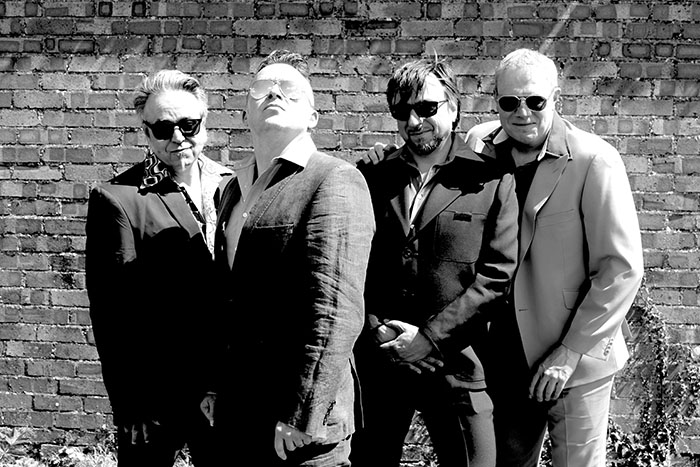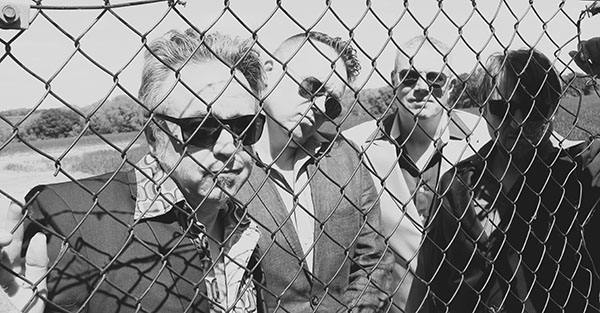
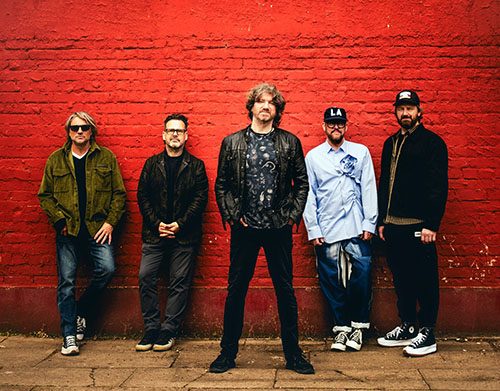
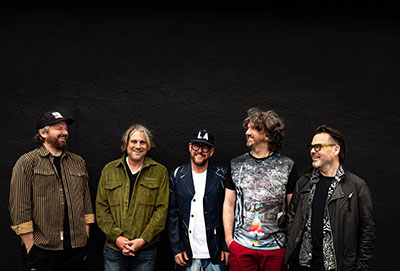
This year, West Yorkshire indie-rock outfit Embrace are celebrating their 30th anniversary.
The band (singer Danny McNamara and his brother, guitarist Richard McNamara, bassist Steve Firth, keyboardist Mickey Dale and drummer, Mike Heaton) have released a brand-new studio album called Avalanche – their ninth – which, with its stadium-friendly anthems, skyscraping choruses and big ballads, as well as some darker and edgier touches, is easily up there with their best work.
Album opener, ‘Stop’, is a banger – a euphoric earworm about living in the moment – ‘We don’t live for ever – life’s too short to mess around’; first single, the pounding ‘Road To Nowhere’ is similarly rousing, with its ringing, U2-like guitars; the poignant ‘Coming Home’ sounds like a country-gospel-meets-Christmas-song; the moody ‘Up In Your Feelings’ has dark disco synths, and the brooding ‘Funny’ is Embrace doing The Cure circa Disintegration.
As well as the new album, there’s also a recently-published book on the group’s early years – Good Good People: The Story of Embrace – Volume 1 – and frontman Danny is about to embark on a spoken word tour of the UK.
‘The moody ‘Up In Your Feelings’ has dark disco synths, and the brooding ‘Funny’ sounds like Embrace doing The Cure circa Disintegration’
In an exclusive interview, Danny spoke to Say It With Garage Flowers about 30 years of Embrace, the inspirations behind the new album, his approach to songwriting, and how he’s looking forward to hitting the road to promote the book.
“It’s been a crazy career – a rollercoaster ride, but it’s been amazing. We’ve had so many comebacks,” he tells us.
Q&A
You’re celebrating the band’s 30th anniversary this year – does it feel like 30 years, or does it feel like only yesterday that Embrace started out?
Danny McNamara: It feels like both at the same time. In one way it feels like yesterday, but then in another way, I can’t remember a time before Embrace existed.
Apart from a hiatus between 2006 to 2014, you’ve managed to stay together for 30 years. How have you managed that?
It’s five people – six, if you count our manager. We’ve all been together longer than 30 years, but it’s 30 years since we started releasing records. We were together for a while before that as well. There is a chemistry that works between the five of us, that if there’s one person missing, we all feel it, no matter who it is. Over the years, we’ve come to really respect that and respect each other’s contributions.
We are very different people, but I think that we all play a crucial part, and we all realise that. Also, I think the fact that me and our Rick are brothers means that we don’t have that political thing where you get the keyboard player agreeing with the manager, and the bass player and the drummer feel the same way, and so they start political factions. If me and Rick disagree about something, we’ll argue about it and sort it out, and that’s generally the decision.
A lot of bands featuring brothers fall out. Some big names spring to mind…
There’s a yin and yang element with me and our Rick. We’re both very different people, but we both really respect what the other brings to the table – what I bring is very different to what Rick brings, and both are necessary.

Let’s talk about your new album, Avalanche, which is your ninth – it’s a great record. It feels like a classic Embrace album, but with a slight twist – how did you approach it and what was your mindset when you were making it?
It was completely different from how we normally do things. Normally, I have a big concept or an idea that I want to build an album around, like The Good Will Out or Drawn From Memory, or, more recently, Love Is a Basic Need and How To Be a Person Like Other People – they’re from epiphanies that I had.
Quite often what happens with bands is that that their best work is usually their first or second album, and then they get quickly get into diminishing returns – I honestly think that hasn’t happened with us. Our fourth album [Out of Nothing] was a big album, and I feel like this one [Avalanche] is another big album, and we’re 30 years in…
The reason why it’s the first couple of albums [that are the good ones] is because that’s when you’re having all your epiphanies as a teenager, or when you’re in your twenties and you’ve fallen in love for the first time, and you’re having your heart broken for the first time, or feeling grief… so, these things are when your emotions are running high, and rock ‘n’ roll comes out of that – that spirit and that energy.
‘What happens with bands is that that their best work is usually their first or second album, and then they get quickly get into diminishing returns – I honestly think that hasn’t happened with us’
Most bands get into diminishing returns after that, but the reason why I don’t think we have is because I’m a slow learner, and I’m still having epiphanies now, as a 55-year-old man, as much as I was when I was in my early twenties. I’m still learning shit, and the thing that I’ve learned from this new album is the idea of just being in the moment – all of life is there, because that’s all you’ve got… But the thing is, when you’re being creative, quite often you’re in your own head, so you miss the moments that are going on around you – you’re not living in the moment.
Because I’ve got two young kids – I’ve got a seven-year-old and a four-year-old – and a wife who won’t let me just be in my head all the time – she wants me to exist and to be in the room – I’ve had to be in the moment, and so, suddenly, as a result of that, all these moments that I’ve missed for the last 50 odd years have suddenly started hitting me, like an avalanche. So, that’s why the album’s called that – it’s me being in the moment and picking up on all these things I’ve never really seen before.
It’s like I’ve been a blind person and suddenly someone’s lifted the veil and I can see again. I’ve never been more inspired than I am now. I feel a lot like I felt before we got a record deal, when I was writing a lot of those early songs that went on those first EPs. I feel as prolific as that and to be able to say that after 30 years is great.
‘The new album is me being in the moment and picking up on all these things I’ve never seen before. It’s like I’ve been a blind person and suddenly someone’s lifted the veil’
There’s a rock ‘n’ roll cliché that a band’s first album is about wanting to be famous, then the second one is about being famous, the third album is written and recorded while the band are high on drugs, and then the fourth album is the bad comedown record, by which time everybody’s lost interest…
It’s kind of a cliché, but that never happened to us because we never got into drugs in that way. There’s that thing where you spend your whole life working on your first album, and then you’ve got a year to sort the second one out. We felt some of that.
The new album opens with ‘Stop’, which is a classic-sounding Embrace anthem – a call-to-arms – and a bit of a banger…
Rick brought the music for that, and it immediately got me on my feet. I imagined having a loudhailer and I was writing all this stream of consciousness stuff about how we’re all spinning on a rock, going one million miles an hour, and how in 100,000 years everything you know and love will just be a thin layer of calcium on that rock, so what are you fucking doing? Get on with your life. The lyrics sort of came out of that.
Rick, and sometimes Mick, will bring me a piece of music, and if I’m buzzing off it, then generally it becomes a song, and if I’m not, then generally it doesn’t – it’s quite hit and miss. They might bring a dozen things, and I might get one verse and then we need a chorus, but it’s a lot more organic, because I hear the music, and I respond to it – the music conjures up something in me. I’m like, ‘what’s this about?’ It’s almost like excavating it rather than imposing on it any sort of preconceived idea of something that I want to write about.
There’s a song called ‘For Kate’ that’s on our last album – it’s about my daughter, but it must’ve taken a week before I figured out what it was about – it wasn’t about a woman, or heartbreak… I started writing the lyrics and talked about going to the moon on a firework, and then it occurred to me that it was about my daughter – that was something I’d never written a song about before. Once I’d figured that out, it came quickly. So, it’s like figuring out what a song’s about is sort of the first part of the process before you start writing it.
And on the new album, you’ve written a song called ‘Emily’ that’s for your other daughter – it’s a song she can listen to when she’s older and going through hard times…
Yeah – that was the idea. I’m an older dad – I’m 55 – and she’s only four. When she’s falling in love, that might be in 15 or 20 years’ time, and I might not be around – I’ll be in my seventies. I wanted to write a song that talked about everything I know about falling in love and having your heart broken, and just to be there for her if I wasn’t around anymore.
The first single from the album was ‘Road To Nowhere’, which, again has an anthemic feel, and guitars that sound like The Edge from U2…
‘Road To Nowhere’ was originally an album filler track called ‘Crumble’, and it really wasn’t going anywhere. It didn’t look like it was going to make it onto the album – it was number 13 on a list of 15, and then we just started jamming it in the studio and I got a different melody for the chorus, and then suddenly it just took off.
It was right at the top of my [vocal] range, and I just remember when I came up with it, thinking, ‘Oh my God, this is another skyscraping chorus, like ‘Come Back To What You Know,’ or something like that’, and just got really excited about it.
It’s uplifting musically, but, lyrically, it’s quite down. Is it about being in a toxic relationship?
Yeah, but I don’t really like the word toxic, because it has implications that I don’t think honour that relationship – turbulent is a better word. It’s about how when you don’t know what love is, you assume that what you’ve got is the real thing, and so you try and make it work.
It’s like in Superman III when they come after him with kryptonite, but the kryptonite has got tobacco in it, and so it’s not quite kryptonite… it’s like bad kryptonite, and it makes Superman turn into a baddie, and he ends up fighting himself.
There’s one Superman in bright blue and red, and with nice hair, and then there’s another Superman that’s scraggy and dark. Well, that’s what like love is like. If it’s not the real thing, you become bad Superman. So, ‘Road To Nowhere’ is about being wholeheartedly on a journey that’s ultimately doomed. You think you’re Superman, but you’re not, your bad Superman.
‘Get Out Of My Own Way’ starts out as one of those classic Embrace piano ballads, but then it builds into a guitar-driven epic. It’s quite a positive song – it’s got a bit of hope to it, hasn’t it?
It’s about me not being in the moment. There’s a line in there, ‘Joy lights up your face, I look the other way / Everything you gave, I gave it all away.’ So, it’s like Lauren, my wife, will be there with our kids, having a moment with the children, and she’ll look over at me to share that moment, and I’ll be away with the fairies, working on a script or the next Embrace song, or whatever it is. I wasn’t there for those moments, and that’s not good enough.
Like I said before, the moment is all we have – the present – and if you’re not engaged in it, you’re not really living life, and what’s the point in great success if you never enjoy it? The song is about me owning up to that and saying I’m going to get out of my own way and do better.
‘Coming Home’ has a country-gospel-meets-Christmas-song feel…
Yeah, yeah… Our Richard wrote that – it was right at the very end of the sessions. He said, ‘This album’s not quite finished’, and I was like, ‘Well, you fucking write something,’ and then he went away and wrote ‘Coming Home.’ That song and ‘Get Out Of My Own Way’ are my two favourites on the album. It [‘Coming Home’] is so powerful – it’s about Richard’s daughter, who is an artist in her own right called Ellur. Her new album is amazing and she’s all over the radio. It really looks like it’s going to happen.
She’s written songs about her mum and her dad, and ‘Coming Home’ is sort of a reply track to the song she wrote about him. It’s not a diss track – he loves her to pieces! It’s got some fantastic lyrics in it: ‘The time that we waste when time’s not a thing… If I’d only known then what I think I know now, I’d have picked you up and never let you down.’
I had a go at writing the lyrics because it’s usually my job… I did write some lyrics for it and it was going to be called ‘Avalanche’, but it was about a completely different thing, and it was clever and it was good, but when Richard came up with his lyrics, I was like, ‘This is what the song wants to be.’ I’m proud of that song – it sounds like quintessential Embrace, but it also sounds fresh and different for us.
‘I now feel powerful and really confident about what I’m able to do as a lyricist and as a songwriter’
I think the new album’s like that – classic Embrace but with some different touches too. The second half of the record is darker than the first. ‘Up In Your Feelings’ is moody, with raw guitar, but it also has a dark disco-synth thing going on…
Yeah, it does. The album definitely gets darker towards the end – that was just instinctive. We had 14 or 15 songs finished and I was listening to them in various orders and trying to pick the best 10. I didn’t come up with the final order until the day before mastering.
It felt right for it to be in that order, and each song kind of sounds a lot better in the setting on the album than it does on its own, which is something that you really strive for when you’re sequencing an album.
‘Deny’ is another classic Embrace ballad: in it you sing: ‘Everybody will hurt you in the end/ You just have to find the one who’s worth your suffering.’ It’s a reflective song. Some of the lyrics on the album are dark, aren’t they?
I was trying my best to live in the uncomfortableness of not knowing, and not having the answer, because that’s more honest, really. Maybe in the past, I haven’t had the confidence to do that so much. I think I now feel powerful and really confident about what I’m able to do as a lyricist and as a songwriter, and so I’m able to live in the uncomfortableness of not knowing – of not having the answers, of being wrong, or of being the antagonist in the song. Those are all really uncomfortable positions to take, but they’re all really honest positions and I think there’s a lot of really good material that can come as a result of being open to doing that.
So, with ‘Up In Your Feelings’, ‘Deny’, ‘Pure O’ and, to a certain extent, ‘Road To Nowhere’, I wanted to acknowledge that darker side, and not to try and sugarcoat it.
‘Funny’ is dark too – it reminds me of The Cure in their Disintegration era…
Yeah – we thought it had a Fontaines D.C. vibe too. That song is about where you can end up on a night out and how when you wake up the next day, it’s not so funny…
We’ve all been there…
Yeah, exactly. People don’t want to write about it because it’s mea culpa, but I’m 55 and I don’t know how much longer I’m going to be on this planet, so, you know, just get on with it.
‘Power’ is the last song on the album – it’s another big ballad, but it ends the record on a hopeful and positive note. Isn’t it about finding someone and being comfortable with them?
It’s about no longer being in control because someone else has that power over you. On ‘Drawn From Memory’, from our second album, I wrote, ‘The girl that I could never hurt had to go and lose all that power over me, and I claim victory.’ It was basically about no longer feeling so strongly about a girl, which was sad.
‘I’m 55 and I don’t know how much longer I’m going to be on this planet, so, you know, just get on with it’
This [‘Power’] is the opposite – someone has complete power over me because I’m just floored by them, and they mean everything to me. It’s about my wife – she completely holds sway over me. I can pretty much tell anybody else in the world to fuck off, but I can’t say that to my wife because I care too much.
I’ve always prided myself on being able to be quite self-contained and being able to walk away… I probably could, but it would destroy me more than anything else, and so someone having that power over you… when you love somebody it gives them all your power.
There’s something about the sort of surrender that feels powerful, and there’s a lot of love in that song. My wife used to say to me, ‘Why don’t you write any songs about me?’ And I used to say, ‘Because you haven’t broken my heart yet…’ Most of our songs are usually about heartbreak.
You’re celebrating 30 years of the band with a UK tour this November…
Yeah, and we’ve got a book [Good Good People: The Story of Embrace – Volume 1] coming out. It was written with the five of us getting together. When we did The Good Will Out, we got asked if we wanted to do a book but said no because we only had one album out, so it was crazy, although we already had one hell of a story by then. We got asked again when we did our fourth album, and again we were like no, because we were thinking ahead and we didn’t want to look back.
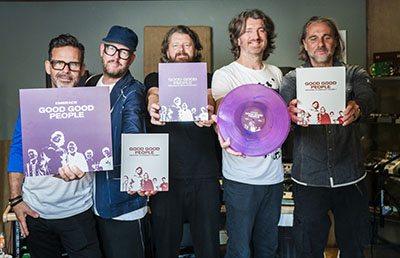
Now, it’s 30 years and we want to do it as a trilogy in three volumes – the first book is our early days all the way up to getting dropped by [record label] Hut after If You’ve Never Been. The second one is going to be the big stadium years, when we did Out of Nothing, and the third one will be everything that we’ve done since then. I’m also going out on a spoken word tour to talk about the book and my 30 years in the band, which is amazing.
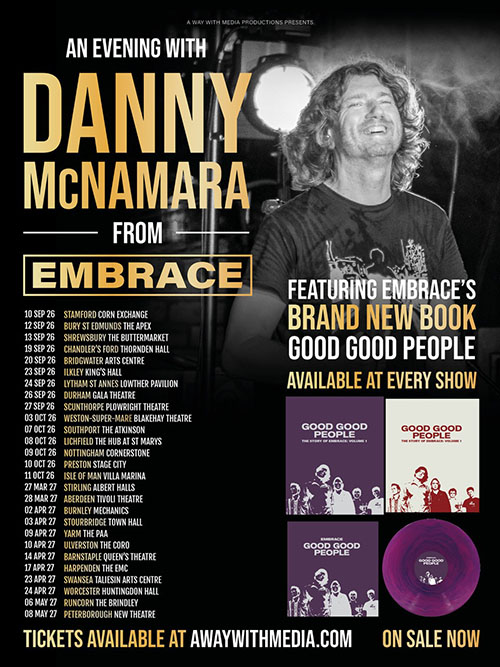
I never thought that I would ever be able to do something like that. During lockdown, someone asked me if would do a spoken word thing, and I said that it didn’t really sound like me, but it went well.
There was a guy asking me questions and I just took the mic off him and I was almost doing stand-up and taking questions off people in the audience.
I got asked to do a dozen of those and they went well, and then this big company got involved last year and said we could do 30 or 40 of them if I wanted to. So, I was like, ‘well, I’m loving it, so why not?’
‘It’s been a crazy career – a rollercoaster ride, but it’s been amazing. We’ve had so many comebacks…’
There’s only 50 or 100 people there, but they’re like the 50 or 100 most ardent, crazy Embrace fans in that town. Normally we play in front of like 2,000 people, but with 50 it’s like it’s just the craziest, most life-affirming and amazing thing to do.
After that there’s the national tour [with the band], which is selling out quicker than ever. The renaissance thing is amazing. It’s been a crazy career – a rollercoaster ride, but it’s been amazing. We’ve had so many comebacks… The first album was kind of a comeback after the first few EPs, and then the fourth album was a comeback after getting dropped. Now this album kind of feels like a comeback.
Come back to what you know…
Exactly.
Avalanche by Embrace is out now on Cooking Vinyl.
For tour dates, vist the band’s official website.
For information on An Evening With Danny McNamara, click here.
The book Good Good People: The Story of Embrace – Volume 1 is available now.