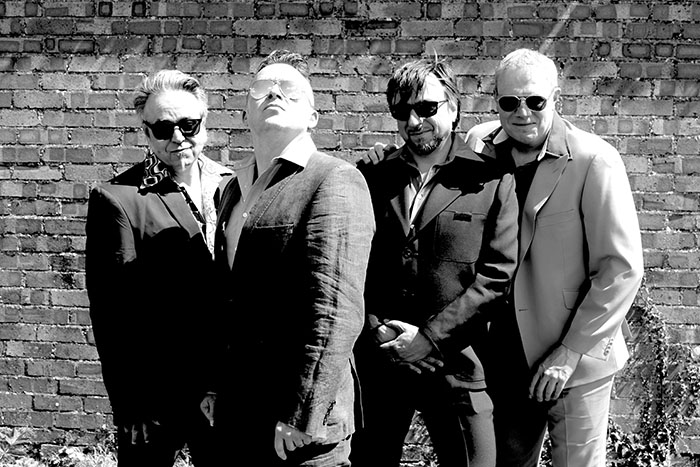
More than 25 years ago, in 1998, when I was living on the South Coast of England, working as a freelance music journalist and putting on gigs, I was blown away when I saw Oxford power-pop-indie-punk band The Samurai Seven play an anti-vivisection benefit show at my local venue, The Wedgewood Rooms, in Portsmouth.
Melding infectious melodies with buzzsaw guitars and Beach Boys harmonies, they arrived in a blur of sharp nylon suits and scissor kicks, and I liked them so much that I booked them for a return visit a few months later, and they played another blinder.
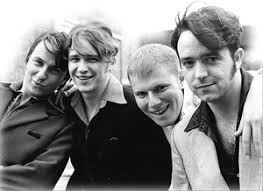
Sadly, the four-piece – Simon Williams (vocals and guitar), his brother, Matt Williams (rhythm guitar and vocals), Jimmy Martin (bass guitar and vocals), and Chris Hayward (drums) – split up in the early Noughties, never fulfilling their true potential.
‘Melding infectious melodies with buzzsaw guitars and Beach Boys harmonies, The Samurai Seven arrived in a blur of sharp nylon suits and scissor kicks’
Tipped for big things – The Samurai Seven did five sessions at Maida Vale Studios for John Peel, as well as recording the theme tune to his Channel Four TV show, Sound of the Suburbs – the band had to put their plans on hold when, in February 1999, on Valentine’s Night, Williams was shot in the eye with an air gun in a drive-by incident in Oxford.
Luckily, his sight was saved by the NHS at Oxford Eye Hospital, and he took time out to recover while the band waited patiently.
However, the music industry had moved on, and The Samurai Seven struggled to regain momentum. An album, Le Sport, was belatedly recorded and released on Rotator Records in 2002 and on Boundless Records in Japan the same year.
But, with their confidence eroded, the band had lost their sense of purpose and focus. When Hayward then decided to leave the group, the original gang was broken. The remaining members drifted on, gradually moving onto new bands, starting families and studying. The story of The Samurai Seven ended there for the moment…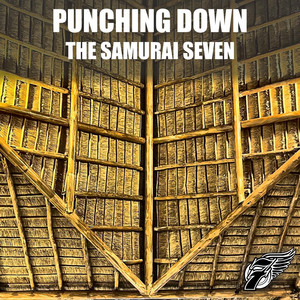
But now they’re back with the original lineup – they reformed to play some shows last year – and a brand-new single, the politically-charged, killer power-pop-meets-garage-rock of ‘Punching Down’, and, in a neat twist of fate, I’m putting them on in my local venue, Vault 17 in Chesham, Buckinghamshire on June 25. I moved away from Portsmouth shortly after the band’s last gig there all those years ago.
In an exclusive interview, frontman Williams, who lives in Oxfordshire, tells Say It With Garage Flowers how and why The Samurai Seven reformed, what it’s like to be back with the band, and if they’ll be doing scissor kicks on stage now they’re middle-aged.
Q&A
Hi, Simon. The last time we spoke was in the late ‘90s…
Simon Williams: It’s been too long.
How does it feel to be back with the band?
It’s incredible. The first time around, I thought we were four little identical samurai, but we’re all different, and it’s those differences that means that we all get on well. If I was in a band with myself, it would probably be a nightmare.
‘We’re not doing it because we’re obligated to – we’re doing it because we want to. I sound like Billie Piper!’
The other thing about being back together is that we’re not doing it because we’re obligated to – we’re doing it because we want to. I sound like Billie Piper! The music I’m writing is just what I fancy doing, and the guys are enjoying playing it.
It’s even harder now to be in a band than it was before, because there’s so little money from record sales, and Spotify pays so little, and it’s harder and harder for promoters to make money putting on gigs, so they’re increasingly wanting to put on things that might pull in more people, like covers bands. We’re lucky to be in a situation where we’re having a second bite of the cherry.
‘Punching Down’ is your first new music in 25 years and it’s a big song to come back with – power pop but with a garage-rock edge…
I’m delighted to hear you say there’s a garage influence. I listen to a lot of different music, but I love garage bands, whether they’re from Detroit or Sweden, or other places. The Nomads, from Sweden, who were around in the ‘80s, had a resurgence 15 years ago, and their stuff was a real inspiration to me.
‘Punching Down’ deals with how the media narrative is controlled by a small percentage of ultra-wealthy people and the way they use it to cause divisiveness in society – it’s very topical…
Now I’m married with two kids, and I’ve got a nice life, I can’t write songs about relationship frustrations like I did before. I think there’s got to be some grit in the oyster. I don’t want to write songs about being happy and how wonderful things are.
You only have to watch a bit of the news to see how the 0.001% of people who control everything are creating a division between people who have more in common [with each other] than they do with billionaires, and it’s a dangerous business.
‘Now I’m married with two kids, and I’ve got a nice life, I can’t write songs about relationship frustrations’
I don’t want to end up sounding like I’m lecturing people, but the song is a call for unity between everyone in the country and beyond who are struggling with the same austerity, the same pressures and the same fears, but have the same hopes.
We’re being treated like puppets who are being made to dance by billionaires who just want another ivory backscratcher, or who want to take away our employment rights and our human rights. We’re all being stirred up and made to feel more divisive than we should be.
You recorded ‘Punching Down’ with Grammy-winning producer, Hugo Nicolson, who’s worked with acts including Primal Scream, Björk and Radiohead. How was that?
The thing that you notice about working with a lot of producers and engineers is that sometimes if there’s a problem in the studio, there will be quite a few hours of head scratching while they fix it. Hugo has got so much experience that he would head off a problem almost before it appeared – he just had a fix for it because he has that kind of experience.
‘There’s a pop sensibility to what we do. We’re not trying to be The Velvet Underground’
As the writer of the songs, I can be quite critical of what I do and what I come up with, and I think it was great that in the pre-production stage, Hugo was able to listen to the songs and say, ‘Okay – you need to get to the chorus faster…’
He got that there’s a pop sensibility to what we do. We’re not trying to be The Velvet Underground. We want something that’s going to have similar sensibilities to all the bands that we’ve loved, like The Beatles, but also The Damned and the Buzzcocks, which is still great pop music.
There’s more new music on the way from you, isn’t there?
Yes. In July, we’ll release ‘Duck and Cover.’ There’s going to be an EP and after that more recording. ‘Punching Down’ is the closest of our four new tracks to what we’ve done in the past.
When we got back together, there was a desire for people to hear the songs that they remember fondly from the past, and there’s absolutely a place for that, but, as the songwriter, I get bored if things aren’t evolving. There’s a legitimacy to playing reunion gigs after 25 years, but that loses its currency pretty quickly if you don’t start bringing out something new that’s relevant to today.
I was really pleased that the new material came together as quickly as it did. The rest of the guys in the band like it, of course, but it’s never a given. The response of people who have heard it has been so positive, so that’s been exciting. I know that the music industry has changed a lot since we’ve been away. One of the ways in which it’s got better is the studio technology. Chris hadn’t been in the studio since we did our previous recordings, and he was like a duck to water [this time around].
 When he left the band back in the day, that, ultimately, led to you splitting up, didn’t it?
When he announced that he was going to leave, he stuck with us while we were honouring our commitments, so I think that emotionally he left earlier than he did physically. We tried to carry on, but there was a chemistry between the original four of us that was hard to replace, so it was difficult.
Why did you decide to get back together in 2025?
We’d all stayed in contact with each other to a degree – Matt, the other guitar player, is my brother, so we’re stuck together, and Jimmy, the bass player, lives in Oxford.
‘We tried to carry on, but there was a chemistry between the original four of us that was hard to replace, so it was difficult’
Sometime around COVID, we all went out for a drink together for the first time in ages – it was like no time had passed, and it was fun. Fast forward to last year, and when Jimmy had his birthday, his wife said, ‘What do you want?’
I’m not saying he’s the man who has everything, but he said what he really wanted was a few hours in a rehearsal room with us guys. I wonder if he’d have had the same suggestion a few years before, and whether we would have all said ‘yes.’
We’ve all had families and we’ve all been on our own journeys and in different places. My brother had a serious health issue… Fortunately, he’s okay now, but I think it made him think that one of us might not be around tomorrow, so you make the most of opportunities when they come up.
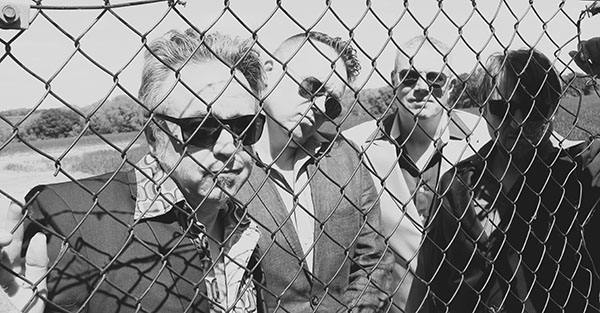
So, when Jimmy suggested it, I was pleasantly surprised that we all said ‘yes’, but the moment we were back in the rehearsal room, we had no preconceptions that it would lead to anything other than a few hours of having fun.
I knew we’d get on, but I was surprised by the speed at which everything happened. We were 90% there with the songs – it was like we’d only just put our guitars away from the previous time – so, by the end of the session, it was obvious that we were going to do it again.
It came together very naturally, because when you’ve been doing 100 gigs a year [in the ‘90s], your muscle memory tends to kick in quite quickly.
‘I didn’t want to do anything involving gigs or the public unless it was going to be good, because we have a responsibility to people – and ourselves – not to suck’
When we met up socially during COVID, Chris shared it on social media, and we were pleasantly surprised by lots of people saying, ‘Reunion!’ People remember us fondly, and, before you knew it, we were being offered gigs and festivals. Suddenly it gained a momentum of its own, but I certainly didn’t want to do anything involving gigs or the public unless it was going to be good, because we have a responsibility to people – and ourselves – not to suck. So, the music came together quite nicely, and we’ve always had a physicality to our shows. People talk about our suits and us jumping around…
It’s been nice to go back to that thing that’s so identifiable with us. I don’t think we’re a cool band (laughs), but we love what we do, and it’s always been important to look like we’re in a band, and that we look like we’re in the same band.
All the best bands look like they’re in a gang. I’m thinking of The Smiths, The Beatles, The Clash…
Exactly. I think The Smiths did it in quite a subtle way. There was a stylistic thread that went through them. The first album I ever bought was Destroyer by Kiss, so the idea of there being a visual identity…. I’m reading a book by David Hepworth about bands touring America, and he talks about how one reason why The Beatles were successful was because they were a unit – they were a gang. They might’ve taken the piss out of each other, but, if one of them wasn’t feeling 100%, the others would close ranks around him, and woe betide anyone who threw rocks at them from the outside. I’m not comparing us to The Beatles, but there’s something about the chemistry between the four of us, and people see us as being a gang or a unit, and I think they want to be a part of it.
One of our first gigs back [last year] was a festival over the summer, in the daytime, so I had the opportunity to look at the crowd in a way that I hadn’t been able to before, and it was just people who were smiling or were agog. As much as I love being in the studio, live is the true environment for us to thrive, so to play some shows has been great.
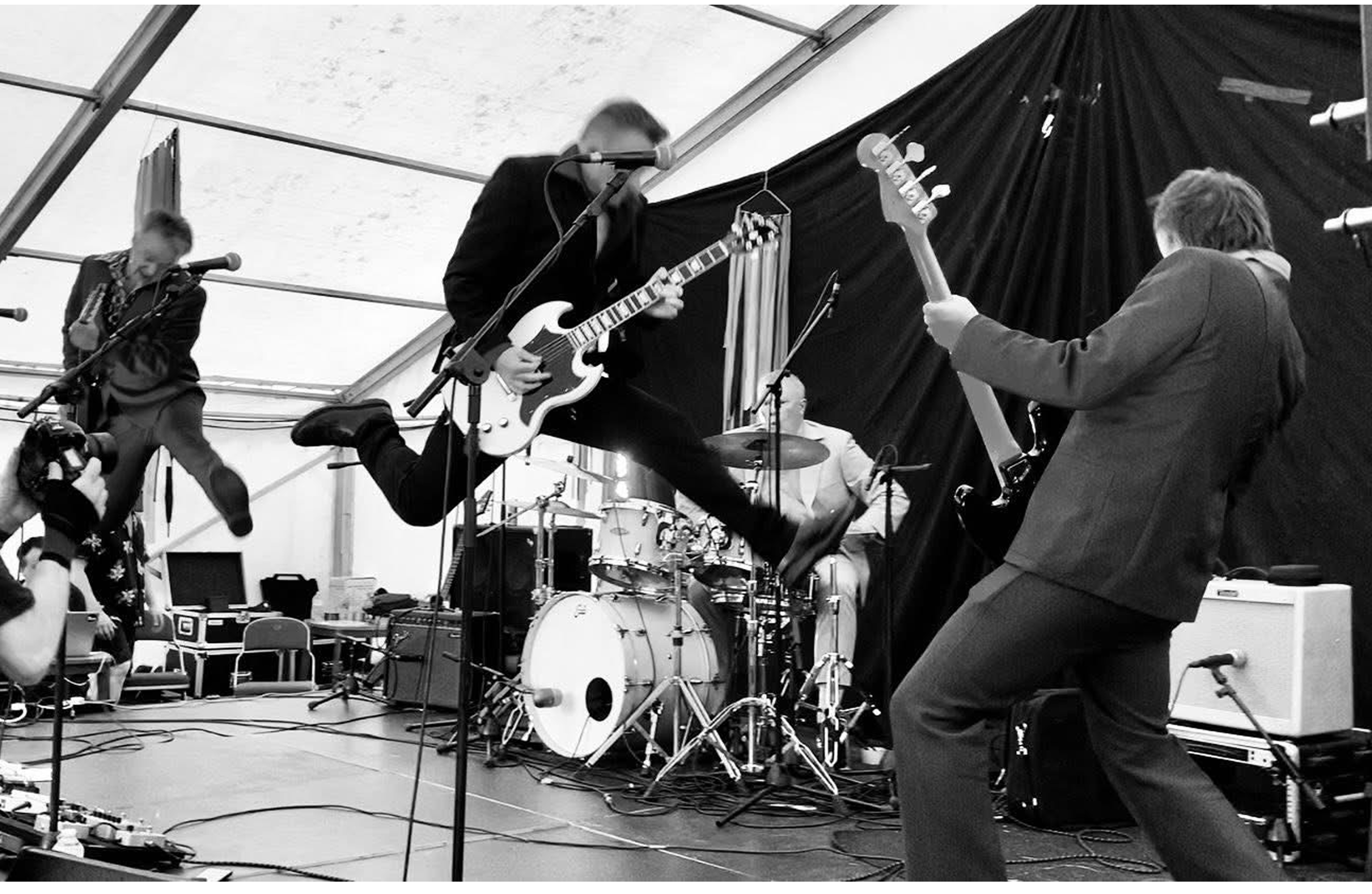
‘The thing about scissor kicks is that they have to come from a place of sincerity’
How is it doing scissor kicks these days?
We do have to warm up a bit. The thing about scissor kicks is that they have to come from a place of sincerity. We probably do less than we used to, but they come from a joie de vivre, so they’re almost irrepressible. When there’s an opportunity for a scissor kick, and you feel so inclined, it’s undeniable.
The Samurai Seven’s new single, ‘Punching Down’, is out now on digital platforms.
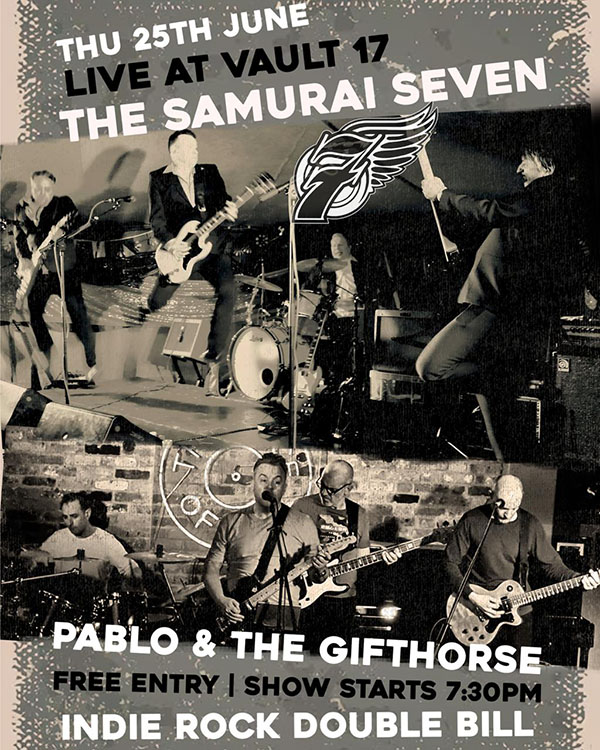
The band are playing live in the UK this summer.
JUNE
25 – Vault 17, Chesham, Buckinghamshire.
26 – The Star, Guildford, Surrey.
29 – Bikefest, Cassington, Oxfordshire.
JULY
18 – Charlbury Riverside Festival, Oxfordshire (main stage).
Follow The Samurai Seven here:
https://www.facebook.com/the.samurai.seven/
https://www.instagram.com/the_samurai_seven/


