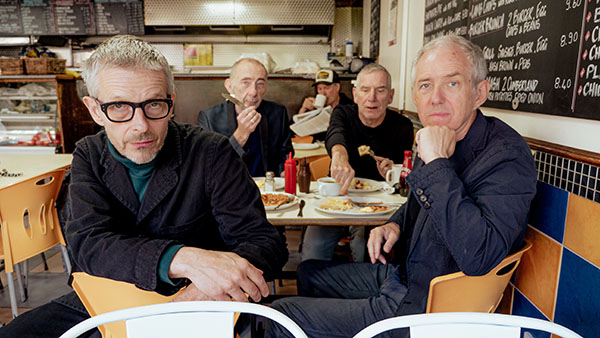
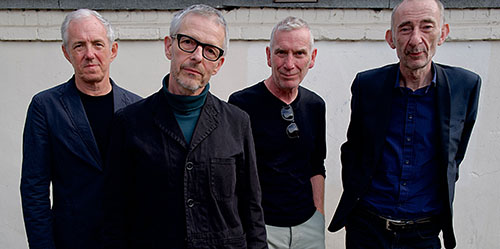
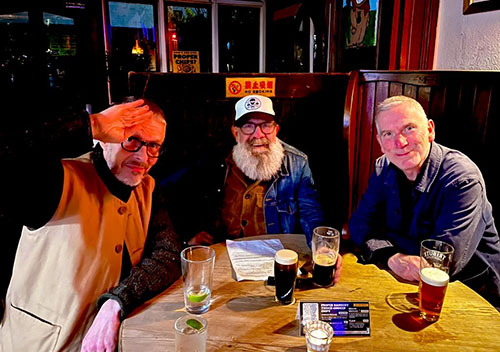
It’s early February 2025 and Say It With Garage Flowers is sat in a North London pub with two members of ‘8os jangly indie band, The Loft: Pete Astor (guitar and vocals) and Andy Strickland (guitar).
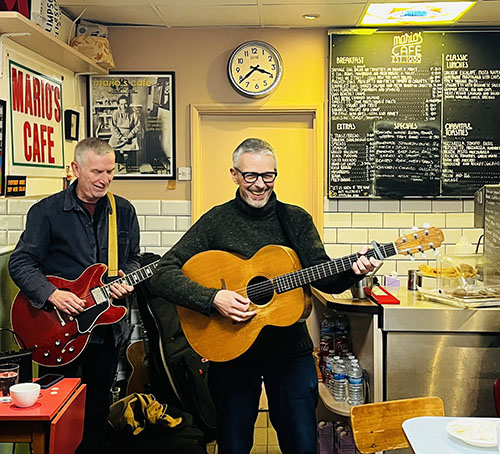
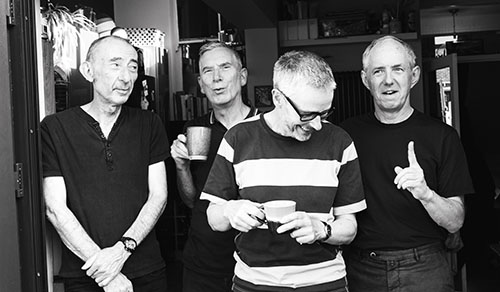
Prior to our trip to the boozer, we had tea and cake in nearby Mario’s Café, the tiny Kentish Town eatery that was immortalised in song by Saint Etienne.
Today, it’s also played another part in pop music history – it’s where The Loft have shot the video for their new song, The Elephant – a jerky and quirky, post-punk-meets-indie-pop tune.
A few friends and associates were invited to the café to participate in the filming and take footage on their mobile phones to use in the video – Astor and Strickland performed acoustic versions of some of the band’s new tracks, including The Elephant and Feel Good Now.
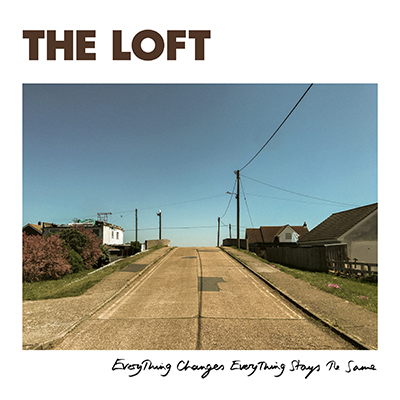
Both of those songs are taken from the band’s debut album, Everything Changes, Everything Stays The Same, which is out in March. Yes, you read that right… their debut album.
Despite releasing their first single, Why Does the Rain, in 1984, on Creation Records, and following it up with Up the Hill and Down The Slope the following year, The Loft never got to make an album – famously, just as they were about to hit the big time, the band split up on stage at the Hammersmith Palais, in front of 3,000 people on the final date of a tour supporting The Colourfield.
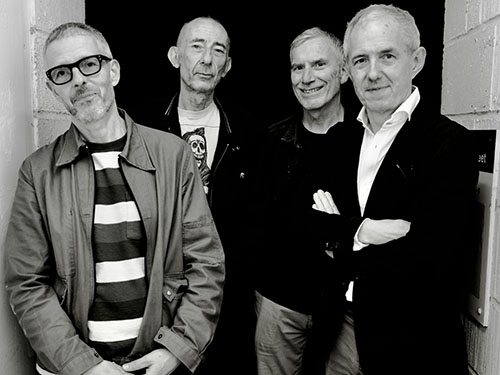
Now, more than 40 years later, Astor, Strickland and fellow original members, Bill Prince (bass) and Dave Morgan (drums), have finally got round to recording and releasing their debut long-player.
Produced by Sean Read (Dexys, Edwyn Collins, The Hanging Stars), it’s a great record – both urgent and upbeat, and reflective and melancholy.
It sounds exactly like you’d hope and expect the first album by The Loft to sound like after 40 years – there are plenty of floppy-fringed nods to their classic and melodic, ‘80s indie jangle-pop, but, at the same time, it’s a record that’s fresh, inspired, inventive and occasionally surprising. Funnily enough, it’s as if everything has changed, but everything has stayed the same…
There’s the mid-‘60s-Beatles-meets-Paisley-Underground of first single, Dr Clarke, the Velvet Underground chug of Ten Years, the angular, Television-like post-punk of Do The Shut Up, and the shimmering, English seaside town nostalgia of Greensward Days and Somersaults – the latter has a brilliant, George Harrison-style guitar solo by Strickland.
“It sounds like The Loft because it’s the four of us… When we play together, we sound like The Loft. There was never any, ‘Oh – how did we get those guitar sounds back in ’84?’,” says Strickland, over a pint.
Adds Astor: “It evolved pretty quickly that the album was going to be two guitars, bass and drums. There are many other ways to make records, and to make Loft records, but for the debut album it just felt right.”
Q&A
Your debut single, Why Does the Rain, came out in 1984, on Creation Records, but your debut album, Everything Changes, Everything Stays The Same, is being released 41 years later – in March 2025. That must be some kind of a record… Does it feel like that long?
Pete Astor: No – time is a very strange thing, isn’t it? It feels like another lifetime and last week. That’s life… Everything changes, everything stays the same. (laughs). Sorry for that so early in the interview.
(Laughs). That’s fine. Famously, The Loft split up on stage at The Hammersmith Palais in 1985, after the release of your second single, Up the Hill and Down the Slope. I don’t want to dwell on that, but, if you hadn’t broken up then, do you think your debut album would’ve come out that year?
Pete Astor: I think it would’ve done.
Andy Strickland: I don’t think we had a great plan exactly, but I’m pretty sure Creation would’ve have put an album out then – we were on that trajectory – and it would’ve been a good one as well.
Pete Astor: Totally.
So, when Creation put out the compilation album, Once Around the Fair: The Loft 1982–1985, in 1989, was that representative of what your debut would’ve sounded like?
Pete Astor: Yes and no, because when you think about it, they were the first things that we did – it was everything we recorded at the time, but there would’ve been other songs…
You’ve reformed since 1985 – you came back in 2006 and put out the single, Model Village, but why did you decide to get back together yet again and make the new album?
Pete Astor: We didn’t really discuss it in 2006… It felt right to do a single, but it didn’t feel right to do an album… I don’t really know why. It wasn’t like we fell out, but it was never on the cards for some weird reason.
Andy Strickland: We did a bit of recording, but there was never any great desire to turn it into something more than that.
‘When you’ve been on the planet for a certain amount of time, the world looks different now from what it did in 2006’
So, what changed?
Pete Astor: It’s so funny – there’s no reason for it, but it just felt right. That sounds a bit lame. We did the Riley & Coe Session [in 2023] and that felt very right. I was taking a year away from work… In the arc of your life, it felt like the right time, without getting too much into it… Different things happen in different decades, and in the 2000s, we were in a different lifecycle – there were a lot of other life things taking place, whereas now it’s more of a coming to terms time. When you’ve been on the planet for a certain amount of time, for me, the world looks different now from what it did in 2006.
Andy Strickland: Pete’s writing songs all the time and releasing them on solo albums or as The Attendant, or gigging with them, or whatever. He felt that he had a bunch of songs that might work with the four of us playing them – we didn’t know if it would – so we signed up to do it, and said, ‘Let’s see what happens, but if it doesn’t work out, we won’t do it’.
How long after your initial breakup did you first get back together and was it awkward?
Andy Strickland: There were about 20 years when we didn’t talk to each other at all.
Pete Astor: It was very awkward, and not good. I think we saw each other in the off licence in Walthamstow once and scowled at each other. We didn’t realise we lived quite close to each other, which was bizarre. Weirdly, we weren’t that far away.
How was it when you got back together to play gigs in 2006?
Pete Astor: It was quite emotional. We felt like we’d grown up – we’d lived much more life.
Andy Strickland: It was nice to reconnect. It’s not a nice thing to have been mates as a group of people, made art – been in a band – and then not talk to each other for 20 years.
‘I think we saw each other in the off licence in Walthamstow and scowled at each other’
You split up in a spectacular style, on stage, in front of 3,000 people…
Andy Strickland: Well, if you’re going to do it, fucking do it right!
Let’s talk about your new album, Everything Changes, Everything Stays The Same – you went into the studio with producer Sean Read to record it last August…
Pete Astor: I’ve made several albums with him, and it was a no-brainer that he’d be the perfect person to do it – and he was… It’s the sound he’s got and his understanding. He’s such a good producer but he’s got such a light touch. One of my pet hates with engineers and producers is when they tell you what they’re doing. ‘I’m just going to EQ your Sidechain MIDI…’ ‘Shut up! I don’t care – just do it!’
Sean isn’t that person – he’s incredible with technology but he’s not a bore at all. He just uses it brilliantly and his editing skills are great – he makes it look very easy. I love his mixing, and when you hear one of our records on the radio, it’s a lovely moment of vanity – you can rewind the track to hear the song before it, and generally you can hear our track go boom! It’s louder than anything else – it’s all the things you want from a record…
How long did it take to make the album?
Pete Astor: Five days. I did all the vocals in an afternoon.
Didn’t you record some of the vocals in bare feet? I saw some photographs that were shared on social media.
Pete Astor: I did do some in bare feet…
Andy Strickland: It was very hot…
Pete Astor: Andy was even reduced to wearing shorts at one stage… So was I, but there were no photographs…
Andy Strickland: Unfortunately, I did get photographed in my shorts…
How was the recording process?
Andy Strickland: Pete told us early on what we should do – we didn’t go into the studio at all when Sean was editing and mixing the album, and it worked brilliantly. There was none of that sitting at the back of the room and saying, ‘Can you turn the bass up a bit?’ Apart from a couple of tiny things, we didn’t change anything.
Pete Astor: You let the person do their job… I was always inspired by Ken Scott, who said when he finished recording Hunky Dory, Bowie was like, ‘See you then, Ken…’ It wasn’t Bowie’s job to mix the record – it was Ken’s… I think that’s exactly how it should be.
How did you approach making a debut album after such a long time? Did you set out to capture any of your original, mid-‘80s sound?
Andy Strickland: No – we didn’t have any discussions or thoughts around that. It sounds like The Loft because it’s the four of us… When we play together, we sound like The Loft… There was never any, ‘Oh – how did we get those guitar sounds back in ’84?’
Pete Astor: It evolved pretty quickly that the album was going to be two guitars, bass and drums. There are many other ways to make records, and to make Loft records, but for the debut album it just felt right – let’s be as good as we can, but let’s use the primary colours of how we make music. It didn’t seem appropriate for this record to be using the studio more as an instrument…
‘When we play together, we sound like The Loft… There was never any, ‘Oh – how did we get those guitar sounds back in ’84?’
You didn’t feel you needed to use strings and horns, either…
Pete Astor: No – I love all of those things, but it felt right to play guitar, bass and drums…
Did you co-write any of the songs?
Andy Strickland: Somersaults was co-written, and everything else is 100 percent Pete.
Were all the songs written for the album or did you dip into a pile for any of them?
Pete Astor: I always have songs on the go – some have sat on my computer for 20 years, but most of them haven’t. Sometimes a song doesn’t sound right, but you revisit it 15 years later and you say, ‘It needs to be faster,’ and then it works…
I started The Elephant in 2008 and it was called The Great Grey Plastic Owl. It was about a great grey plastic owl that everyone pretended wasn’t there, but do you know what? The elephant in the room is a bit more to the point, and it took me about 20 years to figure that out.
Let’s talk about some of the songs on the new record. The first single, Dr Clarke, has a mid-’60s Beatles feel – it made me think of Doctor Robert – but it’s also got a Paisley Underground sound, like The Long Ryders…
Pete Astor: It’s based on a real person, but I changed the name to protect the guilty… There was a trauma workshop thing that I went to, and there was a person running it who wore a cowboy hat – it was one of those people who is charismatic and wrong, and slightly scary. The Doctor Robert thing? Fair dos, but it never occurred to me.
Andy Strickland: Or me…
Pete Astor: Shit! It’s Doctor Robert...
Musically, it has that feel…
Pete Astor: Yeah – it does…
‘We took great pleasure not just liking the older indie canon – we liked Creedence, but you weren’t mean to like them, as they were American and pretended they were from the bayou’
When The Loft started out, you were influenced by Television, The Velvet Underground, The Go-Betweens and Orange Juice. I think Ten Years, which is one of my favourite songs on the new album, has a Velvets feel….
Pete Astor: Yeah – that Foggy Notion thing… and a bit of Creedence Clearwater Revival, who were always one of my favourites. We took great pleasure as a band as not just liking the older indie canon – we liked Creedence, but you weren’t mean to like them, as they were American and pretended they were from the bayou. We appreciated other stuff that wasn’t just jingly-jangly like The Left Banke and, I don’t know…
The Byrds…
Pete Astor: Exactly. We didn’t just like The Byrds…
Andy Strickland: Have you seen the documentary of Creedence playing the Royal Albert Hall? It’s fucking amazing! I think it’s on YouTube.
Pete Astor: What I love about that film… I don’t know if we would be as tough as they were… They were used to people in America dancing and partying, but the fucking Albert Hall is like a fridge – nobody moves… But are Creedence freaked out? No – they are on fire.
Andy Strickland: It was their first ever British gig – no sitting in a little indie club…
Pete Astor: I really admire Creedence. Those American bands – and also those in the ‘80s – always learnt to play. It’s that musicianship thing, but growing up with that post-punk thing, I always felt it was really cool not to be able to play guitar well or sing well… It’s kind of cool, but it’s a bit of an obstacle sometimes. Tom Verlaine from Television would practice for eight hours a day, which is why he was quite good at playing guitar… It’s not rocket science.
I think there’s a bit of a Television feel to some of the songs on your new record – tracks like Do The Shut Up, The Elephant and This Machine… It’s the angular guitars and jerky rhythms…
Andy Strickland: Interestingly, you haven’t mentioned the one song that has the ‘Tom Verlaine note’ in it…
Which song is that?
Andy Strickland: Storytime. There’s one note in the solo which is a Tom Verlaine note… (laughs).
Pete Astor: I have no idea which song it comes from, but I know exactly what you mean. Maybe it’s the chord change and the note…
I really like Greensward Days and Somersaults – they stand out on the album, as they sound different from the rest of it. Greensward Days is a lovely, reflective, nostalgic and jangly song about summers and winters that have been and gone, while Somersaults is another of the album’s more subdued moments, with jangly guitars and a touch of melancholy. There are Victorian gates, a seaside town and rain… It feels very English…
Pete Astor: They’re both seaside town songs. I didn’t realise that greensward is specific to bits of Sussex and Essex – in a seaside town, it’s the green grassy bit before going down to the beach. I thought it was a normal phrase… The lyrics of those songs come from a true place but they’re not all exactly true – I’m trying to paint a paint a picture or write a little story…
I love the guitar solo on Somersaults. Did you play that, Andy?
Andy Strickland: Yeah – it’s the bonkers George Harrison one.
The album opens with Feel Good Now. The first line is: ‘I’m bored, I’m bored, looking at the wall…’, which made me smile, as this is your first album in over 40 years, and it starts with you saying you’re bored…
Pete Astor: (Laughs). I think the idea… There’s a bit in one of my favourite books, The Information by Martin Amis – there’s a character called Richard Tull, who is the world’s most miserable man, and there’s one point where he’s drinking too much and talking about human nature. He says: ‘Do you want to feel good now or tomorrow morning? I’ll feel good now…’ For me, I love the double edge to it.
Andy Strickland: I hadn’t thought of it, but it’s quite a statement to start the record with: ‘I’m bored…’
Pete Astor: It’s nice that it’s not profound – it’s the opposite of a statement…
‘The tour is going to be quite energetic. There will be no Jagger moves, but it’s not mid-paced country rock’
You’re going on tour. Are you looking forward to it?
Pete Astor: Yeah – it’s going to be quite energetic. There will be no Jagger moves, but it’s not mid-paced country rock. I like the fact that it’s going to be quite urgent, which is what somebody said about the album. It’s not a walk in the park.
Andy Strickland: It’s not C, G and F for an hour – it’s quite a workout.
Will you be throwing some shapes?
Pete Astor: Scissor kicks.
So, you’re not planning to break up on stage at the end of the tour?
Pete Astor: Not as such.
Andy Strickland: No.
Finally, what am I likely to find in your lofts?
Pete Astor: I haven’t got a loft.
Andy Strickland: I’ve got two lofts! Are you talking about the smaller one or the larger one?
Pete Astor: You’ve got two lofts?
Andy Strickland: When we bought the house, we didn’t know we had a large loft as well as a smaller one… We opened up a door above our bedroom and there was a bigger loft. In the small loft, we have all those household things that you stick away… camping stuff and old chairs… But in the big loft is basically my life in cardboard boxes – records, cassettes, magazines, DVDs and VHS tapes.
Pete Astor: I thought you were going to say it was a painting of four young men in a band…
Everything Changes, Everything Stays The Same is out now on Tapete Records.
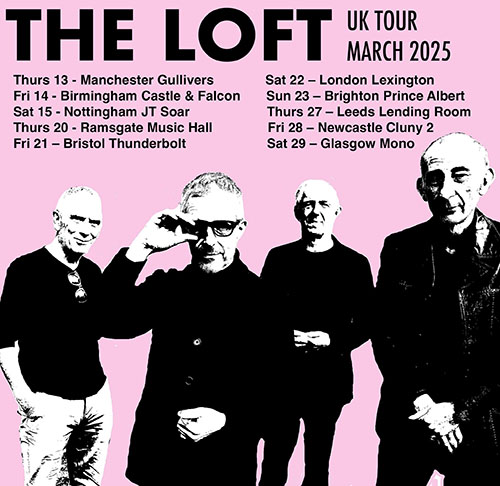
The Loft are currently touring the UK.


 Say It With Garage Flowers