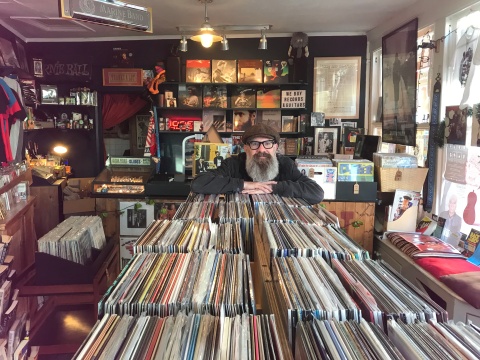

British singer-songwriter Ian Webber, who is based in Nashville, Tennessee, has just released his most political album to date.
Op-Eds tackles social issues including women’s rights, fake news, war-torn Syria and the Dakota Access Pipeline controversy.
Musically, it’s very stripped-down – mostly just Ian and his acoustic guitar – and it makes for intimate and sometimes uneasy listening, as he shares people’s stories of hardship and struggle.
Opener Follow Me and its parent song, The Regime, are haunting tales inspired by reading news stories about families suffering in Syria, while Frontline is a protest song that has its roots in ’50s rockabilly.
First single, Radio Zero, is an ode to the healing power of great music – while the world is going crazy, sometimes you just need to switch off from all the doom and gloom and crank up some classic rock ‘n’ roll tunes. Ian sings the song in a Bowie-like croon that sounds like it’s been beamed in from outer space.
In an exclusive interview, I spoke to Ian to find out why he’s made such an overtly political record and what it was like recording it in Nashville…
Q & A
Your new album Op-Eds totally surprised me, as it’s a lot darker and much more political than I was expecting. Did you deliberately set out to make a political record? And if so, why? What was the starting point for this album?
Ian Webber: The starting point for this album, and pretty much all my projects, was the music I was listening to and absorbing before I began writing it. This time it was The Velvet Underground and Lightnin’ Hopkins. That’s a strange combination, but both were essentially using blues-based chord sequences, keeping it fairly simple, so the vocal melody could take the priority.
The first couple of song ideas were very New York Warhol/Reed inspired. ‘Late night, up on the corner’-type songs, so that’s where my head was to begin with.
I also had a really great hallway with excellent reverb, so that was a good place to stand and sing ideas in a low vocal key.
I had no idea that the record would turn political at all – that really only started when I took breaks from strumming to catch up on daily news. I was intrigued by articles in the New York Times and Washington Post. I discovered really compelling stories, which in turn inspired me to create mini stories as lyrics.
Lyrically and thematically, the album deals with social and political issues past and present, including protesters affected by the Dakota Access Pipeline, women’s rights, the plight of families in Syria, politics in Virginia and immigration issues… This is heavy stuff.
Was it difficult to write such political songs? How did you tackle the issues without sounding trite, or patronising? Was it a worry or a risk?
IW: The universal theme was a common bond that I felt with other humans – all of us moving through life.We all start out the same way, wanting the simplest things, and that gets lost as we grow up.
The world as a whole is a small place. I’ve travelled a lot and you find, whatever language, whatever culture, people are generally the same. I wanted to express that in these songs and, in a small way, shed light on the bigger issues, too.
I don’t proclaim to be a learned scholar, but I really wanted to produce something that was a document of the times. This was the world through my eyes in 2017, living as a Brit in a very American, southern culture.
‘I’ve travelled a lot – whatever language, whatever culture, people are generally the same. I wanted to express that in these songs and shed light on the bigger issues, too’
Musically, it’s a very stripped-down album – it’s mostly just you and your acoustic guitar. Was that how you wrote the songs?
IW: Yes – I certainly had this idea that I would try to do the whole record alone.
I always have voice memos lying around, and when I played them in the car, or through headphones, they sounded great to me. I guess that made me want to make the album in essentially the same way, but obviously, with a better mic than the one on my phone.
Where and how did you record the album and who did you work with?
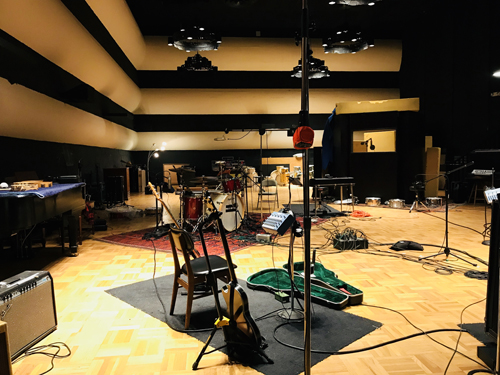
IW: I recorded the record at Historic RCA Nashville Studio A, thanks to my ex-band mate Dave Cobb, who runs the place, and who helped make time between projects for me to go in and record
There is a huge tracking room that’s big enough for an orchestra. I basically set up in the middle and sang live and played guitar. The natural reverb in the room is insane, and there were minimal overdubs. It was a cathartic way to record – no drums, no bass, no other souls around except me and Gena Johnson, Dave’s engineer, who produced the record.
‘It was a cathartic way to record – no drums, no bass, no other souls around except me and the engineer’
One of my favourite songs on the album is The Regime – it’s very haunting…
IW: The Regime started as a chord sequence that was similar to the ideas on my last record [Year of the Horse, from 2015] – walk down progressions and minor chords, of course!
The lyrics were based on an interview that a family in Syria gave to the New York Times, about trying to survive war in the city.
When you grow up, you have this romantic idea of the place you were born, and its streets and sounds, and fond memories. I could never imagine living somewhere you call home and watching it fall apart. That song is a kind of companion to Follow Me, which deals with leaving that kind of scenario behind and having to find a new home in a foreign land.
Another standout track for me is Frontline – it has a ’50s Sun Records feel. It’s an acoustic, rockabilly protest song…
IW: That’s a cool observation, Sean! The love of ‘50s rockabilly music seems to be a recurring theme on my records, but I can’t say I had it in mind when I was writing the song… I have been having a Lightnin’ Hopkins obsession lately, so certainly that was in my brain at the time…
The song Spirit of Houston comes from a similar place, doesn’t it? What’s the story behind it?
IW: That’s the only collaboration on the record. I started the year chatting, via email, to an old singer friend of mine, Sam Smithwick. I was inspired and jealous of his ability to write blues songs. We had been sending each other finished ideas, kind of like a pen pal would write letters. One song he sent had no vocal, just a guitar riff. I took the idea, added words, looped the riff, and sang to it live in RCA Studio.
Lyrically it’s about the 1977 National Women’s Conference for women’s rights. Last year, I went to the Women’s March in Nashville, and the signs I saw and the voices I heard made me want to become more educated.
‘When you grow up, you have this romantic idea of the place you were born, and its streets and sounds, and fond memories. I could never imagine living somewhere you call home and watching it fall apart’
In the last couple of years, you’ve moved from L.A. to Nashville and you’ve become a father – congratulations! How much did relocating and having a son have an influence on this album?
IW: There were a few reasons for the move from L.A. to Nashville. I started out in Atlanta, playing music in the ‘90s, before moving to Seattle and then L.A. Coming back to the South was a way to reconnect with the culture and some amazing musicians I had played with. I got to do some touring for the last record with some former bandmates that still lived here, so it was kind of a homecoming of sorts.
My son, Wilder, was still inside his mum Meg’s belly when I was writing and recording, so his influence was there, but in little kicks. He did get to hear Fire on the Water being recorded, when Meg sang the backing vocals while pregnant!
You’re an English guy living in the U.S. What’s your take on Brexit and US politics at the moment? Is this album your chance to try and make sense of it all?
IW: I have my British passport, my Green Card, and am hanging on to my accent. Living abroad definitely makes you more nostalgic and somewhat patriotic.
One thing about living here is that the news is generally US-based, so Brexit is something I feel like a tourist talking about. From what I hear, it’s going to affect a lot of musicians from touring as freely in Europe. I would rather see a world without boundaries and barriers. One of the least political songs on the album is the first single, Radio Zero. It’s about escaping fake news and bad news and listening to classic rock ‘n’ roll instead. I think your vocal on the track has a slight Bowie feel to it…
IW: At the end of it all, I am a music lover, and so Radio Zero is a nostalgic look back at when I was lying on my bed as a teenager, late at night, scanning the radio for a good song. John Peel was still around, and also some AM pirate radio stations, so cracking rock ‘n’ roll was something I tuned in to and fell asleep to. David Bowie was one of my first musical loves, so maybe he was sending me messages through the wavelengths on that one. I hope so.
Finally, on that note, it seems apt to ask you what music – new and old – you’re currently enjoying?
IW: I like that you added the old and new line there… Currently in my mind – new:
Charlotte Gainsbourg – Rest
Ryuichi Sakamoto – async
David Sylvian – A Victim of Stars
Nick Cave – Skeleton Tree
Devendra Banhart – Ape in Pink Marble
And some older – and loved…
R.E.M – Reckoning
Prefab Sprout – Swoon
The Smiths – The Smiths
Op-Eds by Ian Webber is out now.
For more info, visit: https://ianwebber.bandcamp.com/album/op-eds
http://www.ianwebbermusic.com/


 Say It With Garage Flowers