‘Most of these songs either started, or finished, at my kitchen table’

smallIMG_0343.jpg

Nick Piunti has hit a power pop purple patch. Trust Your Instincts – the new album from the Detroit singer-songwriter – is his third long-player in just under four years and it doesn’t disappoint. 

It picks up where his last record, 2015’s Beyond The Staticleft off and it’s also a worthy companion piece to his 2013 classic – 13 In My Head – a firm favourite here at Say It With Garage Flowers.

I spoke to Nick to find out the story behind the writing and recording of Trust Your Instincts – an album that was made with the help of a kitchen table, coffee, wine, an iPhone and a trusty Fano JM6 guitar…


With the title track, which opens the album, we’re immediately plunged back into classic Piunti power pop territory. What can you tell us about that song and why did you decide to name the album after it?

Nick Piunti: The title track was written for my oldest daughter, who is 20 and was going through a tough time with her boyfriend – now ex-boyfriend.

Most of the songs on this album – if not all of them –  had the good fortune of the lyrics and the melodies coming at the same time. That’s not always the case. For me, if the lyrics come later, they sometimes never come at all.  I always end up with several unfinished songs because the lyrical inspiration wasn’t there in the first place.

When recording the song, Geoff Michael (producer) and I encouraged Donny Brown (drummer) to summon his inner Keith Moon. It took a little bit of prodding, but it paid off. The acoustic guitars also seem Who-like to me.The song really came together for me when Ryan Allen added his double tracked guitars. Ryan played guitar on five songs from the album. He came up with some great parts, as he always does, and it really propelled this song.

I had several working titles for the album, but Ryan suggested calling it Trust Your Instincts.  I initially didn’t want one of the song titles to also be the album title, for the reason of not wanting to bring too much attention to just one track, but the title definitely fits this album.

I pretty much do trust my instincts when making records and, as my wife would tell you (or is that I tell her?), I’m almost always right…


How did you approach this album from a writing and recording process? You used the same studio and core musicians as the last album, didn’t you?

NP: Yes – we used the same studio, Big Sky Recording in Ann Arbor, with Geoff Michael engineering and producing. Also Andy Reed recorded all of his bass parts at his studio, Reed Recording Company, and Donny Brown tracked his drums to Fade Out in his own studio.

We also did a few overdubs at both Andy’s and Donny’s. Ryan Allen recorded a few harmonies in his basement and David Feeny, who owns The Tempermill Studio, recorded the pedal steel parts on Dumb It Down at his great studio.

Rachael Davis, who sings the beautiful harmony vocal on Dumb It Down, recorded her part in Nashville. With today’s technology, it is so easy to just send tracks from one studio to another. It opens up some options and saves a lot of driving. But most of the sounds were recorded at Big Sky Recording in Ann Arbor, Michigan.

As far as writing the album, most of the songs either started, or finished, at my kitchen table. There’s something about that setting that works really well for me. In the morning, it’s me, with my acoustic guitar, coffee, and my iPhone to capture the ideas.

In the evening, I substitute the coffee with wine. My house is hardly ever empty, so somehow my family puts up with my process. They would probably rather have me in the basement, but I like the sunlight and the acoustics and I like them close by.

What were you listening to while you made the record? Did any of those influences filter through into the sound of Trust Your Instincts? What sound were you aiming for with this album?

NP: I listened to a lot of guitar pop. I do remember listening to Paul Westerberg’s album Eventually, Mac McCaughan’s Non Believers, Love Axe’s South Dakota, Ryan Allen’s demos, Guided by Voices, Nada Surf, Weezer, Beach Slang and Nude Beach.  You wouldn’t believe how many bands have Beach in their name!

I don’t ever try to make an album that is directly influenced by one band or sound.  The song usually dictates the direction. I do remember telling Geoff, after the album was recorded, to make it sound like Nada Surf, but I changed my mind afterwards, so we settled on making it sound like a Nick Piunti record.


One Hit Wonder is one of my favourite songs on the album – it has a slight Beatles-esque feel. The intro is a bit Dear Prudence/ psych – and the melody is great – very infectious. I also love the killer guitar solo.What was the inspiration behind it?  

NP: Yeah – One Hit Wonder seemed like the obvious ‘single’ to me.  I originally wrote it with a simpler muted eighth note progression, but I thought it was too simple and obvious.  So I came up with the riff played through a pedal that emulates a Mellotron. That adds to The Beatles sound for sure.

The lyrics are about a relationship that was more about lust than love, but I used the musical reference of a one hit wonder to sum up the affair:  “We were a one hit wonder couldn’t follow it up”.  That kind of says it all.

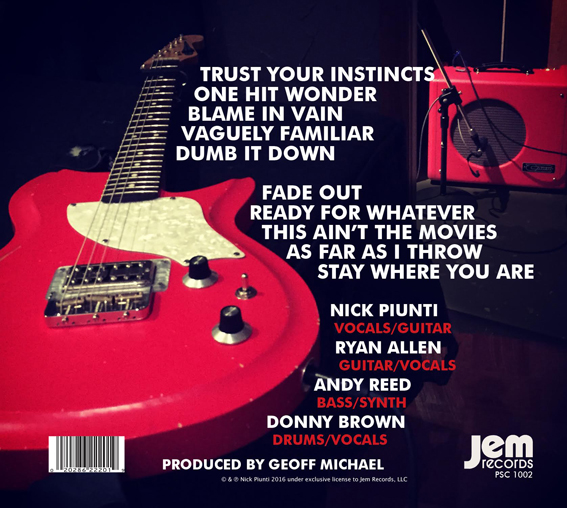
And thanks, the guitar solo is one of mine. I usually hear the solo in my head then try to find the notes on the guitar. I used a Fano JM6 for a lot of the guitar parts on this album. It seems each album I make has one starring guitar. The verse melody evolved a bit and my phrasing reminded me of something that Mike Viola would do. I never intentionally try to write like one of my influences, but if it comes out that way innocently, then I’m fine with that.
smallTYI Back cover.jpg


Dumb It Down is another highlight for me. It’s a gorgeous pop song. Where did it come from? It has a slight country feel in the latter part of the song, with some pedal steel…

NP: That song was a tough one to write, in the sense that it was very personal. The first line, “another day without fiction, I keep it to myself,” came to me after leaving a friend who was slowly succumbing to cancer.

His name was Merle, he was our band’s manager, when we were a bunch of snotty 12-year-olds, and he was really instrumental in my musical journey.

Though the song changes perspective, I felt like the verse was from Merle’s point of view and the chorus was mine, or any of his many friends that would miss him when he wouldn’t be around any longer. The second verse was about how our band Dwarf didn’t make it. Merle wanted to know that I was ok with all those years we put into the band.  I assured him that it wasn’t a waste of time at all. And that I would do it all again…

I know you like pedal steel, so I threw that in for you. David Feeny happens to play great pedal steel. He sent several tracks played through the entire song and Geoff and I picked the parts we liked the best. David recorded a really nice solo, but Geoff thought I should try something as well. And Geoff suggested a female voice in the chorus. The song came out prettier than I expected it to be, which balances out some of the more rocking moments.

There’s a song on the album called This Ain’t The Movies. What’s your favourite movie and who would you like to play you in the Nick Piunti biopic?

NP: My favourite movie? The easy answer would be The Godfather, but these days most of my movies are of the animated variety that my youngest daughter wants to see.

Comedies are easier for me to watch over and over again: Me Myself and Irene, Caddy Shack, Blazing Saddles, Animal House.

Who would play me in a movie?  My wife says George Clooney, but I’m not sure how George sings… If the movie was about a younger me, then there’s an actor named Logan Lerman who my wife says would be a good fit.

The final song on the album, Stay Where You Are, takes things down a notch – it has a more of an acoustic, mid-paced feel. What can you tell us about that song?

NP: Stay Where You Are is loosely based on a past relationship, where it’s obvious to one that the best days are behind them. It’s a simple chord progression, I have probably written this type of song many times before, but it really seems to connect with quite a few people.

It seemed to be the perfect closing song for the album. And I kept the album to ten songs, because I feel that’s enough. I would like for people to listen to the album in one sitting and 36 minutes seems like enough time to ask.

How’s the rest of the year shaping up for you? Knowing you, you’re probably working on your next album already… Can you give us any clues?

NP: The album has just been released on September 9 on Jem Records and I’ve been getting several songs played on The Loft Sirius XM radio, as well as countless smaller stations. WDET in Detroit has always been a great promoter of my music.

There are so many internet radio stations that play my music, from The Ice Cream Man Power Pop Show in Sweden, Jeff Shelton’s Power Pop Show in California, Alan Haber’s Pure Pop, Jim Prell, Howard Byrne, Pop That Goes Crunch, Craig Leve, Dave the Boogieman… so many guys that pour their hearts into promoting power pop for those of us that have never outgrown it. I can’t thank them enough, or the reviewers out there that really make my day when they post their articles. So, getting the music out there is a priority.

Playing live is awesome. It’s hard to do a lot of that, but there’s nothing else like it. I’m always writing, so there are new songs in the works, but I’m not rushing back into the studio yet. Three albums in four years took a lot of work. I may take a bit of a breather before the next one. Of course, I’ve said that before…


Nick Piunti’s new album, Trust Your Instincts, is available now on Jem Records. Its predecessor, Beyond The Static, has just been reissued on limited edition coloured vinyl by Sugarbush Records.


For more information: 

https://nickpiuntimusic.bandcamp.com/

http://www.nickpiunti.com/

http://www.jemrecordings.com/

http://www.sugarbushrecords.com/ 


‘We jammed a version of The Ballad of El Goodo and I collapsed afterwards’

ATH197810

The sound of the summer is here!  Oxford’s jangly-pop maestros The Dreaming Spires are back with a new eight-track EP/mini-album called Paisley Overground, which was partly recorded at the legendary Ardent Studios, in Memphis, where Big Star made their seminal albums.

The record features four songs from The Dreaming Spires (Paisley Overground, Harberton Mead, Silverlake Sky and The Road Less Travelled), as well as four from other acts – Sid Griffin & Tony Poole, Co-Pilgrim, The Hanging Stars and The Raving Beauties.

I asked Robin Bennett – who, with his brother Joe – are the main members of The Dreaming Spires – about the new EP, recording in Memphis and the band’s plans for the rest of the year…


It doesn’t seem that long ago that we were talking about your last album Searching For The Supertruth, which was nominated for this year’s UK Americana Awards.  Now you’re back with another new record – the Paisley Overground EP. You’re unstoppable. What’s the secret to being so prolific?

Robin Bennett: Thank you for calling us unstoppable. We’re more like a swan, paddling frantically under the water. There are a few factors – I try to write songs every day, even if I only have a few moments, or I’m on the bus, typing things into my phone.

I also have a well of songs written a few years ago with my friend Daniel Power from New Orleans. Silverlake Sky [from the new EP]  is one of those, but updated. Our drummer, Jamie, has emigrated to the US, so when he is over here, or if by some good fortune we are there, we try to get some recording done.

Joe and I have our own studio – Truck Studios – where we recorded overdubs for this EP, and we are very lucky to have Tony Poole and Rowland Prytherch on hand to mix our recordings to the amazing standard that they do – it’s really a team effort. That said, we are nowhere near as prolific as Co-Pilgrim, Joe’s other band.

ARDENT-CONTROLROOM.jpg

Three of the new songs were recorded at the legendary Ardent Studios, in Memphis – the home of cult power-pop band Big Star. How was that experience?

RB: When we were in the US for AmericanaFest last September, we slightly extended our stay to fit in a visit to Memphis – our fans will know we had never been there before. It was viable to record for nearly a whole day at Ardent Studios, so we made sure we had rehearsed some material and cut it mostly live. When we got home, we added some overdubs to some of them, including Joe’s recently purchased pedal steel, finishing three tracks.

Big Star were a formative influence for The Dreaming Spires’ sound, undoubtedly. When our previous band Goldrush were in the US, we were introduced to Big Star via The Ballad of El Goodo, which I learned to play before I even knew who it was by. It became a really special song for us.

Soon enough we got into all the Big Star albums. For me, Memphis is the place where the music we love came together, whether it’s Chuck Berry, Elvis, Johnny Cash, Otis Redding, Stax… All of that is hinted at in the music of Big Star, and their style is accessible for us because they were trying to emulate British groups.

Memphis has a very different style to Nashville – there’s more of an edge. It’s the melting pot of American music. All kinds of stuff has been recorded at Ardent, including REM’s Green, which was another formative album for us as teenagers. It’s a very well equipped studio, where you can set up and record live – which is what we did.

The room we used was actually designed for ZZ Top! Jody Stephens, the drummer and surviving original member of Big Star, is the studio manager. We thought perhaps he might drop by, and he did, even singing some backing vocals on a version of Dusty in Memphis, which we recorded the same day.

We kept teasing Jamie, our drummer, that Jody would have to step in if he didn’t play the songs right. Are we really that mean? Maybe that’s why he emigrated.

At the end, we jammed  a version of The Ballad of El Goodo with Jody and it was almost too much. I slightly collapsed afterwards.

Four of the songs on the EP are by The Dreaming Spires and four are by other artists. I’m confused… What’s the concept behind the new record?

RB: Paisley Overground was a throwaway phrase that almost demanded some kind of scene to be built around it. Much as the Paisley Underground was (mostly) LA bands reconstructing The Byrds’ sound with some modern attitudes, this is our British version in 2016.

We had also worked with Sid Griffin [The Long Ryders, Coal Porters ] on a gig showcasing the songs of David Crosby a couple of years ago, which was a really fun experience.

Tony Poole, who worked on our last album and mixed the first two tracks on this EP, had actually worked up a track with Sid called Tell Her All The Time, which is on side two. Rich from The Hanging Stars is an old friend, The Raving Beauties are on our manager’s label, and of course Co-Pilgrim is Joe’s excellent other band.

The proof of concept is that side two hangs together really well – it almost sounds like a Buffalo Springfield album, but with different singers.

https://soundcloud.com/at-the-helm-records/sidea-1-paisley-overground/s-nTv0G?in=at-the-helm-records/sets/the-dreaming-spires-paisley-overground/s-n859Z

The title track is an instant, chiming jangle-pop classic, with a touch of country. It’s a paean to your love of the Paisley Underground scene and the 12-string guitar sound. How did the song come about? Why do you love the Paisley Underground scene so much?

RB: Ever since I heard Turn! Turn! Turn! And A Hard Day’s Night as a kid, I’ve instinctively loved the sound. You can hear it on some songs from the Goldrush catalogue too.

I think there’s something about a 12-string, where you have two strings for each note, which creates an automatic, psychedelically-enhanced effect – you get a drone from the low strings in octaves, and the high E and B strings are the same pitch, but tuned slightly differently. A lot of music from different cultures uses drones and resonant strings, and a 12-string guitar has a bit of that.

Growing up, we also loved the jangle of early The Stone Roses, REM, and Ride. We backed Mark Gardener from Ride between 2003-2006, including several US tours, and I usually played his Rickenbacker 12-string, a custom John Lennon version I believe, so we weren’t the first Oxford band to like them.

The first I heard about the Paisley Underground scene was from Danny  [Daniel Power]. He was also the road manager on those early tours with Mark Gardener and he lived in LA. We stayed with him a lot and got a feel for it, without becoming an expert on any of the bands.

I just liked the phrase, and what it stood for – a kind of contemporary revival of classic sounds and songwriting, sometimes with an edge of psychedelic exploration.

I’m sure in reality it was a pretty small scene, but with a big influence. We’ve done shows with Sid Griffin and Chuck Prophet in recent years and heard a bit more about it.

It’s easy to feel like you miss out on scenes or moments in music, especially when you read too many music books and watch too many documentaries, but I hope the song and the EP as whole create our own shared moment.

The 12-string electrics I use now both belong to Joe – as the song suggests, I still don’t own one. One Danelectro and one Rickenbacker.

You are right in spotting a touch of country in the recording too – Joe made a purchase from Pedal Steels of Nashville when we were there, and this was his first attempt to play it on record.

LITTLEROCK.JPG

Let’s talk about the other Dreaming Spires songs on the EP. What inspired Harberton Mead and The Road Less Travelled? 

RB: Harberton Mead is a road in Oxford. I lived in Oxford for years and never knew the road – it’s full of gated mansions.

Some friends ended up living in a shared house there owned by the university, and the name stuck with me. It has a mystery to it, like Itchycoo Park or Penny Lane.

The Road Less Travelled was a song I had left over from the last album, but I wanted to record it at Ardent because it had a hint of The Ballad of El Goodo about it. The lyric is quite mysterious – even to me.

I think it’s almost a conclusion to the narrative on the first two albums, but not in any obvious way. It’s quite a trippy lyric.

I’ve read that the song Silverlake Sky was written on Sunset Strip, the heart of The Paisley Underground, and recorded in Oxfordshire using a ’60s Eko 12-string acoustic guitar. Can you tell me about how you wrote and recorded the track?

RB: Between 2004-2007 I wrote a lot of songs with Danny, my friend mentioned previously. He lived between Echo Park and Silverlake, at “the house on Elsinore”.

Our whole band would often stay at his house, with much drinking and many evening sing-alongs, but we also developed a songwriting partnership – both there and when he’d visit the UK.

I found the lyric in my notebook from those sessions but I couldn’t remember the original tune properly, so I approximated it and added the vocal part at the beginning.

When we wrote it we were envisaging a struggling Hollywood actor or musician with too much of a focus on the lifestyle. There were plenty of those around.

I can still recall the warm aromas of a Silverlake evening, and the glory of the Californian sunsets. Pretty exciting when you’re from Oxfordshire.

The allure was too much for our drummer, Jamie, who has moved to LA. He actually lived there before, when he was in another band.

We found a moment to record the song when he was here last summer, and the acoustic 12-string ties it in nicely with the other tunes. I actually bought it on impulse at one of Clubhouse’s Record Store Day events in Amersham a couple of years ago. A real bargain.

ARDENT-LIVEROOM

The new EP is coming out on 12in vinyl. Are The Dreaming Spires vinyl junkies?

RB: We’ve always loved it, whether playing our dad’s collection as kids, collecting singles in the ‘90s, or picking up $1 classic albums in American thrift stores.

Our music tastes would be completely different without vinyl – the way it has allowed us to stumble upon discoveries. It’s not that convenient, and I probably listen to CDs more, but there’s something that gives you an instant artistic feel from the object. You can pass it around. I don’t get that from streaming, convenient though it is, and I still find the choice overwhelming.

Twelve inch vinyl works so well as an art object – I love coloured vinyl, too. This EP is going to be translucent purple, I believe. It’s a really nice end point for a recording project to see it on vinyl. I don’t agree with those who say they love the crackle of vinyl, though. Modern pressings are usually much better.

How’s the rest of the year shaping up for you? Do you have any festival gigs planned and any shows gigs in the UK or elsewhere?

RB: We’re doing some Paisley Overground shows with the excellent bands from side two of the EP – Co-Pilgrim, The Hanging Stars and The Raving Beauties – in London, Brighton, Didcot and Winchester.There are more extensive tour plans for the autumn coming together.

As you’re so prolific, surely you must’ve written another album by now?

RB: I have, or perhaps two! It’s certainly a new chapter. I think this EP is my sign-off from jangle. But I’m probably wrong…

Finally, what music – old and new – are you currently listening to and enjoying?

RB: I’m enjoying lots of the current crop of US songwriters, like John Moreland, Austin Lucas, Jason Isbell and Sam Outlaw.

I’m also listening to the Simon and Garfunkel box set, The Everly Brothers. Jimmy Ruffin’s Greatest Hits – when I can get it not to skip). The Lovin’ Spoonful. Crosby, Stills, Nash & Young and The Byrds – Untitled.

I loved the music performed by all our fellow nominees at the UK Americana Awards – it was a special night.

And, of course, the new albums by The Hanging Stars, Co-Pilgrim and The Raving Beauties. There’s plenty of good music out there….

Paisley Overground is out on At The Helm Records on June 10 on coloured 12in vinyl and download.

For more info: http://www.thedreamingspires.co.uk/