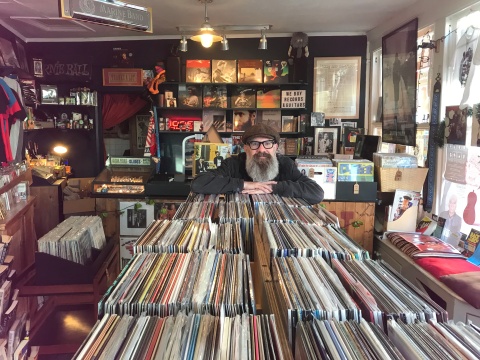
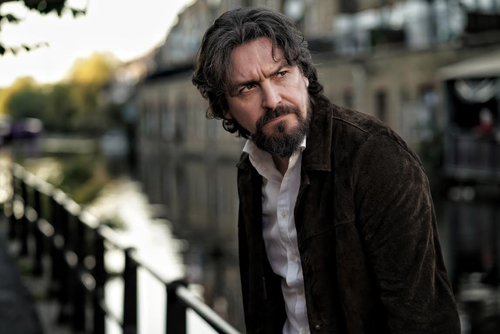
Case Hardin frontman Pete Gow’s first solo album, Here There’s No Sirens, is a brilliant collection of stripped-down, intimate and very personal songs, with acoustic guitar, orchestral arrangements, brass, piano, drums and organ.
For his first interview to promote the record, Say It With Garage Flowers met him for a pint. Subjects on the agenda included string sections, tattoos, relationships, Stormy Daniels and Shane MacGowan…
Pete Gow is sat in Trinity bar in Harrow, North West London, nursing a pint of lager. The last time he was here was in late 2017, when he played a solo acoustic We Shall Overcome anti-austerity charity show for Say It With Garage Flowers.
At that gig, one of the songs he aired was the folky Some Old Jacobite King, which now features on his first solo album, Here There’s No Sirens – albeit in a radically different version.
In fact the new record that we’re here to talk about is a surprising departure for Pete, who fronts UK Americana / alt-country band Case Hardin. Sure, lyrically it’s sometimes dark and often left of centre – like the songs we know him for – but this is a deeply personal and confessional record, and, musically, it explores new territory for Pete – gone are the big electric guitars, old fashioned rock and roll, Springsteen-like anthems and kicked-around country songs of Case Hardin’s 2015’s album Colours Simple. Instead, this is a record of stripped-down acoustic songs, with stirring string arrangements, fleshed out by piano, brass, organ and drums.
We’re reminded of when US Americana singer-songwriter Chris Mills – who just so happens to be a friend of Pete’s – made his 2005 album The Wall To Wall Sessions – a masterpiece that featured lush orchestration and horns.
Opener One Last One Night Stand sets the tone for most of Here There’s No Sirens – it’s a big, honest, relationship ballad with a breathtaking cinematic backing, while the song Mikaela sounds like early Ryan Adams, but with mournful horns and sweeping violins.
There are also character songs – the majestic Some Old Jacobite King is steeped in the storytelling tradition and was inspired by a trip to the remote Isle of Skye, while Strip For Me centres on a guy who treats women in a thoroughly unpleasant way – and it name checks porn actress and stripper Stormy Daniels, who has been involved in a scandal with U.S. President Donald Trump.
Produced by multi-instrumentalist Joe Bennett, (Dreaming Spires, Co-Pilgrim, Raving Beauties / Paul McClure) at Farm Music Studios in Oxfordshire and out in April on Clubhouse Records, Here There’s No Sirens is a stunning record that’s both beautiful and unsettling.
At times, it can be uncomfortable to listen to, as Pete shares raw emotions and intimate relationship details over dramatic orchestral backing. Does he think it will surprise people who are used to hearing Case Hardin?
“I hope it will,” he tells Say It With Garage Flowers, sipping his pint. “So often when you hear a solo record by people who front bands where the lead singer is the creative force behind them – like the manner in which I front Case Hardin – the differences are quite marginal and it’s just a little bit more acoustic. I really put a lot of thought into how I wanted this album to be different. Even if people don’t like it, nobody can say that it’s just a Case Hardin-lite record…”
Q & A
This is your first solo album. What prompted the move to make a record on your own?
Pete Gow: I was trying to get Case Hardin to make a record last year. It was written – it was even overwritten – I had 15 or 16 songs, but we just weren’t able to make it happen for a whole world of reasons. Sometimes five grown men just can’t get their shit together to make a record happen.
So I started about thinking what I should do – the concept of making a solo record had never occurred to me. I thought about us doing an EP – something that would tide Case Hardin over, as it had been two years since we released our Colours Simple album. Bands like us live or die on new products – not to mention the fact that I’d been writing for a long time and needed to find an outlet for it.
When I realised that the Case Hardin thing wasn’t going to happen, there were three or four songs in that pile that I’d always wondered what the hell Case Hardin would do with them anyway?
The whole thing just came about in almost 24 hours. I spoke to Joe and he was into it, and I spoke to Clubhouse Records, who were expecting a new Case Hardin record, and they said that if I could turn the three or four tracks into an album, they’d be interested in it. So then I wrote the rest of the album in a couple of weeks.
This record is a big departure from the Case Hardin sound – it’s stripped-down ballads, with acoustic guitar, orchestral arrangements, piano, trumpet, piano, organ and drums…
PG: I’m the main songwriter in Case Hardin and we have a sound that’s reasonably distinctive, so I had to find a way of making the album a proper solo project.
I went to Joe and said, ‘here’s what I want to do’ – I didn’t want any guitars on it, but I wanted strings and piano and drums, with everything else stripped-out. Joe was brilliant – he listened to the demos and said, ‘I’ll meet you halfway’.
‘I didn’t want people who came to my solo record to find that it was just like a Case Hardin album, but with different musicians playing on it… I didn’t want to make a Case Hardin record’
He wanted to keep the acoustic guitar, because that’s how the songs were written and it’s what drives them along, but there’s no lead guitar on the record.
I didn’t want to short-change anybody – I didn’t want people who came to my solo record to find that it was just like a Case Hardin album, but with different musicians playing on it… I didn’t want to make a Case Hardin record and I knew that Joe could do strings – he’s done some wonderful work on albums that I’m familiar with. I play all the acoustic guitars on the record, the drums are by Fin Kenny and Joe plays everything else.
Even the backing vocals? I thought they were female…
PG: I’ll tell him that!
You made the record last year. How was the recording process?
PG: There were two short sessions of four or five days each in the middle of last year. We did it slightly differently to the way in which records are usually made – I laid down the guitar and then I’d put a guide vocal over the top of it. Then we brought Fin in, who had two days to work through the tracks. Joe wrote melody parts on a violin and then recorded the strings – it was all real instruments. He also wrote the various harmony parts.
The whole experience was very different – when we make a Case Hardin record, it always sounds like a 100 per cent better version of what I knew it was going to sound like in my head – a beautiful, shining, brilliant and more fully realised version.
With this record, I handed the acoustic guitar, vocals and drum tracks over to Joe and he then built the string arrangements. There are a few songs – One Last One Night Stand and TV Reruns – which have big, long, instrumental sections. If I were writing those for a Case Hardin record, I wouldn’t have made them so repetitive and so long.
‘I told Joe that I wanted this record to sound like Nick Cave’s The Boatman’s Call and most of Ryan Adams’ 29’
One Last One Night Stand was the first track Joe sent back to me and I knew then that it was going to be a great project. Joe has produced this album in the fullest and most traditional sense. He understood the content and took all of the songs to a place that was beyond my comprehension. That’s what he brought to this record. When Joe sent the tracks back to me, I was blindsided – they almost sounded like other people’s songs.
What were you listening to when you made this album? What were the musical influences?
PG: I told Joe that I wanted this record to sound like Nick Cave’s The Boatman’s Call and most of Ryan Adams’ 29. He said, ‘I’ve heard neither of those records and I’m not going to listen to them!’ It sounds nothing like either of them.
Joe and I was a wonderful juxtaposition – I had these ideas of what I didn’t want it to sound like, and the influences I did want to draw on, but all he wanted to do was to make the best record possible. Sometimes that fell into line and sometimes it didn’t – sometimes I managed to persuade him to make changes and sometimes change for change’s sake wasn’t the right thing to do. It was a very fulfilling relationship.
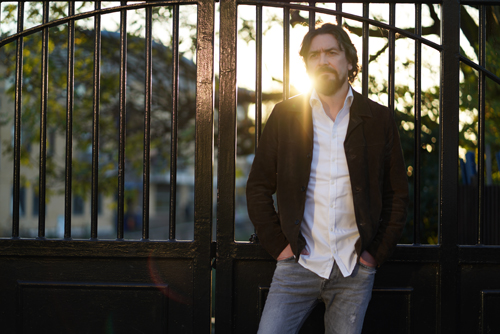
It’s a very personal album – emotionally raw and confessional. It’s naked Pete Gow – often in more than one sense of the word, but we’ll come to that later…
Let’s talk about some of the songs. The opener, One Last One Night Stand, features the lines, ‘We don’t need to die here on this beach – we don’t need this sand to wipe blood off our hands…’ This is dark territory, isn’t it?
PG: It’s just my way into relationship songs. I’ve always tried to find that slightly left of centre way into any situation. If there’s anybody who likes the way I write, then I’m guessing it tends to be because of stuff like that.
One Last One Night Stand – like a lot of the album – shows that I’m in a relationship and a place that I never expected myself to be in. I’m certainly in a place that I never expected to be in so comfortably that it would reflect in the music that I’m making.
One Last One Night Stand is just a slightly left of centre way of realising that that’s where I am. It was one of the songs that I wrote for the record – it hadn’t been written previously and it was one of the last ones I wrote. I realised where the record was going and it sets the tone for the project, which I why I put it at the beginning. ‘Here’s where I am – now go and listen to the rest of the record and you’ll realise…’
‘A lot of the album shows that I’m in a relationship and a place that I never expected myself to be in’
It’s an album that’s very relationship-heavy, isn’t it? Some of your Case Hardin songs feature characters, and, although there are characters on this record, most of the songs are personal, aren’t they? They’re about you and the relationship you’re in…
PG: Yes. Apart from possibly Some Old Jacobite King, which is a story song, this album is self-contained and doesn’t really stray from its mandate or remit. Over the course of 40 minutes you need something like Some Old Jacobite King to pull you away… nobody wants to just sit and listen to me and my relationship! [he laughs].
The second song on the album, Mikaela, is my favourite track, largely for the great line: ‘Songs are like tattoos – you should think before you name one after a girl…’ That’s a rare moment of humour in one of your songs…
PG: It is – if you listen to my records, you’ll know that.
Have you got any tattoos of girls’ names?
PG: I haven’t, but it’s that famous thing, isn’t it? Get a tattoo of a girl’s name that been spelt wrong…
That song was never intended to be put on a record, but it suddenly became indicative of this whole album, which is relationship-based, more than anything else I’ve ever done. The song was written for her [Mikaela]. There are references in it that you might think shouldn’t be put on an album for people to hear…
The sexual stuff? Well, I did say it was a naked record…
PG: Literally and figuratively. That’s why that song sits so beautifully next to One Last One Night Stand… ‘Hold on, what’s he saying here? Oh – OK, this is why…’
That was a song that was written for the Case Hardin record, but when I sent it to the band I thought, ‘what the hell are we going to do with this?’ I just didn’t want to throw a load of guitars over the top of it and turn it into alt-country by numbers.
I really like the brass on it – it’s mournful, like a New Orleans funeral band…
PG: Yes, but slightly Mariachi as well – the trumpet was slightly buried in the string section originally, but it got pulled out and pushed front and centre in the final mix.
‘Nobody wants to just sit and listen to me and my relationship!’
From one sexual song to another… Next up we have Strip For Me, which could possibly be the first song to name check Stormy Daniels…
PG: It could well be. The song is nothing to do with her, but it’s about the underbelly of the male perspective of relationships – something I’ve written about at other points in my career.
It’s a character song, isn’t it?
PG: Absolutely.
The opening lines are very uncomfortable. There’s a fictional male protagonist who says to a woman: ‘Do you think you’re one of those girls too beautiful to hurt, too beautiful to cheat on? There’s no girl too beautiful for that’…
PG: That horrible guy would quite easily just see a porn star and remember her name – ‘Strip for me, like Stormy Daniels’ – without really realising who this woman is.
It’s a pop culture reference – it’s had an odd reception already. It’s one of the few songs I’ve played live – I did some acoustic shows with Jason McNiff and I road tested some songs. Whenever I played Strip For Me, people burst out laughing… I was like, ‘shit!’
I obviously don’t think through the consequences of these things when I’m writing, but it will be interesting to see if people can peel back the layers, rather than just hearing that woman’s name. I wouldn’t want it to turn into some kind of joke or parody song – it’s not. I used her name to underline the stupidity of the guy in the first verse.
‘I hope history will be a lot kinder to Stormy Daniels and realise that she’s quite a significant character in the theatre that is the Trump presidency’
I guess the reason I left the reference in is because I hope history will be a lot kinder to people like Stormy Daniels and realise that she’s quite a significant character in the theatre that is the Trump presidency. The second verse is supposed to be the woman talking about the guy…
Strip For Me is going to be the preview digital single from the album, so let’s really see what people make of it…
The title track, Here There’s No Sirens, contains a lyrical reference to the Pogues song, A Rainy Night In Soho, playing on the radio, and there’s also a snippet of the song in the outro…
PG: It’s a song about just finding yourself in the kitchen, with a radio playing your favourite song. I’ve given Shane MacGowan a co-writing credit – the song was originally intended for the Case Hardin record and I think they could’ve done something with it.
When I was finishing writing it and demoing it, I thought, ‘what key am I in? This is almost A Rainy Night In Soho’, so I slightly changed the guitar pattern and the style of the strum. I put a little bit of swing into it and changed the key.
The original demo was me playing it into my phone, with the last verse of A Rainy Night In Soho playing on my stereo. I’m a huge Pogues fan – that song is the one to slap people around the face with when they say the Pogues are just a bunch of drunks and that MacGowan is not a good writer…
Why is Here There’s No Sirens the title track?
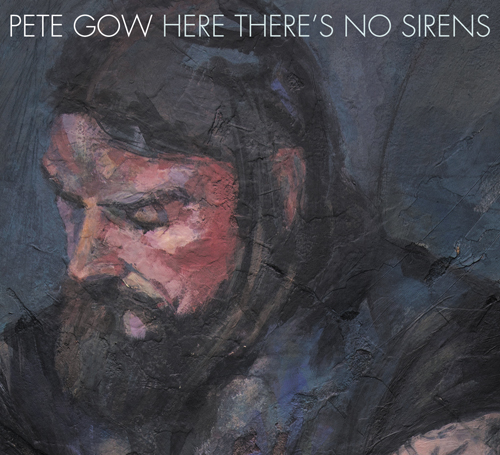
PG: On this album I deliberately set out to do a few subtle things that I wouldn’t have done on a Case Hardin album – never titling a record after a song and never having our images on the front cover. I wanted to name the record after a song and the cover art is a picture of me by an artist from Edinburgh called Veronica Casey – she painted it many years ago. This album is a case of me unticking a lot of boxes for reasons only known to myself…
‘On this album I deliberately set out to do a few subtle things that I wouldn’t have done on a Case Hardin album’
You’re launching the album at a special London show in the Network Theatre, Waterloo on April 6, where you’ll be joined by The Siren Strinqs quartet…
PG: It’s a community theatre and it’s a beautiful space. Clubhouse Records and Joe wanted people to realise that this album is something different, so we have the Siren Strings – it’s not just me and a guitar. The show will be me, Joe, Tristan Tipping [Clubhouse Records and Paul McClure and The Local Heroes] on bass, Fin on drums, and the string quartet.
There are two supports – Lucy Kitt and Tony Poole [Starry Eyed and Laughing and Bennett Wilson Poole]. Tony mastered my record. We’re going to play the album and there will be one or two little surprises on the night.We’re also going to play at the Ramblin’ Roots Revue [April 12-14, Bucks Student Union, High Wycombe].
Finally, let’s talk about Case Hardin. Any plans for a new album?
PG: It’s written – we’re going into the studio as soon as we can. I think we’re going to start recording it in June and then get it out by June the following year.
What can we expect it to sound like?
PG: Looking at the solo project and knowing that I didn’t want electric guitars on it – and looking at the songs I’ve taken away from Case Hardin for my record – you’re left with something that will quite organically be a collection of much shorter, punchier, louder songs.
There won’t be anything on there as expansive as Poets Corner [the eight-minute album opener from Colours Simple], and I also won’t feel the need to put on tracks like High Rollers and Cheap Streaks From A Bottle [also from Colours Simple].
I think the next Case Hardin album, will, by default, be louder and punchier, and we can zone in on what many people think Case Hardin do best.
Pete Gow’s Here There’s No Sirens will be released on April 5 on Clubhouse Records. There will be an album launch show with The Siren Strings quartet on April 6 at The Network Theatre, London Waterloo, with support from Lucy Kitt and Tony Poole. Tickets are available here.
Pete Gow and The Siren Strings will also be playing at the Ramblin’ Roots Revue festival (April 12-14, Bucks Student Union, High Wycombe).


 Say It With Garage Flowers