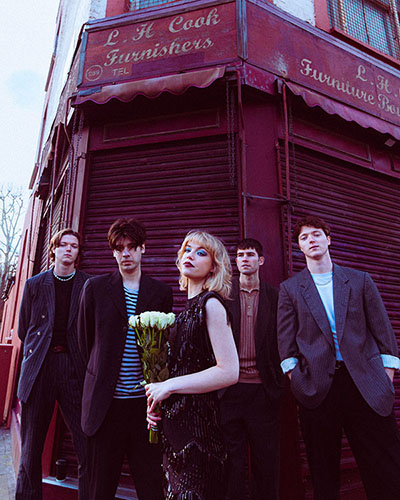
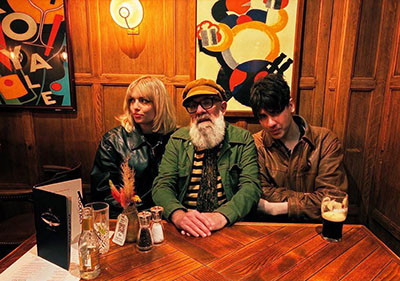
It’s a Monday night and Say It With Garage Flowers is sat in a Camden pub with two members of our favourite new band – North London “frazzled English pop” outfit, GIFTHORSE.
Twenty-something songwriting duo, Naomi Mann (vocals) and Charlie Butler (guitar, backing vocals), are doing their first ever face-to-face interview to talk about their glorious, debut five-track EP, Queens of Highgate, which includes their first three singles, ‘Please Love Me,’ ‘13 Going On 30’ and ‘Love Is a Landslide,’ and two brand-new songs: dramatic synth-pop banger, ‘Silent Disco,’ and epic and cinematic ballad, ‘Stranger Baby.’
During our conversation, we are briefly interrupted by a middle-aged rockabilly, who is sat with a friend at a neighbouring table.
“When Morrissey lived in Camden, his favourite seat was over there’,” he tells us, pointing to a corner of the pub.
This won’t be the only Morrissey-related nugget of information shared in the boozer this evening – Charlie, whose dad is guitar hero, singer-songwriter and producer, Bernard Butler (Suede, McAlmont & Butler,) tells us that when he was 11, he got into The Smiths by watching a DVD of their videos, with his brother, Rory, while they were on car journeys.
“My brother got into The Smiths before me. He was quite an eccentric kid – he would wear suits and he was really into The Smiths,” says Charlie.
“I wasn’t really that interested in music until I was about 11 – I was more into football. But one summer, we watched The Smiths on DVD – every one of their videos from ‘This Charming Man’ to ‘Stop Me If You Think You’ve Heard This One Before’, and I became obsessed.”
He adds: “I set myself a challenge of learning to play ‘This Charming Man’ – I’d been playing guitar since I was eight or nine, but I was probably too young to take it seriously. Around the time I was 10 or 11, Johnny Marr was in The Cribs, and my dad would take me to see them, so Johnny was the first guitar role model I had.”
GIFTHORSE, whose other members are twins, Zak and Iggy Waller (drums and bass), and Hilton Home (synth), share Morrissey and Marr’s gift for writing great, wry guitar-pop songs, and their love of ’60s girl groups, but they also throw in influences including ’80s synth pop, Blondie, The Sundays, The Jesus and Mary Chain, The Cure, Camera Obscura and Fontaines D.C., as well as contemporary pop artists like Chappell Roan and Sabrina Carpenter.
“We like listening to melodic music – different forms of ‘pop’ songs, whatever the genre,” says Naomi, while Charlie adds: “‘Perfect pop songs to make you cry’ – that’s our manifesto.”
Where do we sign up?
Q&A
Let’s talk about how GIFTHORSE came together…
Naomi: I moved to London in 2022 – Charlie and I both followed each other on Instagram and we kind of knew each other. He was aware of my old band.
Charlie: Naomi used to be in a girl group in Sheffield – I thought they were good. They were cool – like an indie version of The Saturdays – and I thought she was the star of the band.
Naomi: We were called The Seamonsters, but the band ended and I moved to London to do a course, but I wanted to do music too.
‘I had this idea that we could be like a London version of Blondie’
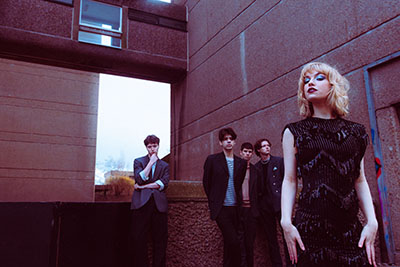
Charlie: I saw Naomi was in London, and I was at a bit of a loose end, musically. I had this idea that we could be like a London version of Blondie – I thought Naomi had the vibe of Debbie Harry. This was at the end of 2022 – the music scene in London was lacking something like that.
Naomi: It was all very serious.
I think there’s been a lack of glamour in indie music for a while…
Charlie: There’s a massive gap between us and most of the guitar bands in London, who are very serious. It’s either very grungy and very male, or very arty and weird. We want to be fun but also beautiful and melancholic.
Naomi: We’re our own thing.
When you were growing up, Naomi, did you dream of being a pop star?
Naomi: I watched Hannah Montana and I was obsessed with an ABBA documentary. I’ve always loved singing, and I did drama and dance.
‘There’s a massive gap between us and most of the guitar bands in London, who are very serious. We want to be fun but also beautiful and melancholic’
It feels like your songs have a mix of both your backgrounds and personalities – the glamorous appeal of moving to London to pursue a dream – but also finding beauty in the everyday of the capital city, where you were born and brought up…
Naomi: Yeah – I grew up in Sheffield, but I always saw myself living in London one day. Sheffield is a city, but it’s a very close community – like a small town. I know it sounds cheesy, but I finished uni in York, and I thought, ‘What do I do with my life?’ When I first moved to London, it was very idealistic. That comes across in ‘Please Love Me.’
Charlie: I guess I was seeing London through Naomi’s eyes a little bit as well. When we first met, we would go walking around Primrose Hill and Parliament Hill – places that are quintessentially North London. We spent a lot of time in Highgate.
So, you started writing songs together…
Charlie: We got together in 2022 but it took until summer 2024 to write some songs.
Naomi: That was when we discovered our sound. We’d been writing and experimenting for ages, but we hadn’t found the music we wanted to write. For a while we were copying what was popular, but it wasn’t working.
Charlie: I think ‘Please Love Me’ was the one where we felt like we’d found our identity.
How do you write the songs?
Charlie: It’s 50:50.
Naomi: Charlie does the arrangements. We write together and we always start with the song idea – the melody and the lyrics.
Do you sit down and write together, like Lennon and McCartney used to do in the early days?
Charlie: Yes – like that, or the Brill Building or Goffin & King. We just get together and write a song. We’re not people that think, ‘you have to be inspired…’ Here’s an hour, let’s write a song…
You have a great pop sensibility mixed with a quirky Englishness – on the Spotify playlist of acts that inspired or influenced ‘Please Love Me’, you’ve included ‘60s girl pop, Camera Obscura, ‘80s and ‘90s indie, like The Smiths, The Jesus and Mary Chain, The House of Love and The Sundays, as well as bands like Blondie, The Jam, Squeeze and The Beatles, but also modern pop, like Chappell Roan and Sabrina Carpenter. It’s a real mix, but at the heart of it is melodic pop…
Naomi: We like listening to melodic music – different forms of ‘pop’ songs, whatever the genre. On that playlist, we also had ‘Favourite’ by Fontaines D.C. It was 2024 and we were listening to their album [Romance] and Sabrina Carpenter – it was a mishmash of genres.
‘I think ‘Please Love Me’ was the song where we felt like we’d found our identity’
Charlie: ‘Favourite’ inspired me – that kind of Cure sound. Chappell Roan had also just released her album, which is as pop as you can get, but the lyrics are really clever. A lot of pop that came before her, like Billie Eilish, was very downbeat – Chappell Roan’s songs are fun and uplifting. We wanted to make something that makes people feel good.
Naomi: As it was a love song, our earliest influence was ‘Be My Baby’ – it’s a classic love song and it inspired the drums and the harmonies.
You describe your sound as “frazzled English pop,” which is a reference to Richard Curtis films…
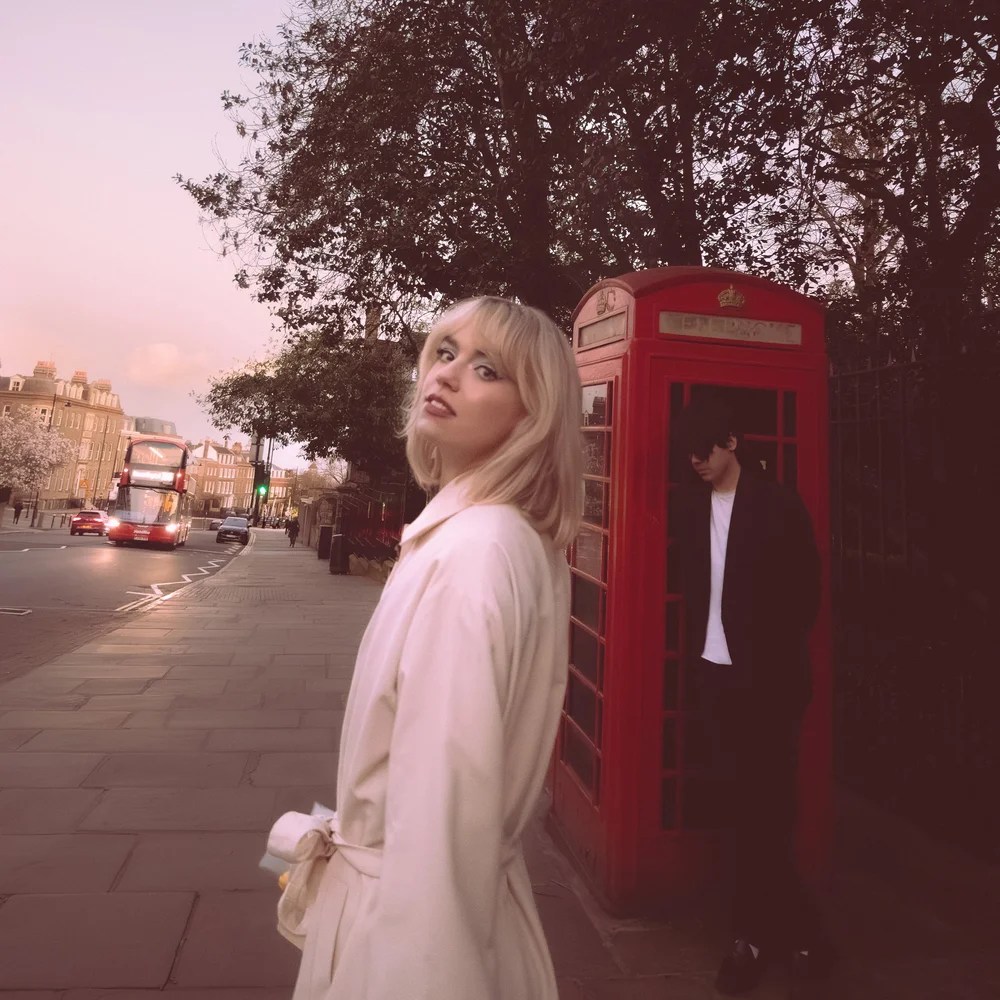
Naomi: And Bridget Jones. I see myself as a frazzled English woman. I can relate to those characters, and Charlie is a frazzled English boy.
Charlie: It’s like Hugh Grant and Julia Roberts in those ‘90s films, slightly bumbling and walking around Notting Hill or Hampstead. I feel like that’s GIFTHORSE’s character.
Naomi: It’s how I pictured boys in London for a while.
‘I see myself as a frazzled English woman, and Charlie is a frazzled English boy’
Charlie: It’s also the way those films focus on quite normal situations, but it’s very romanticised.
Naomi: Not a lot happens… Everyday things that are not necessarily romantic.
I guess it’s about finding beauty in the everyday. A lot of people who live in London take it for granted and don’t enjoy simple things like walking in a park…
Charlie: We write about what we do, like walking in Waterlow Park.
‘Please Love Me’ is also a love song to North London, isn’t it? You mention Waterlow Park in the lyrics, as well as ‘the Heath’ and Highgate Cemetery, and there’s the line: ‘Do you think of me as your English rose?’ which reminds me of the song ‘English Rose’ by The Jam…
Charlie: It’s a nod to that.
I’m also reminded of ‘Cemetry Gates’ by The Smiths…
Charlie: I used to think that song was written about Highgate Cemetery, but it’s about somewhere in Manchester. It’s that Morrissey thing of taking someone on a date to a cemetery.
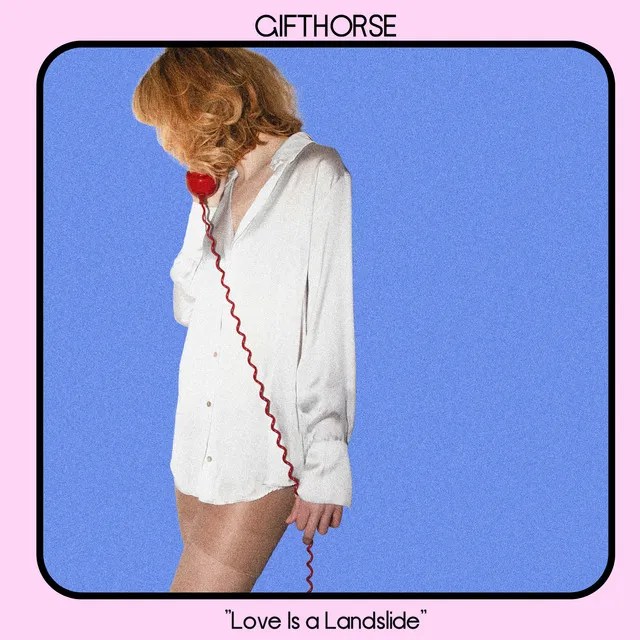
‘Love Is a Landslide’ is a song about the trials and tribulations of young love. Where did that one come from?
Charlie: Well, the title came first… We had this mad week in the summer of 2024 when it was boiling, and we lived in this tiny flat in Finchley – the heat was stifling. We’d just written ‘Please Love Me,’ which I felt was the first time we’d written a good song, and we were like, ‘Let’s just write an album…’, so we wrote 10 songs…
Are you prolific?
Naomi: We have a lot of songs.
Charlie: I don’t know if we’re prolific… I wouldn’t want to think in those terms, because if you start thinking like that, you’re gonna slow down. I just think of it as what we do – we write songs.
Naomi: We love writing new songs – we have ideas all the time and we’ll add the songs to our set. We don’t think of the way the industry works… You know… release something in a year or two years…We just like writing.
All your songs are short and sharp too, which is great…
Naomi: Nothing drags on.
So, Charlie – wasn’t ‘13 Going On 30’ inspired by your younger sister turning 18, and her thinking she was old?
Charlie: It was written around the time she turned 18 – yeah. It’s that thing when you get into your 20s – you’re 21 – and you start to feel like you’re past it, which is stupid and ridiculous. So, I was reflecting on that, and also that we’d tried a long time to write some decent songs, and we were finally starting to do it. It felt like an empowering message: ‘You’re not old, you’re in your prime. Things are here for the taking…’
I like the lines: ‘I’m scrolling through the apps / Girlfriends don’t come easy/ But I’m making other plans/Vienna waits for me!’
Charlie: That’s a nod to the Ultravox song.
Naomi: I love that song. ‘13 Going On 30’ is a reminder that there’s always time to do something – slow down, you crazy child – you can’t do everything.
Charlie: The line: ‘I’m scrolling through the apps, girlfriends don’t come easy’, was inspired by when Naomi had just moved to London.
‘It took us a long time to find our place within the musical community’
Naomi: There was an app for making friends or to go on dates… I was just imagining other people in that situation, whether they were looking for relationships or friends. There’s always time to meet the right people, but, particularly with female friendships, it can sometimes be hard to break into that. It was a reflection on that – female friendships are great, but very complicated, and it’s not really talked about that much.
Charlie: It took us a long time to find our place within the musical community as well.
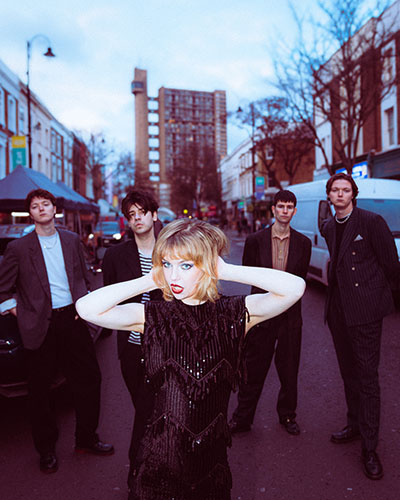
Do you think the London music scene has been very East London-centric over the past few years, but that’s now changing and there’s a North London resurgence?
Charlie: Absolutely. It’s happening with us and with bands called Gingerella and Another Day. We all sound different – they are a lot more indie-rock than us, but we all have pop song sensibilities, and the lyrics are all very English. It’s quite glamorous and aspirational. A lot of what else is going on in the city, particularly East London, is very downbeat, dour and grungy. We could never fit into that – we don’t know how to play that game.
‘Rather than just playing shows, we want to create a world and an aesthetic – we get obsessed with that’
Naomi: After playing East London gigs – sometimes we played in places where we felt overdressed – North London felt like it was the right vibe for us; we were well received and people got our style and our references. Rather than just playing shows, we want to create a world and an aesthetic – we get obsessed with that. When we do a campaign for a new single, we work with our photographer, Charlie, who helps us to create that world.
There’s a buzz around you, and your social media activity on Instagram and TikTok is great. You do it all by yourselves, and you’re unsigned. As a young band, has it been hard to get everything off the ground and get heard?
Naomi: It’s hard to be discovered.
Charlie: If you don’t have the backing of a label, then getting distribution on your side is quite difficult.
Would you like to be signed or are you happy as you are?
Charlie: I think we’re happy doing it ourselves in terms of the creative aspects, but we will need the backing eventually – ultimately, it’s the relationships that a label has: distribution, press…
Naomi: You can’t compete with someone who is on a big label.
Charlie: It’s also about trends – it can feel quite difficult if you’re not what the trend is right now.
I think that can also work in your favour, though. Sometimes people want something that’s different from everything else…
Charlie: Ultimately, to become a great band, you need to be the complete opposite of what’s happening, but to get to that point… Where we are at now is we’re in the middle ground – we haven’t cut through as being the new thing, but we’re also not what’s going on right now.
On the new EP, as well as the three singles you’ve released already, there are two other songs: ‘Silent Disco’ and ‘Stranger Baby.’
‘Silent Disco’ is a banger – an anthemic and dramatic, three-minute slice of pop heaven, with a killer chorus. It references ‘80s pop, singing ‘Like A Virgin’ at karaoke on your birthday, dancing at a silent disco, pop star dreams… It’s got it all. Where did that song come from?
Naomi: It came from going to a karaoke bar on my birthday – I sang ‘Like A Virgin’ and it felt like an iconic night. We accidentally took over the bar and people got annoyed… We were doing duets… The song is a love letter to karaoke – it’s such a great thing, as it’s the one place anyone can get up on stage and sing – and it’s a bit of a metaphor for chasing our own musical dreams. There’s a kind of theme to the EP – thinking my pop star dreams are fading…
In ‘Silent Disco’, you sing, ‘Perfect pop songs to make you cry…’
Charlie: That’s our manifesto.
So, what’s your preferred choice of karaoke song, Charlie?
Charlie: ‘Bizarre Love Triangle’ – my voice is the perfect register.
‘Stranger Baby’ is an epic and cinematic ballad with a bit of an ‘80s alt-rock feel, like Echo and the Bunnymen, as well as a touch of ‘80s synth pop, like Ultravox…
Naomi: It’s the first time we’re showing that side of our sound. It’s quieter and slower.
Charlie: It’s more emotional and dreamier. People say it’s like Joy Division. It’s an outlier in terms of the EP because the rest of the songs are more specific, but ‘Stranger Baby’ isn’t set anywhere. We were inspired by poetry books and using words and phrases. It was the first time we’d written like that.
Naomi: It was more about the musical vibe, and it’s quite melancholic.
So, finally, when was the last time you were gifted something, and if you had a horse, what would you call it?
Charlie: I was gifted a blazer by my mum because I lost mine, and, if I had a horse, I’d call him Rory.
Naomi: I would call my horse Hilton, after our keyboard player, Hilton Home, and the last gift I got was a pair of shoes I bought myself.
Perfect for wearing to karaoke bars and silent discos, no doubt…
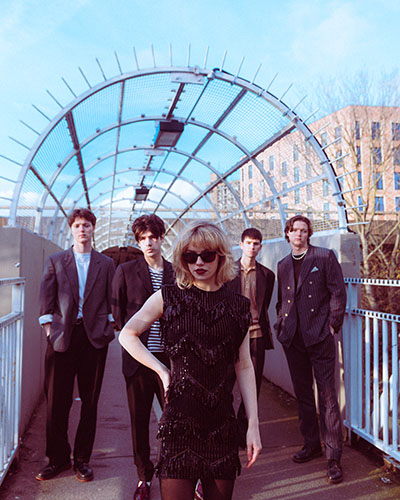
- The Queens of Highgate EP is out now on digital platforms.
www.instagram.com/thebandgifthorse/
Live Shows
21/04 – London, The Victoria (TMT Tuesdays / Money Trench Podcast)
04/06 – London, Archway Tavern (supporting Sean Trelford for Islington Radio)
10/06 – London, The Elephant’s Head, Camden – GIFTHORSE Presents “Frazzled English Summer” residency (acts TBC)
12/07 – London, The Elephant’s Head, Camden – GIFTHORSE Presents “Frazzled English Summer” residency (acts TBC)
30/07 – Kendal Calling Festival, Tim Peaks Diner Stage
04/09 – London, Islington Assembly Hall – Altered Images: Happy Birthday 40th Anniversary Tour (support)
05/09 – Bristol, Thekla – Altered Images: Happy Birthday 40th Anniversary Tour (support)
07/09 – Nottingham, Rescue Rooms – Altered Images: Happy Birthday 40th Anniversary Tour (support)
15/09 – Manchester, Band on the Wall – Altered Images: Happy Birthday 40th Anniversary Tour (support)
04/10 – Middlesbrough, Twisterella Festival