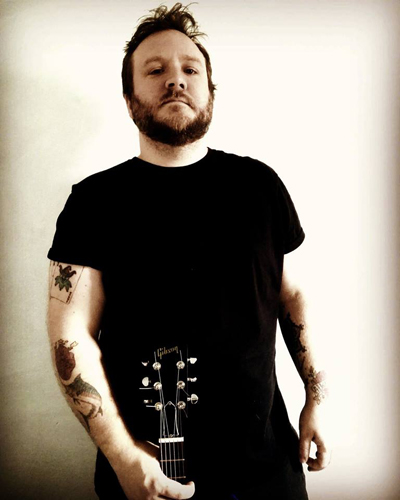
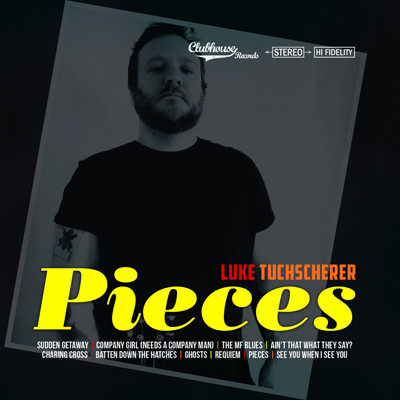
There’s a song on Pieces, the latest album by Americana singer-songwriter Luke Tuchscherer, called Batten Down The Hatches. It sums up the record perfectly – this time around, on his third – and best – solo album, Luke, former drummer with Bedford alt-country band The Whybirds, isn’t pulling any punches – he’s made an angry, heavy, often political album that rocks like Neil Young and Crazy Horse. Batten down the hatches, indeed, for it’s like a hurricane out there… There’s even a nine-minute, epic rallying call (Requiem), which attacks social injustice in the UK and comes across like Luke’s very own Rockin’ In The Free World…
It’s not all big guitar anthems, though – there are some quieter moments in the eye of the storm, like the apologetic ballad Charing Cross and the gorgeous, Springsteen-like country-rock song Ghosts, which sees Luke revisiting his childhood haunts.
In an exclusive, in-depth interview, Luke, who now lives in New York, gives me the inside story on the making of Pieces and reveals that he’s already got his next five albums planned out…
Q & A
The last time we spoke was in the summer of 2017, for the release of your second solo album Always Be True.
You told me then that you’d already got the next four albums planned – track listings and all…. So I guess Pieces, which came out earlier this year, is the first of those albums. Is everything going to plan?
Luke Tuchscherer: Yeah – it’s going well. Pieces is the first of those albums. There’s another one, which will be called Widows & Orphans, that’s already been recorded. That just features Dave Banks and me on acoustic guitars, and is a really intimate, autumnal record and, as such, will be out in October 2019.
I have recorded my acoustic guitar and vocal parts for another record, provisionally titled Salvation Come, in Maplewood, New Jersey. We’re going to be adding some violin parts soon, with a Brooklyn musician I met called Steve May, then I’ll add the drums in the spring back home [in the UK], before adding the other parts as and when, including a baritone guitar player I met here [in New York] called Chris Tarrow. Widows & Orphans should buy us a bit of time before that one comes out, but I’d imagine it would be 2020.
So, the fourth of those records would actually be another full-band Penny Dreadfuls effort, akin to Pieces, which will have to wait until I’m back home [in the UK] again…
But, on top of that, I’ll be recording a solo Neil Young Hitchhiker/early Dylan-type album in New Jersey early next year, and I’ve had a folky/bluegrass album planned for years, akin to Steve Earle’s Train a Comin’ or something, but I just need to find the players for it.
The first thing that strikes me about your latest album, Pieces, is that it’s a much heavier sound than your last two records – quite frankly, it rocks, in a Neil Young and Crazy Horse style. What was your intention with this album? It has a big sound!
LT: I’d already started moving things that way with the Shadows EP, which came out earlier this year and was mainly rockers. The reason is because I didn’t want to be pigeonholed as an acoustic artist. The first record was only that way because The Whybirds were still going, so my “electric” side was satisfied. You Get So Alone… [first solo album] was made up of songs that didn’t fit the band. But now the band is done, I wanted to get back to that rock sound.
‘I’ve actually written quite a few political songs, but they’ve never made it on to any albums before – I can see myself writing more about the wider world now, because my personal life is stable’
In 2017, you told me that classic ‘70s rock records like Bruce Springsteen’s Darkness On The Edge of Town and Tom Petty’s Damn The Torpedoes informed your last album, Always Be True. What were you listening to when you made this album? A lot of Neil Young, I guess…
LT: Neil Young has always been an influence, and for sure, it comes out the most on this album compared with my others. But for anyone who heard The Whybirds’ Cold Blue Sky, it shouldn’t be too much of a shock.
I think there’s a bit of Pearl Jam on this album, too – and in fact the Neil Young/Pearl Jam album Mirror Ball was an influence in terms of how quickly they recorded it – and the Petty stuff is still there.
Your song Requiem is a Neil Young-like protest anthem that bemoans the current state of the UK – high taxes, the challenges faced by the NHS and how the rich are getting richer and the poor are worse off… It sounds like your very own Rockin’ In The Free World, crossed with Like A Hurricane…
It’s great to hear a modern protest song. Considering the dire situation the world’s in, doesn’t it surprise you that more artists don’t write protest songs? You’re not afraid to tackle issues head-on, are you?
LT: I’ve actually written quite a few political songs, but they’ve never made it on to any albums before. The thing about them is that they tend to date quite quickly. If the NHS goes tits up, then so does Requiem – ha ha! A truly great political song, like Masters of War [by Bob Dylan] is always relevant, sadly enough. Some other reactionary songs are redundant as soon as whatever event they’re responding to is over. Requiem was written after watching the Noam Chomsky film Requiem For The American Dream and applying it to the UK.
As for other people not writing them… I dunno. Maybe they’re wimps. Maybe they don’t care. Maybe they just don’t like political music. Personally, I can see myself writing more about the wider world now – though not strictly protest songs – because my personal life is stable. It’s kind of weird singing old break-up songs when I’m happily married, whereas I can see myself still feeling the things in Sudden Getaway or Ain’t That What They Say? in the future.
The first four tracks on the album don’t mess around – they rock out. Things don’t calm down until we’re halfway through, with the song Charing Cross. It’s quite an angry album in places, too. What frame of mind where you in when you wrote the songs and recorded them? Requiem, The MF Blues and Company Girl are angry songs – the latter is very vicious. It’s a put-down song. What inspired it? It sounds like a dig at the music industry…
LT: The only songs that were written shortly before recording were Requiem and Ghosts, but, because I have such a big backlog of songs, I basically choose the best batch to make a cohesive album, along with any new stuff I’ve got that fits. It’ll probably take me to the mid-2020s to clear my backlog! The MF Blues was pretty old, probably 2007, but it fitted the theme of the record.
Company Girl was probably written in 2012 or so. And yeah, it’s angry. It’s about a lot of people, not just one, and they don’t have to be female at all… It’s just I was writing from the ‘company man’ perspective, so it made sense for the other part to be female, but it could’ve been Company Boy easily enough.
‘I have such a big backlog of songs – it will probably take me to the mid-2020s to clear it!’
I guess it’s a bit high horsey, but it’s a dig at the people who aren’t really artists – they’re just after fame. The kind of people who don’t love “Americana” or whatever, and would happily do an RnB album if they thought it would make them more successful. I won’t name names, but they’re not hard to spot. But they’re all doing better than me, so, what do I know?
Let’s talk about the recording sessions for Pieces… How was it making the album? You recorded the seven ‘rock’ songs live in one day, with a band – in June 2017, at The Music Centre, in Bedford. That must’ve been a long day? Talk me through it…
LT: I had limited time before I moved to New York to get the album done. We knew the move was coming, so I wanted to maximise my minutes, so to speak. Between April and September 2017, we recorded Pieces, Widows & Orphans and my hard rock side-project Herd Behaviour’s debut, which is called Animal Habitual, and I played drums on David Banks’ forthcoming solo debut. All were recorded by Chris Corney.
I don’t remember it being a long, or even particularly stressful, day. We’d rehearsed the songs in the weeks leading up to the date – with me on drums, Dave on guitar and Simon Wilson on bass. We set up the night before to get all that out of the way. Then we went in and did it.

Requiem was one take – we didn’t complete a second one. Sudden Getaway was like second take or something. It was all easy as I recall. I think Batten Down The Hatches was the only one that was a slight struggle, but even then it wasn’t too hard. Dave’s an amazing guitarist – every single note he plays on those seven rockers is live – Simon’s a great bassist, and I’m more comfortable behind the kit than anywhere, apart from singing, I suppose.
Then I added my guitars, vocals and percussion in a couple of additional sessions. Chris did almost all the harmonies and did a great job on the vocal arrangements, and Tom Collison added his keys from his home studio – I’d already moved by that time. Done!
When we last spoke, you were gearing up to move to New York. Does the opening song on the album, Sudden Getaway, reference that?
LT: Sudden Getaway was written in 2015, I think, maybe 2014, when NYC wasn’t even on the horizon. It’s really about an existential crisis, I guess. About struggling to be happy with your lot and wondering when that struggle might end.
Why did you move to New York and how is it working out?
LT: Essentially my day job got us to NYC, but I’d never have gone if the band was still going. But once the writing was on the wall with The Whybirds, I felt like I’d given up all of my twenties to the band and had nothing to show for it.
All my holidays were used up touring and recording, as were my weekends and a lot of my evenings. And I felt like I’d never really done anything for myself, or – since I was married by then – for my wife and I as a couple.
A lot of people asked if the New York thing was a music career move, but it was the complete opposite. It was to do something that wasn’t music-related, so I could feel like I’d actually done something with my life. That sounds pretty negative, but if you listen to Waiting For My Day to Come or Outside, Looking In on Always Be True, you can tell that I wasn’t very happy with music anyway! That said, See You When I See You is a fond look back at the ‘birds days, with just a tinge of regret that things didn’t turn out better.
‘A lot of people asked if the New York thing was a music career move, but it was the complete opposite. It was to do something that wasn’t music-related, so I could feel like I’d actually done something with my life’
I was basically working two full-time jobs and it was slowly eroding my passion for music. Since moving to New York, it’s been like starting at the bottom again, and the gigs have been half good and half soul suckers. But it’s made me miss playing music just for the fun of it, and that’s just about the most positive thing that could’ve happened. When I went back [to the UK] for the Pieces gigs in the summer, they were the best and most fun solo shows I’ve ever played. Bar none. I’m already massively excited about coming back next year and firing up the Penny Dreadfuls again.
Let’s talk about one of the ballads on the album – Charing Cross. It’s a sad song – an apology to a loved one. Demons and drink are involved. What’s the story behind it? Is it set in Charing Cross? Surely that must be a first for a song…
LT: Yeah, that was an old song – 2010. It was written after a night at The Borderline, which is obviously just off Charing Cross Road. Anyway… I’d had my wallet and phone stolen, I was in a terrible mood, I got very drunk and I was an arsehole. The song was the apology. I can’t actually remember what the original chorus line was, but it was more positive, as the relationship lasted a few months more. But since that particular relationship is long gone, I turned the lyric into “I know I’ve really blown it now”, to make the song make sense on its own, and give it some finality.
Ghosts is another quieter moment on the record – a gorgeous country-rock song about going back to where you grew up. What can you tell me about that song?
LT: That’s probably my favourite on the album and one of my best ever songs lyrically. It was inspired by something quite personal that I won’t go into, but, hopefully, it was written in a fairly universal way, so that people can get their own meanings from it.
What music are you currently listening to – new and old? Any recommendations?
LT: Even though I was a year late to it, I can’t get enough of Phoebe Bridgers’ Stranger in the Alps. It’s one of the best albums I’ve ever heard, let alone recently. Again, I was late to the party, but I finally watched The Devil and Daniel Johnston and I find his stuff pretty addictive. The latest Mudhoney album, Digital Garbage, is really good, too. I discovered a band on Spotify called Arliss Nancy, who have broken up now, I think, but I thought they had some good stuff.
So, finally, what’s next for you? There are all those albums to get out…
LT: I’d expect something like this:
2019: Widows & Orphans – stripped back acoustic album akin to Time (The Revelator) [by Gillian Welch].
2020: Salvation Come (Country-ish Southern Gothic album, with fiddle as the lead instrument.
2022: Luke Tuchscherer & The Penny Dreadfuls – another rock effort.
2023: Carousel – completely solo “session” album.
20??: Untitled folk/bluegrass album.
But I’m back for a solo show at the Green Note in London on April 11, then I’ve got full-band shows in Leicester, Bedford and London on July 18, 19 and 20, respectively. There’s also a European festival, but I don’t know if I can announce that yet, but I’m super-excited about that!
Pieces by Luke Tuchscherer is out now on Clubhouse Records. For more information, go to: https://www.luketuchscherer.co.uk/


 Say It With Garage Flowers