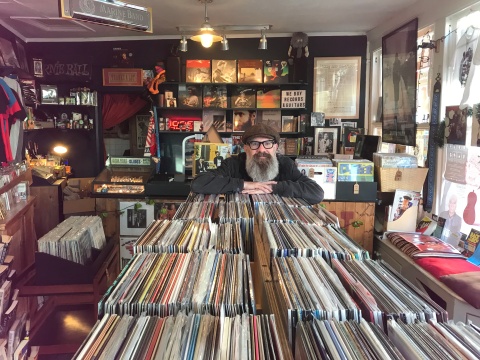
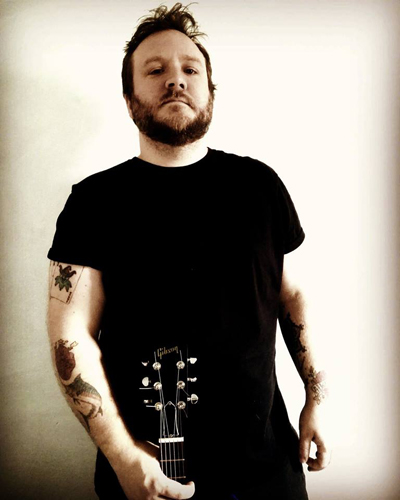
Canadian singer-songwriter Jerry Leger’s brilliant Nonsense and Heartache – out now on Latent Recordings and produced by Michael Timmins of Cowboy Junkies – is a double album, but, essentially it’s two distinct collections of songs.
The first half – Nonsense – is a raw, primal, bluesy, electric rock ‘n’ roll record, while the second instalment – Heartache – is a stripped-down, alt-country affair, with intimate ballads, lap steel, piano and fiddle.
Put them together and you have an album that reminds me of those classic early Ryan Adams long-players Heartbreaker and Gold – yep, it’s that good.
I spoke to Jerry, who with his band, The Situation, is on a tour of Europe and the UK, to find out why he decided to release a double album and to gauge if his current mood is nonsense, or heartache…
Jerry Leger: photo credit – LPPhotographs
Q &A
Nonsense and Heartache is a double album of 18 tracks, which is quite a brave move, isn’t it? You don’t hear of many double albums being released these days…
Jerry Leger: Yeah, it’s usually the artist who fights for a double LP, not the label, but, in this case, it was Mike Timmins and Latent who suggested it.
I dug that and I had more than enough songs and we had a bit of a concept behind it. I think it was a cool move, I mean why not? It seems these days a lot of people are gonna listen to it, or they’re not, whether there’s two or 200 songs. A lot gets lost – I just wanna make albums I like while I’m here.
How were the recording sessions for the album? Was it an easy or a difficult album to make? Did you have a lot of songs written before you went into the studio?
JL: They were easy – we all knew what we were there to do. Heartache was recorded first – that took about four or five days. Nonsense was recorded four or five months later – I think that took two days. I can’t quite remember how many songs I had lying around, but we recorded about 29 and chose 18.
‘I just wanna make albums I like while I’m here’
The album has a raw, live sound – Michael Timmins , who produced, recorded and mixed it, alsoworked on my favourite album of last year –John Murry’s A Short History of Decay, which is another raw, live-sounding record. How do Michael and you and your band manage to get that feel and sound in the studio? What’s your working relationship with Michael like?
JL: We just play live together in the studio. I also try to keep all the live vocals, but sometimes it’s not possible. There may be technical issues, or, if the band were cookin’ and I flubbed something that I really wanted to fix instead of leave in. Sometimes we just leave it in, though. Mike and I have a great working relationship – we like making the same kind of albums and we also like a lot of the same albums. He doesn’t get in my way creatively and when he makes a suggestion in the studio, it’s usually the right one. I respect what he does and what he has to say
One of my favourite songs on the Nonsense side of the album is Baby’s Got A Rare Gun – I think it channels ’65/’66 Dylan. Do you agree? It’s heavy, electric blues. What can you tell me about that track?
JL: Well, I love Chess Records – stuff like Muddy Waters, Little Walter and Howlin’ Wolf. I think it came from that sort of place, but, of course, I love Dylan, too, and that period is ingrained. When we recorded it, I wanted to get that over-driven vocal and band sound that’s on those records and early Bobby Bland.
The Big Smoke Blues – another of my favourite tracks on Nonsense – has a bit of a New Wave feel to it. It reminds me of Ryan Adams fronting The Strokes. Is that a fair comment?
JL: That’s fair, but I’d say it’s more Lou Reed and The Velvets rock ‘n’ roll, just ‘cos I listen to and love those records. I did really like the first Strokes album when it came out. I was 14 or 15 and thought they were here to save the day! I never really followed their career after, though. TheBig Smoke Blues is a reference to Toronto, but it could be a lot of different places for the listener. It’s a tune for outsiders.
‘I really liked the first Strokes album when it came out. I was 14 or 15 and thought they were here to save the day!’
Let’s flip the record over and talk about the Heartache side. It kicks off with the first single, Things Are Changing Round Here, which sounds like a classic country-rock song. What inspired that track?
JL: The East End of Toronto, where I grew up, was the initial inspiration. I’m only 32 and the area I grew up in is a strange land to me now. A lot of the personality is being sucked out of it – they’re knocking down blocks of old homes to build up to the sky. The unique shops and bars that can’t make the inflated rent are being replaced by boring chains.
Another Dead Radio Star – I love that title – is one of my favourite songs on the album. What’s the story behind it? I’ve heard that it was inspired by the 1930s radio show The Shadow, which was voiced by Orson Welles…
JL: I was listening to a compilation of radio stars from the ‘30s. The song I’d Give A Million Tomorrows (For Just One Yesterday) was playing and it sparked the idea – it’s referenced in the song. I also had another record of old radio shows by The Coon-Sanders Nighthawks of Kansas City, so they got a plug.
Things come and go, but their shadows remain in one way or another, and I’m the kind of person that looks for them. My dad used to listen to The Shadow, The Creaking Door and others as a boy and that has always stayed with him. It’s theatre of the mind.
The last song on the album, Pawn Shop Piano, is a great way to close the record – a gorgeous piano ballad. Was it written and played on a pawn shop piano?
JL: Some of the lines and ideas I’d written down before, or had floating in my head just waiting to be used. The first time we toured in the States we stayed at a dingy motel called the Travel Lite Inn, or something like that… I just liked the way it sounded and we survived.
We played Johnson City in Tennessee a couple of times and I remember this pawn shop called Diamonds and Guns and it had this great hand-painted sign, too. I jotted that title down in a notebook and figured I’d use it for something some day. It’s one of my favourites on the record and it just has a lot of truth in it for me.
Who are your main musical influences?
JL: There’s a lot, but Hank Williams I’ve heard for as long as I can remember and I just don’t think it gets better than that. Bob Dylan changed the way I wanted to write, Lennon and The Beatles made me wanna start playing, and Lightnin’ Hopkins was the coolest. When I was 13, my grandparents’ neighbour was giving away blues records. I just thought Lightnin’ looked cool – I hadn’t heard of him. When I listened to it, it was just wild – so natural, no bullshit. Leonard Cohen was also an early influence – my dad came home one day and gave me the first Cohen album and a book of poetry called Death of a Ladies’ Man.
‘My dad came home one day and gave me the first Leonard Cohen album and a book of poetry called Death of a Ladies’ Man’
Jerry Leger & The Situation: photo credit – LPPhotographs
You’re heading out on a European and UK tour. What can we expect?
JL: I’m really looking forward to it – it’ll be my first time overseas in general. They’re all full-band shows and this line-up has been together for over 11 years, so it’s nice to do this together for the first time. What can you expect? I don’t know – I’ll just be singing my songs. I’m not ready to do anything flashy yet.
What music – new and old – are you currently digging?
JL: Lucinda Williams – Down Where The Spirit Meets The Bone; Ronnie Lane – See Me; Graham Nicholas – Dial Tones And Pretty Notes, and Ann Peebles – I Can’t Stand The Rain.
If I’m home I listen to a lot of music – the first thing I do when I wake up is put a record on. I don’t love silence.
So, what next? Can we expect a triple album?
JL: Why stop there?
Finally, what kind of mood are you currently in: Nonsense or Heartache?
JL: I’m in a Nonsense and Heartache selling mood.
Nonsense and Heartacheby Jerry Leger is out now on Latent Recordings. For a full list of European and UK tour dates, go to https://jerryleger.com/
John Howard at Sala Apolo in Barcelona: photo : Eva Fraile
Singer-songwriter John Howard – who turns 65 this year – is publishing his autobiography, Incidents Crowded With Life, has his 1975 debut album, Kid In A Big World, being re-issued on vinyl, along with a collection of ‘70s rarities, and is planning a new album this summer.
Earlier this year, he put out a five-track EP, Songs From The Morning, on which he paid tribute to some of his favourite songs by ‘60s and ’70s artists, including Nick Drake, Tim Buckley and Sandy Denny.
In an exclusive interview, he tells me why he’s looking forward to becoming a pensioner and why recording music keeps him young and agile…
Q & A
Your latest release, Songs From The Morning, is a five-track EP, which features your versions of songs by artists that you admired when you were growing up. The tracks are Morning, Please Don’t Come (Tom Springfield), You Get Brighter (Mike Heron), The Lady (Sandy Denny), Morning Glory (Tim Buckley/Larry Beckett) and From The Morning (Nick Drake).
Can you tell me why those songs inspired you so much? What do you like about them and what memories do they bring back?
John Howard: They all bring back different recollections really, and all inspired me for different reasons. You Get Brighter, written by Mike Heron, was the first song I saw The Incredible String Band perform in Manchester in late ’69 – when I was 16 – at The Free Trade Hall. It was the first concert I’d ever been to. The song completely hooked me as soon as Mike sat at the piano and began singing it, and has always stayed with me. I’d been planning to record it for years.
From The Morning by Nick Drake blew me away the first time I heard it, on his final album, Pink Moon. Nick’s version features just him and his guitar, as does that entire album, but I always felt it was a great pop song that would suit a full backing. Some people refer to Nick as a ‘folk singer’, which is not entirely untrue, but he was also a great writer of hook-laden pop songs.
The truly uplifting lyric of From The Morning, written when Nick was at his lowest ebb, touches me deeply. What spirit that boy had. I tried to capture that innate, feel-good vibe of the lyric – Nick’s sense of wonder at everything in nature around him – with my interpretation.
‘Some people refer to Nick Drake as a ‘folk singer’, which is not entirely untrue, but he was also a great writer of hook-laden pop songs’
Sandy Denny’s The Lady impressed me when I heard it on a friend’s LP in 1972, but when I got a CD box-set by Sandy, a live version was on there and I loved that even more. Her introductory comment to her audience that “this song has a lot of chords” made me smile. She wrote it, and yet it daunted her. It’s the perfect pianist’s song, having as it does some very strange chord changes and progressions.
Morning, Please Don’t Come was a 1970 single by Dusty & Tom Springfield, which I heard on the radio at the time. I thought it was truly lovely, displaying Tom’s great songwriting skills, but by then the pop scene in the UK had radically changed and artists like Dusty, Cilla, Lulu and Sandie Shaw, who’d been so huge in the ‘60s, seemed to have lost their market.
I heard the song again only a couple of years ago, when DJ Rodney Collins played it on his weekly show – on ABC Oldies – and that inspired me to have a go at recording my own version.
I actually met Tom Springfield in 1975, at his flat, with a friend of mine who knew him quite well. It’s a visit he would want to delete from his memory I would imagine as, in ’75 – ’76, I was going through a heavy drinking period and behaved appallingly, like a really ranty queen, which makes me cringe now when I think about it. Tom very quietly asked my friend to take me home, which he did. If anyone who knows Tom reads this, please convey my abject apologies! Mea culpa!
The Tim Buckley song Morning Glory is on an LP I’ve had for years, Goodbye and Hello, and its lyric has always intrigued me. I’m still not sure what it’s about – and even the lyric writer, Larry Beckett, couldn’t fully explain its meaning in an interview a few years ago.
I interpret it as about the way some people can’t settle anywhere – they always have to be on the move, like a hobo, going from ‘fleeting house’ to ‘fleeting house’. I’m probably wrong but that interpretation does for me. It’s a wonderful song, whatever it’s about…
How did you approach the songs on the EP? What did you want to do with them? Is it hard to strike a balance between being respectful to the originals and also wanting to put your own stamp on them?
JH: Yes – that’s always a slight dilemma when recording other people’s songs, especially songs that are rooted deeply in many people’s minds and hearts by the original writers. I treat any recording the same way – I routine it on the piano until it starts to take shape, and then ideas begin pouring into my head for arrangements, vocal approaches and harmonies.
It’s never clear what I want from a song – whether it’s one of mine or someone else’s – until I begin the process of getting to know it really well, playing it many times until it feels like it’s reached the point of initial completion, before I start to build up the backings in my studio. I always sing a song in my own way, never trying to imitate or copy the original versions.
You actually can’t be too respectful when covering songs, or else you’d be slightly frightened of them, so you have to believe what you’re doing is working as a track. Once you’re in the studio, it’s no longer the song, it’s the recording you’re working on, getting the best out of a track that you can. What came before is what came before. You can only do what works for you now.
‘I always sing a song in my own way, never trying to imitate or copy the original versions’
How was it recording the EP? How did you play, arrange and record the songs?
JH: As all the songs were already very dear to me, I felt extremely close to them, like old friends. And, of course, as I record usually on my own, I can change things as I go along and try other things quite easily, I often spend weeks on a track, living with it for a while, then going back into the studio and either building on what I’ve done, or starting again from scratch. Happily, it’s the former usually…
Let’s talk about Nick Drake – one of my favourite singer-songwriters. A lot of people only discovered Nick’s music years after his death, which was in 1974 – a year before your debut album, Kid In A Big World, came out. Were you a fan of Nick’s during his lifetime? Isn’t it such a shame that he only got the recognition for his talent after he’d died? Why do you think that’s the case?
JH: I was aware of Nick’s music when I was at art college, as people played his stuff – certainly his first two albums – in the common room, and I liked what I heard. Back then he reminded me a little of Colin Blunstone [The Zombies] vocally.
‘I remember seeing Five Leaves Left in Javelin Records in Bury, pondered over whether to buy it, but then plumped for Joni Mitchell’s Clouds’
I never bought any of Nick’s releases, as funds were obviously limited at that time, and with the money I had, I was buying albums by my current heroes Roy Harper, The Incredible String Band, Laura Nyro, Joni Mitchell and – belatedly – Dylan.
I remember seeing Five Leaves Left [by Nick Drake] in Javelin Records in Bury, pondered over whether to buy it, but then plumped for Joni’s Clouds instead, which my school friend Pauline had played me a few nights earlier.
I think that was Nick’s mainproblem – when his albums had just been released, in terms of gettinghis music across to people, you never heard him on the radio – or at least I didn’t. He didn’t perform live – again, if he did, I wasn’t aware of it – and I’ve since read he hated doing live performances. If I wanted to hear his albums they were usually lying in a pile beside the common room record player. The artists I spent my money on were those I’d seen and loved on stage, heard on the radio or watched on things like the In Concert TV series.
In the ‘80s, I think it was, I bought the four-CD set of Nick’s albums and outtakes and fell in love with him. What a talent and what a waste of a talent – to lose him so young. His songs really touched me and still do. When you read his life story – his sister Gabrielle’s biography of him [Remembered For A While] is superb – you realise what a fascinating guy he was.
I loved how he performed impromptu for The Rolling Stones in Tangiers in the late ‘60s, and he was a huge fan of Donovan’s – when Mr Leitch was no longer very cool to Nick’s mates. He’d been a really happy ambitious lad until the ‘black dog’, as he called it, came to rest on his young shoulders. Very sad.
His music has now benefitted from social media spreading the word among a wide, record buying-public, and is happily now loved by a large slice of lovers of good music. Good songs will out. Talent will out. I believe that. Sadly, we can never predict how long that will take…
I mentioned your ’75 debut album, Kid In A Big World, earlier. It’s being re-released on vinyl soon, isn’t it? How do you feel about that and how’s it come about? There’s also an album of John Howard rarities – from’73-‘79 – coming out, too, isn’t there? What can we expect?
JH: Yes! You Are The Cosmos, a great and highly-respected Spanish label, run by Pedro Vizcaino, is releasing Kid In A Big World and The Hidden Beauty – a new compilation of demos, outtakes and singles from my ‘70s back catalogue, both on LP. I’m, to say the least, thrilled. For many years people have been asking me if Kid… would ever be re-released on vinyl, and at last I can reply, “Yes, it is.”
Pedro contacted me last year about releasing Kid… on LP and then he suggested an additional vinyl album of some of the demos and stuff I’d recorded from ’73 – ’79. The LPs look really great – Pedro and his designer have done a stellar job.
‘For many years people have been asking me if Kid In A Big World would ever be re-released on vinyl, and at last I can reply, “Yes, it is”.’
The Hidden Beauty is a very interesting compilation, with some fascinating tracks on there – recordings that, in most cases, have never been available on vinyl before. There’s a Trevor Horn production from 1977 called Stay, which has never had a proper release (apart from online about 10 years ago) – it was the first track I recorded with Trevor and features a storming guitar solo by Bruce Woolley.
There are some of the demos I recorded in 1973, when I arrived in London, at Chappell’s studios in Hanover Square. There are also some late ‘70s demos, too – a song called Loving You, which I demoed in 1979, and which gets regularly downloaded, so that’s a great inclusion on the LP. Also, there are a couple of tracks I did with Trevor Horn in 1978 – Don’t Shine Your Light and Baby Go Now, which were released on a double A-side single in late ’79. Those two tracks feature the musicians who a year or so later formed Buggles and then The Art Of Noise (Geoff Downes, Luis and Linda Jardim, Anne Dudley, and, of course, Trevor).
Bruce Woolley is also on those two tracks, doing backing vocals with Linda.He co-wrote Video Killed The Radio Star with Trevor in 1979, and was signed to CBS when I returned to the label in 1980.
Kid… will have the original LP artwork, even including the same lyric sheet that came with the 1975 album. Pedro has done an amazing job – he’s showed a lot of love and respect for the recordings and that’s very nice to see.
John Howard in Vienna – photo: Georg Cizek-Graf
It’s a busy time for you. … You’re working on your new album – your eighteenth – which will be out this summer, and you’re already working on the album after that! You’re very prolific. What’s your secret?
JH:Ha! If I knew the secret I’d probably stop doing it. I have no idea why I am still so prolific. Songs simply arrive out of the ether into my head and I write down loads of sketched notes and ideas until I’m ready to start recording. The fact is I love recording. I love the whole process, and working as I usually do on my own, I have all the time in the world to work on ideas and try things out, with no pressure from anyone.
‘I have no idea why I am still so prolific. Songs simply arrive out of the ether into my head and I write down loads of sketched notes and ideas until I’m ready to start recording’
I’m not sure yet who will release the new album. If I can’t find a label to put it out, I’ll do a self-release. I did several self-releases – 2009 – 2014 – before the John Howard & The Night Mail album came out on Tapete. Self-released albums don’t get the same exposure, of course, but at least they’re out there if people want to find them. I’ll keep putting stuff out while people want to hear it and – bless them forever – buy it.
A label release would be lovely, there’s no doubt about that, but it’s not always easy to get deals with new material, which is by its very nature, and lack of history or a back story, not as immediate or immediately recognisable as a back catalogue release. I was very happy with how my last studio album, Across The Door Sill, was received. I can only hope this new one will also appeal. But about that I can do nothing. Only hope!
So what can we expect the new album to sound like? How’s it going?
JH: The new album was completed about two weeks ago. It contains ten new songs, and is probably more instantly ‘accessible’ than the stream-of-consciousness material on Across The Door Sill, in that the songs are basically pop songs (i.e. with a verse/chorus structure in most cases), but of course done in the John Howard pop way.
People who’ve heard the tracks in progress so far – friends like Kenji Kitahama from Friedrich Sunlight, Robert Rotifer,Ian Button – who will be mastering the album – and my ‘70s producer Paul Phillips – have all commented how I seem to have a new sound with these tracks, a ‘new palette’ as Paul put it recently. I don’t really – I just use what I have in my studio [in Spain] in different ways, putting together different combinations of instruments and percussion.
I record everything in real time, using real instruments wherever I can – obviously I don’t have an orchestra standing by in my tiny casita! I play everything – the drums, the percussion, the guitars, accordion, and keyboards, but as I’m not a guitarist, or a drummer, it takes me weeks to do just one track, slowly building up sounds. But I love this acoustic way of recording. It’s as old school as it can be using a digital recording set-up – a 15-year-old Yamaha AW16G workstation – and I mixeverything in real time, too.
‘I record everything in real time, using real instruments wherever I can – obviously I don’t have an orchestra standing by in my tiny casita!’
If a mix isn’t quite right, I scrap it and start again, I don’t ‘save’ mixes and just tweak things – it’s always instinctive and quite intense, often going to 12 or 13 mixes before I feel it’s right. It’s obviously very time-consuming – ask my husband, Neil, who hardly sees me when I’m in the middle of recording – but I love it and still look forward to trotting across our courtyard and opening the casita door. I say ‘hello’ to all the instruments and pieces of percussion sitting on various shelves, and begin the process of starting work on a new track, selecting this and that, trying them out, deciding what works and what doesn’t on that particular song. It’s a delight that I can still do it, still love doing it, and that people seem to like the results.
You’ve written your autobiography, too. It’s called Incidents Crowded With Life. When’s it coming out? How was it to write and should anyone be worried? Is there any scandal?
JH: Oooh! Scandal, such a scandal! I don’t think anyone needs to be particularly concerned by Incidents Crowded With Life. My approach throughout the book – which covers my life from childhood to 1976 – was that I would tell things as I saw it and experienced it. I never write about hearsay or situations from anyone else’s points of view. I also don’t comment. That’s for the reader to do as the stories unfold. So I haven’t said things like “What a bastard!” about anyone, I’ve just told what happened and leave the reader to decide what they think.
‘My approach throughout the book – which covers my life from childhood to 1976 – was that I would tell things as I saw it and experienced it. I never write about hearsay’
The book basically covers my life working towards and preparing for what became the recording and release of Kid In A Big World, the build up to it, and the aftermath of its failure to make an impact, up to when I broke my back in an accident at home in late ’76, just as things seemed to be indicating a turnaround for the better.
The only chapter that is constructed as a third-party observation is where I discuss glam rock, its stars, and their career paths and how their music affected and inspired me. I wasn’t sure whether an autobiography needed such a chapter, but I decided that, as glam made such an impact on me and my music, then I should talk about that. It truly changed the way I wrote songs from ’71 – ’73, and how I saw myself in the scheme of things.
The book is due out in the spring, published by Fisher King. I’m pleasantly surprised that the book has found a publisher, to be honest. I never expected that, as I never considered myself well known enough to warrant a publishing deal. I’d been posting it online, chapter-by-chapter, for about 18 months when a friend suggested I should get it published in book form. My reply was “How?” and he duly sent the online links to the managing director of Fisher King, and the rest is my history in print! How fabulous is that? Will there be a second book? Well, I’ve just begun writing it, so we’ll see…
John Howard in Vienna – photo: Robert Lettner
This year, you turn 65 and you’re showing no sign of slowing down – you’re busier than ever! How does it feel becoming a pensioner?
JH: My husband is thrilled that I’m finally going to be bringing in some proper money! Being a ‘niche recording artist’ means I earn very little from my music, so that monthly cheque from April onwards will be extremely welcome.
I’ll continue to stay as busy as I want to be. As long as my voice holds up – and it seems to have done so far – I’ll carry on recording. I’m physically aware that I’m older, I get tired more quickly, the usual 60-years-plus aches and pains are quite bad some days – due, in part, to my injuries in ‘76 of course – but when I’m recording, I feel extremely young and agile, especially vocally. I can probably sing better now than I did in my 20s. The higher range is not so stratospheric as it once was, but my lower range is much richer now. People tell me I sound very young when I sing, and that’s because I feel young when I sing.
‘I feel extremely young and agile, especially vocally. I can probably sing better now than I did in my 20s’
Do you still have many musical ambitions left? Are there any songs by other people that you’d like to record, or anyone that you’d like to collaborate with?
JH: Ambitions? I don’t really have any. Back in my teens, of course, with the arrogance of youth, I was convinced I’d be an international superstar by the time I was 21! That didn’t happen of course, and the realisation that things are not that easy was a big part of my ‘Further Education In Life’ from thereon in. But now, I have no expectations, no ambitions, I just enjoy what I do. Most things tend to happen while I’m busy doing other things.
Kid… was reissued on CD in 2003 because people were discussing it on the internet, which piqued RPM and Cherry Red’s interest. The John Howard & the Night Mail album happened because Robert Rotifer encouraged me to start performing in public again and have a think about us doing something in the studio together.
John Howard & The Night Mail
Across The Door Sill was issued by Occultation because Nick Halliwell told me he thought it deserved to be out on LP and that he’d like to release it. Kid… is being re-released on vinyl because Pedro contacted me to say he would like to do it, and the autobiography is being published because a friend sent it to a book publisher. I’m very lucky that people seem to want to encourage me to do things. They – God bless ‘em – want to spread the word about my music and writing.
Robert Rotifer and I sometimes talk about recording another Night Mail album with Ian Button and Andy Lewis, and I’d love to, but getting us all together at the same time is the difficult bit!
‘I’m very lucky that people seem to want to encourage me to do things. They – God bless ‘em – want to spread the word about my music and writing’
I did contribute backing vocals and piano to The Granite Shore album, Suspended Second, last year, which was fun, and I’ve also contributed piano to other friends’ projects over the last few years – Papernut Cambridge’s Nutlets, Alex Highton’s Nobody Know Anything, Darren Hayman’s Secondary Modern, and Anthony Reynolds’ British Ballads. That’s always a nice thing to do, especially when you hear the finished tracks and go “Oooh! That’s me on that one!”
I’m sure there’ll be more EPs featuring covers of other people’s songs. I quite fancy doing an EP of Rufus Wainwright songs – and even a Marc Bolan EP – gosh! That would be fun. We’ll see…
Finally, what music – new and old – are you enjoying at the moment?
JH: I’m very into Judee Sill – I have been for months. I loved what she did back when I was a teenager in the ‘70s – Jesus Was A Crossmaker was a particular favourite when I was at college, but recently I’ve been given her lovely CD set by a friend and it’s gorgeous. What a superb songwriter and singer she was.
I still play Roy Harper’s astonishing Stormcock album – it still sends shivers down my spine. I recently bought the new version of Sgt Pepper… it’s very good. Giles Martin’s done a great job – he’s really brought the tracks to life again – though, note to Giles, Being For The Benefit of Mr Kite is far too loud compared to the other tracks. What’s that about then?
New stuff? Well, there’s a wonderful singer songwriter on You Are The Cosmos called Daniel McGeever – his album, Cross The Water, is one I play a lot. Excellent songs.
Daniel Wylie’s latest, Scenery For Dreamers, is fab, too, Ralegh Long’s Upwards of Summer is very uplifting guitar pop for the 21st century, and Alex Highton’s newie,Welcome To Happiness, is a synthesiser-fest of loveliness.
• John Howard’s Songs From The Morning EP is available to download from iTunes, Amazon, eMusic, etc, and to stream on Spotify, Apple Music and Rhapsody.
Kid In A Big World and The Hidden Beauty – 1973-1979 will be released on vinyl by You Are The Cosmos on April 20: visit http://www.youarethecosmos.com/ for more details.