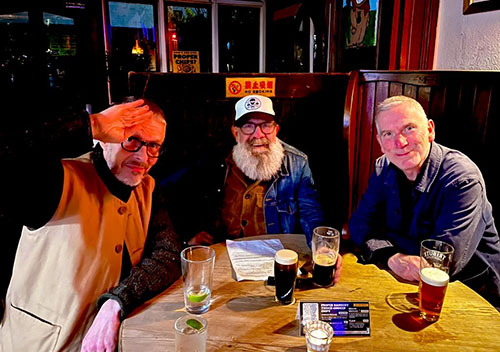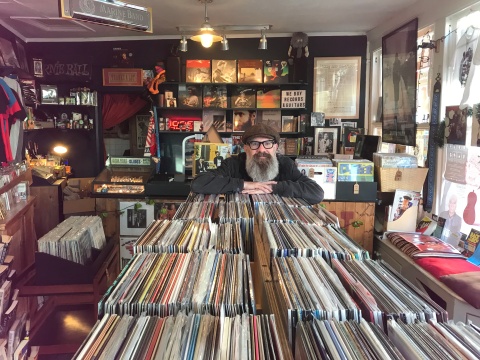
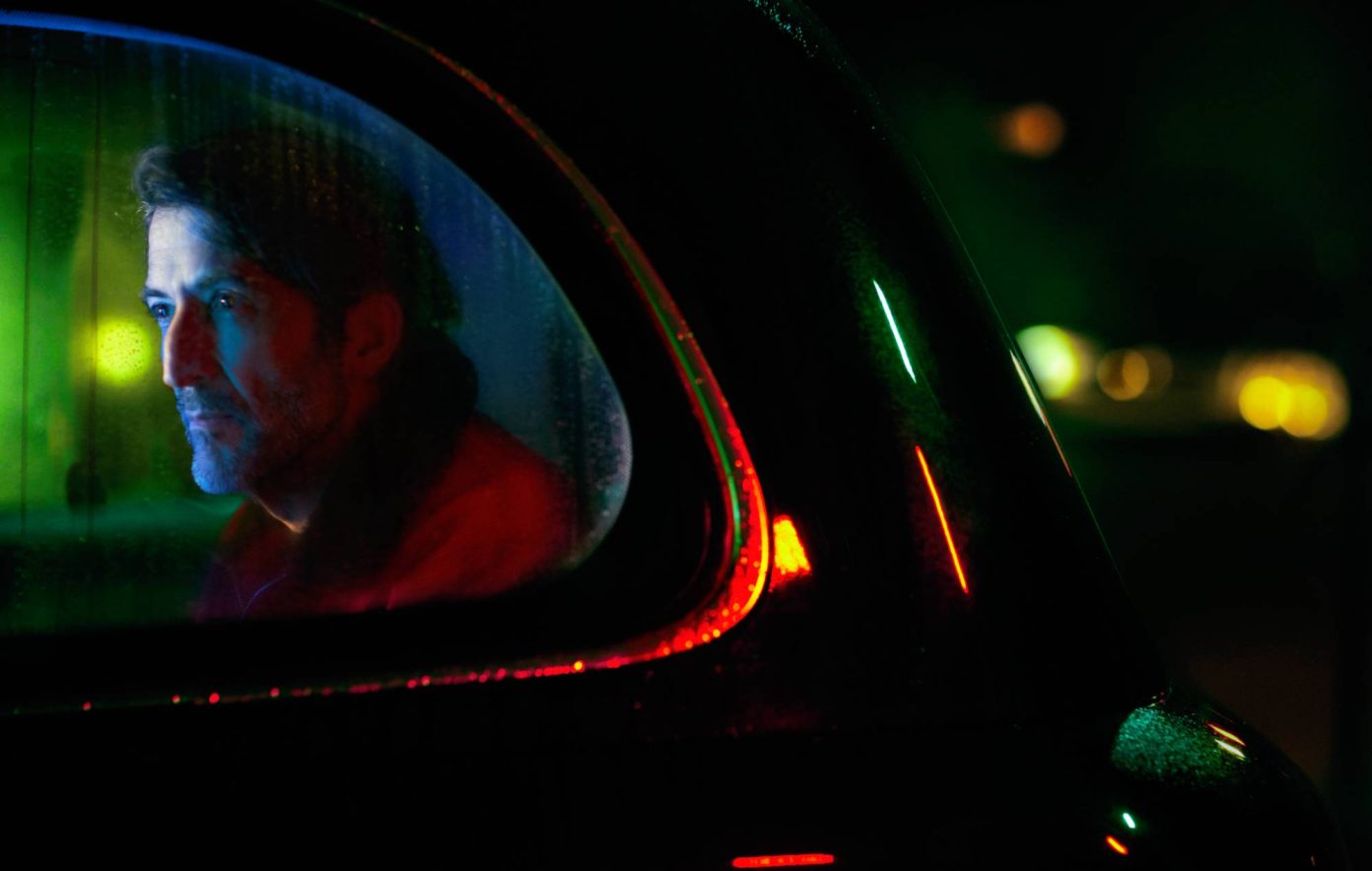
‘I wasn’t thinking about putting an album out – my music is unfashionable and I’m a bald man in his mid-fifties – but the songs appeared, and I recorded them…’

Polite Company  – aka Alan Gregg. Photograph by Kerry Brown

One of my favourite albums of 2024 was Please Go Wild by Polite Company – the new project from London-based songwriter, Alan Gregg.

Released in May this year, it was a lovingly and brilliantly crafted record of melodic, wry and observational power-pop songs with a melancholy undercurrent.

Reminiscent of Fountains of Wayne and Squeeze at times, Gregg has a knack of composing a killer tune, as well as penning clever and amusing lyrical couplets – more on that later…

On Please Go Wild, he tackles topical subjects including super yachts and the oligarchs who buy them (New Yacht), the rise and fall of charismatic tech entrepreneur, Adam Neumann, (Barefoot Billionaire: ‘He’s the star of the new tech boom/You can find him in the meditation room.’ ) and press intrusion and PR manipulation on Perfectly Good Explanation, which is flavoured with Mariachi brass.  

“Some of these songs kind of wrote themselves after reading newspaper articles about people in high places doing dodgy things,” says Gregg. “Rock stars are generally pretty well behaved these days. If you really want to see bad behaviour, read the business pages.”

First single and album opener, Circulation, could be the happiest song about depression you’ll ever hear, while Second Chance Charity Store is a delightful, piano-led, country-tinged tune inspired by a second-hand shop, which looks at the staff who work there and the hipsters who hunt for bargains amongst the bric-a-brac.

‘Please Go Wild is a lovingly and brilliantly crafted record of melodic, wry and observational power-pop songs with a melancholy undercurrent’


Previously a member of New Zealand band, The Mutton Birds, who were signed to Virgin Records in the late ’90s, Gregg, who has recorded with Neil Finn and had a song covered by Ron Sexsmith, also released a self-titled, bubblegum pop album under the name Marshmallow in 2003. 

That record included the wonderful Casting Couch – a song written about the darker and seedier side of Hollywood that has become even more relevant in the wake of the Harvey Weinstein scandal and the MeToo movement.


Please Go Wild was recorded mostly in Gregg’s home studio in North London, but additional recording was done by Sean Read (Dexys, The Hanging Stars, Soulsavers) at his Famous Times Studio in Clapton, East London – Read also plays brass and percussion on the album, and Paul Lush (Danny & the Champions of the World) guests on guitar on Perfectly Good Explanation. 

As well as Fountains of Wayne, Gregg’s music has also attracted comparisons to The Go-Betweens.

“At the time of recording this album I was listening a lot to ’70s songwriters like Mike Nesmith and Gilbert O’Sullivan,” he says. “In fact, for a while the working title for the album was The Gilbertweens.”

In an exclusive interview carried out over coffee in his North London home, Gregg tells Say It With Garage Flowers how the self-released Please Go Wild came about, reflects on the craft of good, old-fashioned songwriting and reveals some of his influences and inspirations.

On releasing the album, he says: “If you sat down and looked at the pros and cons of doing it, it might seem like a crazy thing to do, but a good song is a good song, and I just wanted to get it out there in some way and let it do what it does.”

Q&A

I love your new album. It’s a collection of wonderfully crafted, observational and old-fashioned guitar pop songs that are full of clever lyrical couplets, but with an edge and a melancholy to them…

Alan Gregg: Yes… A friend of mine, who was quoting somebody that I can’t remember, used the phrase, ‘a pleasing sense of melancholy’, which I quite like.

You mentioned couplets… I’m actually a bass player. I sang on the Marshmallow album, but usually I’m a backing vocalist… I thought that if I was going to be singing, I needed to give people a reason to listen because I don’t feel like a confident singer. I love couplets and I don’t mind how corny they are… I like corny rhymes.

Some of your lyrics remind me of Chris Difford from Squeeze, and, like Squeeze, you combine them with a strong pop sensibility…

Alan Gregg: Yes… Some of those early Squeeze songs had great rhyming couplets.

I think Up The Junction has one of the greatest opening lines ever: ‘I never thought it would happen with me and the girl from Clapham….’

Alan Gregg: That’s genius – it’s a great opening line.

There are some great rhymes in some of your songs – I like the line in Barefoot Billionaire: ‘He’s a force of nature, a wheeler dealer, with a taste for weed and tequila…’

Alan Gregg: Anyone can come up with a couplet, but to build up some good ones that can surprise you, make sense or make you laugh is hard to do – Leonard Cohen was the master of good couplets. Everyone thinks he’s miserable, but some of his couplets are very funny.

‘I love couplets and I don’t mind how corny they are…’

If you have a good couplet, it’s like having a really well-made guitar… you know it’s good, and it’s got quality and substance. It’s really satisfying. I also like a lot of impressionistic writers, like Neil Finn – he’s got the voice to carry it off. When he sings anything, you think, ‘That’s beautiful…’ but I never had the voice to fall back on.

Do you think that way of writing pop songs with clever couplets is now seen as being old-fashioned?

Alan Gregg: I think it is, but the craft of writing songs, where couplets and melodies hang it all together has changed. I’m not comparing myself to Ray Davies, but his songwriting is an amazing thing to be able to do or to aspire to. It’s probably not something that a lot of people care about now…

Your new album hangs together as a solid piece of work. Were all the songs written with the intention of making a record, or do some come from a while back?

Alan Gregg: Two of the songs are from poems that a friend of mine from New Zealand wrote: Peculiar Julia and Shrinking Violet. His name is James Brown – he’s quite a well-known poet in New Zealand – and he put a book out [Floods Another Chamber, 2017].

Those two poems were on facing pages. I did those two songs first – I said they sounded like song lyrics and he said, ‘Give it a go…’ I wasn’t really thinking about making an album but then a whole bunch of songs just emerged, like Circulation, Barefoot Millionaire and Perfectly Good Explanation – I just sort of vomited them out!

So, when was that?

Alan Gregg:  Just after Covid… As I wasn’t thinking about putting an album out, I actually talked to a couple of people, one of whom was Tom Collinson [Danny and the Champions of the World], about finding singers – he knows everybody and he loves Gerry Rafferty, Crowded House and Supertramp. I thought he would know a singer, so I sent some songs to him, but he said the person singing the songs should be the person who did the demo, because the songs had an everyman quality. I agreed with him.

Alan Gregg – photograph by Kerry Brown

‘I wasn’t really thinking about making an album but then a whole bunch of songs just emerged, like Circulation, Barefoot Millionaire and Perfectly Good Explanation – I just sort of vomited them out!’

So, you recorded the album and put it out yourself rather than working with a label…

Alan Gregg: With Marshmallow, I worked with two labels that ceased to exist – it was hard and I didn’t need to do that again. I wasn’t thinking I would put an album out for all the reasons we just talked about – my music is unfashionable – and I’m a bald man in his mid-fifties… But the songs appeared, and I recorded them. The music industry has changed so much, and it felt like an uphill slog, but something happened… I had a moment and I decided I wasn’t going to be overwhelmed by it.

People have been putting out music long before Spotify existed, and they will after it stops… I thought it was worth doing it for the sake of doing it, and there are a few Marshmallow, Mutton Birds and power-pop fans around the world. The album has been selling on Bandcamp and it’s getting played on Spotify.

I think it’s going to be a word-of-mouth record…

Alan Gregg: Yeah – so, if you approach it from that point of view, without any expectations and without thinking you’re competing with anybody else…. If you sat down and looked at the pros and cons of doing it, it might seem like a crazy thing to do, but a good song is a good song, and I just wanted to get it out there in some way and let it do what it does.

You were listening to songwriters like Mike Nesmith and Gilbert O’Sullivan while you were writing the songs, weren’t you?

Alan Gregg:  I like those sort of slightly goofy guys – there’s a humour in their music and they come across as not taking themselves too seriously. I felt like that was a good area to be in – music with a good sense of humour and good tunes.

When Mike Nesmith died, everybody claimed to love him and professed what great fans of his they were, although they never mentioned him when he was alive… Gilbert O’Sullivan isn’t a fashionable name to drop, but I like the fact that him and Nesmith were a bit out of the mainstream…

D0 you like Randy Newman too?

Alan Gregg: I love Randy Newman – he has some great couplets too.

What’s your songwriting method? What comes first – the music or the lyrics?

Alan Gregg: I do tend to write the words first. For example, I had the words for Circulation… the chorus was spinning around in my head for months and months, and one day I read an interview with Joe Strummer, and he said that The Clash always operated on instinct rather than intellect, which is quite an obvious thing to say, but I thought, ‘wow – that’s really good,’ and the next day I said, ‘I’ve got to finish the Circulation song’ and I thought about instinct not intellect… I wrote the lyric in five or ten minutes, didn’t change it and I never looked back. 

Circulation feels like the right song to open the album with – it’s about getting back on your feet again after being depressed and out of the loop. You haven’t made a record for a long time and now you’re back with a new album. The song, which was also the first single from the record, is very apt…

Alan Gregg: That was the idea – it came along after a few of the other songs, but when I realised I was making an album a certain amount of fear crept in… I was like, ‘What the hell am I doing?’ and I think Circulation came from around that time.

The song Perfectly Good Explanation is a topical one – it deals with privacy issues and the media, and it mentions a love rat… a man who cheats on his wife…

Alan Gregg: It is a topical song – the love rat came from when Matt Hancock was photographed cheating on his wife and I also read the book The Age of Surveillance Capitalism [by Shoshana Zuboff], which is great… One of the verses was inspired by that.

New Yacht is another great social commentary song – it mentions oligarchs and weapons – and it also has some lovely lyrical couplets, rhymes and half-rhymes in it.. 

Alan Gregg: Mojitos and torpedoes…

One of my favourite songs on the album is Second Chance Charity Store – it’s up there with Bennett Wilson Poole’s Wilson General Store when it comes to great, jangly guitar pop songs about shops… Funnily enough, Wilson General Store was written about band member Danny Wilson’s family shop, and there’s also a Danny mentioned in your song… 

Alan Gregg: I saw a sign that read ‘Second Chance Charity Store’ – I think it was when I was in the States years ago. I always remembered the name of the shop.  I played bass with Danny Wilson [Bennett Wilson Poole and Danny & the Champions of the World] for a few shows when he did his solo album. We played at a festival and he left his sleeping bag in my car. He came back to my house in London to get it, and I was working on the song Second Chance Charity Store at the time… He called me from the Tube station and said he was going to go to the Oxfam shop opposite, so it’s that Danny! I needed a name for the song… Hipsters go to charity shops because they find cool stuff.

It’s an old-fashioned way of writing a song – it started with the idea of the shop, the lyrics came reasonably quickly, and it was based on a real situation.

Alan Gregg – photograph by Kerry Brown

Talking of real life… Barefoot Billionaire was inspired by the disgraced, WeWork tech billionaire Adam Neumann…

Alan Gregg: I read an article – the first line of it was, ‘He’s the star of the new tech boom,’ and then it mentioned a meditation room…  There’s a book about him called Billion Dollar Loser [by Reeves Wiedeman], which is fantastic – it reads like a thriller.

People used to say that Adam Neumann was incredibly charismatic – one person said he imagined it was like meeting Julius Caesar… He could stand up at ridiculous tech events and win over a whole room. A guy from SoftBank who invested four billion dollars in Adam Neumann’s company did it based on a 15-minute meeting with him…

That song has a lot of couplets that I love – when they come along, it’s a nice feeling. Some people don’t like the quirkiness or the corniness, but I don’t care about that.

Please Go Wild by Polite Company is out now. 

Bandcamp

Instagram

‘I don’t really want to record on my own. I would love to be in a room with some people, and hear the music come alive’


Bernard Butler – photograph by Bella Keery


In 2022, I spoke to singer-songwriter, guitarist, producer and former Suede member, Bernard Butler, for a hi-fi magazine article on the re-recording and reissue of his 1998 debut album, People Move On, which included new vocals and extra guitar parts.

He told me he’d been going into a London rehearsal room for 18 months with an electric guitar and a microphone, revisiting some of his old songs, and then writing some new ones, with the intention of finally putting out a long-awaited follow up to his last solo album – 1999’s Friends and Lovers.

So, that record, Good Grief, came out this year and it’s my favourite album of 2024 – a very personal, intimate, honest and reflective collection of songs, which, lyrically, tackled subjects including his religious upbringing and Catholic guilt, his teenage years when he was dreaming of a life in music, anxiety, the companionship of solitude, and, how as a young man, he was often shamed for showing his emotions.

Butler, who has worked with acts including Duffy, Pet Shop Boys, Sharleen Spiteri, The Libertines, Tricky, Sophie Ellis-Bextor, Ben Watt, Sam Lee and Jessie Buckley, produced the album, and played a lot of the instruments: guitars, drums, bass, piano and violin.

‘Good Grief is my favourite album of 2024 – a personal, intimate, honest and reflective collection of songs’

He was joined by a small amount of guest musicians, including long-time associate Sally Herbert on violin, who arranged the strings, cellist Ian Burdge, and violinist Jo O’Keefe.

First single, the cinematic mini-epic Camber Sands, with mariachi horns, piano and violin, was a soundtrack to jumping in your car and escaping from London to be beside the sea: ‘We’ll get away from this town where the pavement’s stained – it’s the backstreet of your heart that’s clogging up your veins…’

Deep Emotions had a gorgeous, folky, Bert Jansch-like acoustic guitar intro – Butler was a friend of Jansch’s and collaborated with him – but then slipped into rock-soul territory, with a big chorus, finger clicks, soaring strings and a superb, liquid, ‘70s-sounding electric guitar solo.

There was more lush orchestration on the wintry and moody London Snow, which was partly inspired by the city of London becoming a ghost town during Covid, and The Forty Foot had some wonderful, spiralling acoustic guitar patterns and startling electric playing.

Not all of the songs on Good Grief  were new –  Clean, a sparse, bluesy ballad that was written with Edwyn Collins, first appeared as a B-side in 2001, but Butler re-recorded it for the album.

Final song, The Wind, was a beautiful, stripped-back, country-tinged track, with opening lines penned by singer and actress, Jessie Buckley, with whom Butler made the 2022, Mercury Prize-nominated album, For All Our Days That Tear The Heart.

I spoke to Butler in late 2024, a few days after he’d played a superb show in London’s Lafayette, to tell him I’d made Good Grief my album of the year, and I also found out about life on the road as a solo artist, asked him to choose his favourite album from this year, and got the lowdown on his next record, a collaboration with Scottish singer-songwriters Norman Blake (Teenage Fanclub) and James Grant (Love and Money), which is released in March 2025, under the name Butler, Blake and Grant.

Q&A

Good Grief  is my favourite album of 2024. It’s the record I kept going back to most this year.

Bernard Butler: Thank you.

When I interviewed you earlier this year, for the website Superdeluxeedition, the album was just about to come out. Were you pleased with the reaction to it? It was your first solo record in 25 years…

Bernard Butler: I’ve probably taken for granted the way that it’s gone because I’ve been so busy this year. When I last spoke to you, it wasn’t so much how the record would be received, but [more] how I would be received for doing it.

I wasn’t worried about the songs, but whether people wanted me to do something or would accept me doing it – particularly as I was making a solo record for the first time in a long time and performing.

Roll the clock forward and the past six months have been a bit of a blur… I think I’ve done 61 shows this year. I felt that by the time I got to London the other night [November 2, Lafayette], I was flying and it was very natural. I don’t doubt myself – I’m not insecure, and I feel like I’m in a place where people are there because they want to be there… Probably the best way of looking at it is that I’m keener to get on with the next one now and make a mark in the road rather than just make a start.

You’ve toured all over the UK and in Europe this year. How was it?

Bernard Butler: It was gruelling because I do everything on my own – I drive myself to the shows and I do the setting up and the packing down, and I meet everyone afterwards, and do the merch. You find yourself driving off to find a hotel at midnight, parking and then checking in… I’m that weird person… ‘You’re checking in now?’ ‘Yes – I’m checking in now and I don’t need to know the hotel facilities, apart from the wi-fi…’

Bernard Butler at Lafayette, London, Nov 2, 2024 – picture by Sean Hannam

‘Being po-faced and over-earnest isn’t me, so if I was on stage trying to be a serious artist and enigmatic, it wouldn’t be natural’

I’ve been up and down the M1 a million times – that’s the overriding feeling. It’s tiring, but, at the same time, I feel like musically it’s made me better – more fluent and confident with what I’m doing. As a musician, you want to be in a position where you’re always learning – the more you do something, the more you learn. When you get to show 20 or whatever, you feel like you’re in a free space…

I like your in-between songs patter… You make me laugh. Do you think a lot of people expect you to be a lot more po-faced, or over-earnest on stage?

Bernard Butler: Yeah – I’m aware of that… Down the years, you get to know what people think of you, vaguely, and so you get to a point where you can get to address that a little bit… I don’t have to try and address it, as I’m just being myself. Being po-faced and over-earnest isn’t me, so if I was on stage trying to be a serious artist and enigmatic, it wouldn’t be natural.

I think there’s enough emotional and drawn-out drama in my music to cover me when I’m playing the songs. In-between the songs, it’s a nice contrast, and I like talking to people and disarming them… I don’t like silence, like when I have to play churches and everyone’s super-quiet and reverent – it’s a bit restrictive.

Most of the time it’s just me on stage… I don’t have a band, so I’ve got no one to turn around and talk to… I come off stage and go into the dressing room… I can’t say, ‘Hey, guys – how was that?’, as there’s no one there… So, in a way, when I talk to people from the stage, it’s just a bit of a conversation for me and I make a bit of a joke, or tell a few stories about the songs – I think people like that kind of stuff.

Photograph by Bella Keery


I’m very aware – there’s no secret about this – of the perception of me from where I came from… Suede, basically, and that situation, and everything that was written about me around that time, and is still written about me in the shadow of that narrative… It’s a narrative that I have no control over – it’s written in stone, and I cannot say anything about it… It’s a very difficult situation for me in one sense, but, on the other side, I just think, ‘OK – I have a little space every night where I can address that in my own way…’ Not by going on about that situation, but by saying, ‘Hey you lot – you probably think of me as this person, but I’m just going to give you exactly who I am…’

So, if people go away thinking, ‘I thought he was going to be this shy, cynical arsehole, who’s wrapped up in himself, because I’ve read that, but I’ve actually had a fun night…’ It’s the only space I’ve got available to do that…

When I saw you play at Lafayette in London, you were joined by a great double bass player called Caimin Gilmore…. 

Bernard Butler: I met him when I was doing the Jessie [Buckley] record. We went to Ireland to do The Late Late Show  and I was put in touch with some Irish musicians – I only met him two hours before the show… We did a quick rehearsal, did the show, and went out and had a few beers… He did some other shows with me around that time – he’s an amazing musician.

I did a Bert Jansch tribute show last year at the Royal Festival Hall, and I got Caimin over to play a couple of songs with me – it was kind of testing the water, and I really enjoyed it.

Caimin Gilmore and Bernard Butler at Lafayette, London: Nov 2 2024. Picture by Sean Hannam

‘Something that thrills me about my shows, and that I hope people pick up on, is that I’m not running a laptop or playing the songs exactly as they are on the record. A lot of it is improvisation on the spot’

It’s interesting that you mentioned Bert Jansch, because when Caimin played with you, it reminded me of John Martyn and Danny Thompson, or Pentangle… That improvised, folk-jazz thing…

Bernard Butler: A lot of my shows are improvised, but the reason I wanted Caimin up there was to have another person who could also improvise – he could go against me, and I could spar with him. Something that thrills me about my shows, and that I hope people pick up on, is that I’m not running a laptop or playing the songs exactly as they are on the record. A lot of it is improvisation on the spot.

You have to know your shit to do that in-front of people, night after night. It’s a really thrilling part of this episode in my career – every solo I ever do is improv.

Photograph by Bella Keery


With Caimin, everyone always talks about Danny Thompson… It’s a fair call, but he’s also very different to that, and he’s very good as using his instrument to get almost special effects – what he does with a bow is amazing.

With Caimin, there’s a bit of an opening… a beginning of where I go next… I made a lot of this record [Good Grief] on my own – almost all the instruments… It always ends up like that – not by my choice… I just start writing something and recording it, and if it sounds good, I just keep it, but my dream is to be in a room with people. I don’t really want to record on my own – it’s a very painstaking process and very long-winded. I would love to be in a room, just standing with some people, and hear the music come alive. I want to take a bit of the weight off my shoulders. With the next stage of what I do, I really want a bit of help… (laughs). I feel like I’ve earned it.

You are known as a producer, as well as a guitarist and singer-songwriter. Would you like to work with a producer?

Bernard Butler: I’d love it. People probably don’t expect me to say that, but I would. I’ve produced many records for people and myself – I’ve done it and I’ve learnt all those skills. I don’t need to prove anything, but I’ve love to sit with somebody else and let go of the reins. I don’t know if that will happen next time… maybe I’ll try something. I’ve no idea how that would come about… Part of that is the cost – everything in my business has got to be economical now. It’s so hard to earn a living… Having Caimin is the first step…

Earlier this year, you released an EP on digital and vinyl – Live At The Green Note, which featured six songs from Good Grief

Bernard Butler: I wanted something out in time for the tour, so people could go to a show and bring something home. For most artists, merch is their petrol home or their Travelodge, or it pays their bills, and, because of streaming, I feel if people go to a show they enjoy, they want to take a souvenir home…. I’ve got a feeling that a lot people who buy my records don’t have a record player, but they’re still beautiful things to have – we’ve gone to a lot of effort, as we always have done, to create good artwork.

When you leave a show, hopefully feeling good, then you might want to take something home to remind you of it. Before streaming, you could go home and put the record on the next morning, because you wanted to hear it again, but now you don’t have that thing to hold in your hand… Also, because of the way I’ve been playing the songs from Good Grief all year, I thought it was nice to have a version of that… a little record.

I like the live version of Clean, which has a snatch of you singing Temptation by New Order… 

Bernard Butler: Whenever I do that live, no one ever mentions it! I’m just doing it for me and you, Sean.

Is Temptation a favourite song of yours?

Bernard Butler: Of course. I’m a huge New Order fan and I always have been. My brother used to be a king bootlegger in the ’80s. He used to go to New Order shows with a Walkman under his raincoat, record everything and bring it home. New Order, The Smiths, The Cure… acts from that era. That’s pretty much how I learnt to play guitar.

‘I buy a few records every year – a handful of things that I like and I know I’m going to return to’

Temptation is an odd song… It’s one of the best New Order songs, but, for me, it’s never had a definitive recording. They did two versions in 1982, which are the best ones, but they’re really dirty and not technically up to scratch. It was redone for Substance in 1986, but I don’t like that version at all.

You mentioned buying vinyl earlier… Do you buy a lot of records? Are you a crate digger?

Bernard Butler: I don’t go out every weekend, like I would’ve done, but I buy a few every year – a handful of things that I like and I know I’m going to return to.

So, what new vinyl albums have you bought this year?

Bernard Butler: I’ve bought the Bill Ryder-Jones record, which I really love, Beth Gibbons, and the Weller album, which was good – things that are beautifully made and that I know I want to find next year, not lose in the cocoon of streaming. I can just pick them up again…

Have you got a favourite album of 2024?

Bernard Butler: Probably Bill Ryder-Jones… I’ve been listening to him for a long time, but haven’t always thought it completely hits the mark, but he’s one of those people who’s giving you nods all the time that he’s a talented fucker. With this record, I felt it just hits it, over and over again. I’m blown away by it – it’s really beautiful and I love his approach to vocals and the playfulness of the instrumentation.

Butler, Blake and Grant: (left to right: Norman Blake, Bernard Butler and James Grant)


So, in March next year, you’re releasing an album by Butler, Blake and Grant – your project with Scottish singer-songwriters Norman Blake and James Grant, which started off with you playing some shows together. How did that collaboration come about?

Bernard Butler: Two or three years ago, Norman and James were going to do a Celtic Connections show, and a friend of mine suggested that I should do it with them. I knew Norman from years back, but I didn’t know James at all. It was a deliberate thing to put three songwriters together and do a songwriters circle thing to experiment…

We did it once, it was a good laugh and really easy – we just got up there and joined in with each other, and it went down really well. So we did another, and then we ended up doing a tour and it’s snowballed.  All the time we were just playing the songs that we had already, but it was James’s idea to do some writing. I was a bit reticent because it worked with us just doing it for a bit of a laugh, but then we did it… We went up to Norman’s to hang out for a couple of days and see what would happen. It really worked – there was no set way of doing it – we just sat around in armchairs playing, and James said, ‘I’ve got this tune…’ and he started playing a song, and we joined in and started working it out together.

‘I always write for a purpose – I never have songs stockpiled, but I keep notes and ideas for lyrics’

I asked Norman if he had any recording gear and he did, so we got out some mics and set them up in Norman’s living room we had no headphones or isolation. There was no studio set up – just three microphones plugged into a computer. We said we would record everything we did – just press record and leave it… We did a song by James and one of Norman’s, then I wrote something really quickly, overnight (laughs). 

James Grant, Norman Blake and Bernard Butler

The two of them are super-talented James has got loads of songs, and Norman has little bits here and there, and he has to pull them together, but I always write for a purpose – I never have songs stockpiled, but I keep notes and ideas for lyrics. I write down thoughts and things people say or things that I hear, so when I want to write, I have a resource to go to. I don’t ever sit and finish a song, type it out and leave it for weeks…

So, from the first session, we each came up with a song, and we recorded them just us singing and playing guitars. I took the recordings back to London and had a little fiddle with them and added a few things – a bit of percussion, or whatever, and said, ‘Guys – this is good, it’s a record…’ So we did another couple of sessions and did a song each and that’s how the album’s come about. It was a real joy.

How is it being the only English guy in the band? It’s like a twist on the old joke: an Englishman, a Scotsman and a Scotsman walk into a bar… 

Bernard Butler: It’s terrifying – especially in Scotland. They go into super-Scots mode, where the accents and the in-jokes get thicker, and I have to admit that I’m the idiot Englishman and just have to be obvious about it. It’s a lot of fun and it’s really helped with my confidence, and it gave me an opportunity to get going again.

When I arrived to do the first show, James and Norman thought I was just going to play guitar, which is quite funny looking back at it – I assumed they thought I was coming to sing as well, so I rocked up with some songs and they were like, ‘OK,’ and they didn’t say anything about it… It wasn’t until months afterwards that they admitted it. I think it’s better for it – I hope everyone thinks that… We do a really good version of ‘Yes’ [by McAlmont and Butler] – I really like playing it with them because they get stuck into the harmonies.

Are you making plans for another solo album?

Bernard Butler: Yeah – I’m thinking about when I’m going to do it and start putting it together, but I haven’t written anything yet. I’ve got lots of things knocking around, but I want to use next year to focus on Butler, Blake and Grant, and then I’m going to start getting my own record together for the year after, because I don’t want to lose momentum. There will be lots of solo shows next year too – I’m going to keep touring.

Good Grief is out now on 355 Recordings.

www.bernardbutler.com

The debut album by Butler, Blake and Grant will be released in March 2025 (355 Recordings).