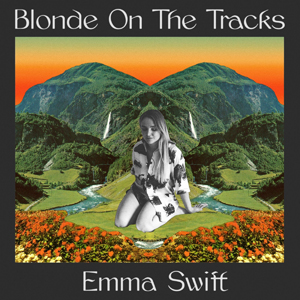
Emma Swift’s new album of Bob Dylan reinterpretations, the wonderfully titled Blonde On The Tracks, is one of the best covers records we’ve ever heard.
The Australian-born, Nashville-based country singer-songwriter has put her own [simple] twist on some of her favourite Dylan songs, but, unlike some artists who’ve covered his work, she’s remained reasonably faithful to the original versions, rather than radically overhaul them.
“Interpreting other people’s emotions is how I learned to sing and I’ve always enjoyed hearing Dylan’s songs from a female perspective,” she says. “You can learn a lot about melody and feeling by the way a singer chooses to interpret someone else’s song. You can learn a lot about words by singing someone else’s. I’m very influenced by singers like Sandy Denny, Joan Baez, Billie Holiday and Sinead O’Connor. There’s an art to interpretation.”
Produced by Patrick Sansone, multi-instrumentalist from Chicago alt-rockers Wilco, Blonde On The Tracks sounds intimate, warm and inviting – Swift’s voice is gorgeous and breathy. The eight-track album opens with Queen Jane Approximately – in a nice touch, Swift gives it a wonderful, Byrds-style makeover, with chiming 12-string guitar.
She slows down One of Must Know (Sooner or Later), turning it into a pleading, haunting, late-night country song, with pedal steel. Simple Twist of Fate gets a similar treatment, but with some understated, twangy guitar licks, as does the 12-minute epic Sad Eyed Lady of the Lowlands.
Swift even reinterprets one of the songs from Dylan’s latest record, Rough and Rowdy Ways, on hers – the reflective and stately ballad I Contain Multitudes. Her achingly beautiful voice is accompanied by acoustic guitar and minimal instrumentation.
“Like many of the great Bob Dylan songs, I Contain Multitudes is a magnet, a fly’s eye view of the cultural miasma in which we wander,” says Swift. “It’s magnificent and heartbreaking – a love letter to words and art and music, to all that has been lost and all that might be redeemed. To me this song has become an obsession, a mantra, a prayer. I can’t hope to eclipse it, all I hope to do is allow more people to hear it, to feel comforted by it, and to love it the way I do.”
Blonde On The Tracks is a record that was born out of crisis, as Swift explains: “The idea for the album came about during a long depressive phase – the kind where it’s hard to get out of bed and get dressed and present [yourself] to the world as a high-functioning human. I was lost on all fronts no doubt, but especially creatively.”
She adds: “I’ve never been a prolific writer, but this period was especially wordless. Sad, listless and desperate, I began singing Bob Dylan songs as a way to have something to wake up for.”
Work on the album began at Magnetic Sound Studio, Nashville, in 2017, but it was the Covid-19 lockdown that brought the rest of the project to fruition. Swift worked with Sansone over email to polish up the six songs that had already been recorded, but her versions of I Contain Multitudes and Simple Twist of Fate were laid down in April and May this year, at home, and overdubbed via correspondence.
The album features guest appearances from Sansone, singer-songwriter – and Dylanologist – Robyn Hitchcock, who plays guitar, Thayer Serrano (pedal steel) and Steelism’s Jon Estes and Jon Radford on bass and drums, respectively.
Say It With Garage Flowers spoke to Swift during lockdown in Nashville, to find out why Dylan’s music means so much to her, why Blonde On The Tracks, which can be purchased via Bandcamp and from record stores, won’t be available to stream on Spotify and other digital music sites, and her plans for her new independent label Tiny Ghost Records.
Q&A
How has lockdown in Nashville been for you? How have you coped – both personally and professionally?
Emma Swift: I have been in lockdown and haven’t left the house since the beginning of March, so although I am technically in Nashville, it feels, in a way, like I am on an island. I don’t see any of my friends or colleagues or even venture to the supermarket. All communication – for food, for friendship and for work – has been done online and it’s definitely weird.
The idea of “coping” is one I struggle with because, in many ways, we’re still deep in this Covid experience, so it’s hard for me to have perspective on it. Am I coping? I don’t know. Right now, the virus is worse than it’s ever been in Tennessee. Each day brings new challenges. On the one hand, I’m extremely fortunate to be able to work from home, on the other, my primary source of income is as a touring musician and all that work is not going to return for a long time, so that weighs heavy on my mind. I am constantly seeking distractions. I read a lot.
I have insane, one-way conversations with my cat [Ringo]. “Who’s a good boy? Yes, Ringo’s a good boy! Oh, Ringo you’re such a good boy. Ringo have I ever told you what a good boy you are? Look at your little face! You’re such a good boy.” There’s a lot of that.
How did you first get into Dylan’s music and what does it mean to you?
ES: I’m not from the generation that grew up when Dylan began making records, so for many years most of my discoveries were made well after that – through albums I bought at record fairs and charity stores and songs I heard on the radio. My first memory of hearing a Bob Dylan song is The Byrds version of Mr Tambourine Man, which got played a lot on the golden oldies station I listened to as a kid.
I can remember watching clips of the Traveling Wilburys on music TV – I adored Handle With Care, though Roy Orbison was the one I was drawn to at the time. My first Dylan album was Blonde on Blonde, which I must have acquired when I was 17 or 18. I’ve been under the sweet, sorrowful spell of Sad Eyed Lady of the Lowlands ever since. My love of the artists that came of age in the ‘60s and ‘70s isn’t exclusive to Bob Dylan though. I’m just as influenced by Dusty Springfield, Joni Mitchell, Sandy Denny, Gene Clark and Lou Reed to name a few. I’m a kid of the ‘80s and ‘90s, but I’m quite old-fashioned really.
You’ve recorded a version of I Contain Multitudes, from Dylan’s 2020 album, Rough and Rowdy Ways. Isn’t it brave to tackle a brand new Dylan song?
ES:It didn’t feel brave to me – it just felt like a song I was utterly magnetised by and compelled to do. For me, it’s a love song to all that is great about music and art and poetry. It’s a confession, a hymn, a celebration. Like many of the Dylan songs I am drawn to, it’s a little bit funny and a little bit sad. I laughed out loud the first time I heard him sing: “I paint landscapes/ And I paint nudes.”
As for my interpretation of it, it’s very lo-fi. It was recorded in the lounge room at my place on a Zoom recorder, with Robyn Hitchcock on guitar, and then sent to my producer, Patrick Sansone, for overdubs. Patrick’s a brilliant man who can do a lot with not very much. I’m lucky to know him.
Interestingly, on your versions of the songs, you haven’t changed any of Dylan’s lyrics to make them sound like they’re being sung from a woman’s point of view. What was your thinking behind that?
ES:They are being sung from a woman’s point of view – mine. I just haven’t changed any of the gender pronouns to make it sound like it’s coming from a heteronormative context. It’s not how I view the world.

You’ve said that you can learn a lot about melody by singing someone’s else’s songs? Can you elaborate on that? What has making this album taught you?
ES: I’m pleased that the record is coming out because historically it hasn’t always been easy for me to put music out. I can be apprehensive. I can be scared. I can be very self-critical. People can be brutal. And you have to feel safe enough in yourself to be able to say, ‘I like it and no-one else’s opinion matters’, to be able to release music. It took me a while to get to that point.
As for learning about melody, every time I put a record on I become a student. My ears are primed. For that matter you can learn a lot about harmony too, if you let the recording take the lead and try to find a different part.
Which other singers / artists do you admire, other than Dylan? Who inspires you?
ES:Marianne Faithfull, Cat Power, Sandy Denny, Nick Cave, Billie Holiday, David Berman, Robyn Hitchcock, Lucinda Williams, Vic Chesnutt, Leonard Cohen, Guy Clark, Patti Smith, Johnny Marr. Even though it’s music, I guess what inspires me musically is artists who really love words. Artists who read books. Artists who care about the world.
Am I right in thinking Blonde On The Tracks won’t be available to stream on Spotify and other digital music sites? You have strong views on streaming and royalties / payments to artists, don’t you?
ES: Blonde On The Tracks is available as a digital download, vinyl, CD and cassette. I’m selling it through Bandcamp online and it has distribution, so folks will be able to go and pick it up from their favourite local record store as well. There’s never been a better time to support small business.
You are right, I’ve been quite outspoken online about wage exploitation from mainstream streaming services. I’m tired of corporate music companies spinning a line that these outlets are good for “exposure”, while some of the best musicians I know find themselves now out of a job due to Covid-19. You can’t eat exposure! You can’t pay your rent with exposure. It’s just another bullshit argument for trickle-down economics – an argument which fails to take into account that the music industry is bigger than its bigger name stars.
‘I’m tired of corporate music companies spinning a line that mainstream streaming services are good outlets are good for “exposure.” You can’t eat exposure!’
What’s the latest on your planned album of original songs, Slow Dancing With Ghosts? Have you been writing any new material? Is there another record in the offing?
ES:Slow Dancing With Ghosts is all set for release in January 2022. I have recorded eight songs so far, but they are not quite finished as all the overdub sessions were cancelled due to Covid-19. There are some really lovely people playing on this record. I’m pleased to say that once my depression lifted I was able to write new songs, and that will be what is on offer here.
What music – new and old – have you been enjoying recently and how do you listen to it?
ES: I listen to music through digital downloads, the Bandcamp streaming app, vinyl and CD. Though it’s been brutal on other fronts, 2020 has been a great year for new music and I’ve been enjoying the recent albums from Marchelle Bradanini, Luke Schneider and Becca Mancari.
I just bought the Prince Sign o’ The Times 7in singles collection that Third Man is releasing and I’m excited about that. And I’ve got the new Dylan album, plus quite a large vinyl collection that goes back decades. I come back to Joni Mitchell’s Hejira probably more than any other record.
What are your plans for the rest of the year when things get back to normal?
ES: I have big plans to play this album – and my own new songs – live. I’m just not sure when it will be safe for me to make that happen.
You’ve started your own label,Tiny Ghost Records. Any plans to sign any other artists to it and put out their records?
ES: One of the main reasons for starting Tiny Ghost was because I am a mouthy brat and I like my independence. I couldn’t find a record label in 2020 that was artist-friendly enough for me. Even the cool ones are still in bed with the streaming services, so that wasn’t really an option. The new Robyn Hitchcock album will come out on Tiny Ghost in 2021. I’d love to sign other artists eventually, I just have to get the business off the ground first. I’d also encourage any artists who are looking for a label to consider starting their own. If it works for Gillian Welch and Courtney Barnett, it can work for you too.
‘One of the main reasons for starting Tiny Ghost Records was because I am a mouthy brat and I like my independence’
What are some of your favourite cover versions of Dylan songs?
ES:Okay so what’s wild here is that I could list versions of just one song and it would go on for pages. I could talk about Joan Baez’s Daddy You’ve Been On My Mind for days. Betty Lavette’s Mama You’ve Been On My Mind, particularly when sung live, is glorious. Robyn Hitchcock doing Visions of Johanna is pure heartbreak. I have to say, with this project, I couldn’t really listen to other people’s Dylan songs for a while because I needed to just be with the source material. I’m also not too interested in a rigid list of favourites – the list is ever changing.
Finally, did you ever think about calling the new album Blood On The Blonde? Maybe that could be your next record – reinterpretations of Dylan’s murder ballads?
ES: [laughs] No, I didn’t…
Blonde On The Tracks by Emma Swift is released on August 14 (Tiny Ghost Records).
https://emmaswift.bandcamp.com/


 Say It With Garage Flowers