

New York-based singer-songwriter Jake Winstrom’s second album, Circles, which came out in 2020, was one of our favourite records of that year.
As we said at the time, ‘the former frontman of Tennessee band Tenderhooks has cranked up the guitars and embraced his love of classic rock ‘n’ roll, power pop and country rock.’
Now, five years later, the follow-up, Razzmatazz!, is out this month and it’s easily up there with its predecessor, but sees Winstrom exploring new territory, while also maintaining his knack for writing a killer pop tune – look no further than the wonderful R.E.M-meets-Tom-Petty, 12-string jangle of Don’t Make The Rules and the crunching, organ-drenched Freelancing On A Pheromone.
Recorded with producer, multi-instrumentalist and film composer, Jason Binnick, at his basement studio in Brooklyn, and featuring Matt Honkonen (Tenderhooks) on drums, the new 10-track album is more stripped-back than Circles, opening with the warm and intimate Paul Simon-style folk of Exhausted.
“I knew if I made a third record, it couldn’t just be another batch of songs. I wrote an album’s worth of songs in lockdown that I later realised were just more of the same,” explains Winstrom.
“That was hard to swallow, but it made me realise I needed to challenge myself. So, I put my nose to the grindstone, I learned how to fingerpick, and I played around with open tunings. That all helped me unlock something new in my songwriting, and Jason brought it to life in ways I couldn’t even have imagined.”
First single, Molotov, an atmospheric country duet with Bex Odorisio, has a Gram Parsons and Emmylou Harris feel, while This Blue Note is fragile and melancholy – a beautiful, autumnal folk tune – and final song, the elegant and pastoral Lucy’s Luck, which was influenced by Ray Davies, has a touch of chamber pop.
‘I wrote an album’s worth of songs in lockdown that I later realised were just more of the same.That was hard to swallow, but it made me realise I needed to challenge myself’
Jaws of Life, the heaviest track on the album, is a big blast of Southern rock, and One More For The Moon is thrilling and urgent power pop, with wailing harmonica and a retro synth sound thrown into the mix.
In an exclusive in-depth interview, Winstrom tells Say It With Garage Flowers about the writing and recording of Razzmatazz!
“This certainly wasn’t the album I was expecting to make, but I’m glad I made it,” he says. “Out of my three solo albums, it’s the one I would point to that feels most like me.”
Q&A
The last time we spoke was five years ago, in 2020, for the release of your second album, Circles. Before you made the new album, Razzmatazz! you wrote another album’s worth of songs, during lockdown, but you didn’t want to put the record out…
Jake Winstrom: Yeah – I thought, ‘Oh, this would be a great time to write songs…’
I’m usually kind of lazy about writing them, so I had all the hours of the day with my guitar and drum machine and stuff to fool around. So, I probably amassed around 10 to 15 songs, but it just felt like I was doing the same old thing, except just not as inspired… So, I put that aside and went through some different permutations of playing live – playing with a full-on rock band, and playing some more stripped-down shows, with just me and an acoustic guitar, and my friend, Bex Odorisio, singing with me.
So, how did the new record come about? It’s much more stripped-down than I was expecting… There are a few full-band songs, but not as many as on the last record…
Jake Winstrom: Yeah – the turning point was that I started fooling around with fingerpicking-style guitar. It was something I’d been meaning to learn for years, but I was always too lazy. I would try it for 15 minutes and think, ‘This seems like a lot of work…’ But I got this new apartment with a little back patio, so I could go out and kind of learn a pattern, and then just sit and do that for an hour. By the end of the hour, it would be like, ‘Oh, I’ve got this’. And I could start moving around chords and stuff, and I fooled around with open tunings as well.
I wasn’t even intending to write songs, but then I was getting out of my old songwriting habits, and I was like, ‘Okay, these are some surprising and interesting things to my ears and they’re fun…’
So, yeah, basically the intention was to go in and have no rock songs, and really, for all of them to be stripped-down… and there is some very deliberate production, with Mellotron and lap steel…
‘The turning point was that I started fooling around with fingerpicking-style guitar. It was something I’d been meaning to learn for years, but I was always too lazy’
You worked with producer, multi-instrumentalist and film composer, Jason Binnick, on the record, who has a basement studio in his apartment in Brooklyn…
Jake Winstrom: Yeah – he played bass in one of my bands. I knew him as a good bass player, but it was months before I realised that he plays virtually every instrument and composes music for films and video games. He’s such a fun guy to play with.
And drummer, Matt Honkonen, plays on the album…
Jake Winstrom: Yeah – we were three or four songs into it, and when we got to Don’t Make The Rules, which was going to be just stripped-down with an electric guitar and an organ, we thought it begged for a treatment that was a bit more muscular. We were fooling around with a drum machine and stuff on it, but we were like, ‘This just isn’t it…’
Originally, our philosophy was that we were going to go in and do a song from start to finish every day – just to kind of work in those parameters. But we were like, ‘This needs a proper drummer…’ So Matt, my old buddy from my first band, Tenderhooks, is a talented producer in East Tennessee.
We were able to send him tracks recorded with a click and pretty much in a day or two, he would send us back the drum track. We found it was good, and once we got that back, we re-recorded some stuff, as it needed to have more oomph and make it feel more like a band.
Don’t Make The Rules is one of my favourite songs on the album – it has a ‘60s feel, but also reminds me of R.E.M. and Tom Petty…
Jake Winstrom: Yeah – totally. I played my 12-string Rickenbacker on it.
The new album sounds quite folky at times. I know you like Elliott Smith, but also there are moments on the record that remind me of Nick Drake and Paul Simon – the first song, Exhausted, is a mostly acoustic ballad, but with a Mellotron on it. It sounds very Paul Simon-esque, and is a low-key way to start the album…
Jake Winstrom: I fooled around with the track listing, and there’s something about the first line, which is, ‘Everything’s so complicated. Now, where do I begin?’ That felt like the in – I’m sitting down and telling you whatever… It’s the beginning…
The next song, Freelancing On A Pheromone, is crunching power pop – one of the fuller-sounding tracks that sounds like it could’ve come off Circles…
Jake Winstrom: Yeah. I think that’s the only song that survived from the pandemic album – I had it in my back pocket.
We recorded around 16 songs, so we had more than we needed, but as soon as we’d done Don’t Make The Rules, we were like, ‘We can’t just have nine Exhausted-style songs and then one song with a rock band coming totally out of nowhere… So, it was kind of like, ‘Let’s see if we can do a few more of those…’
On that note, Jaws of Life is the heaviest song on the record, with a bit of Neil Young and Tom Petty… There’s a big guitar solo on it, and it reminds me of the sound you explored on Circles…
Jake Winstrom: Totally. That song is very much in the style of the band Matt and I were in – more kind of Southern rock… That was a hard one to mix – I think I drove Jason and Matt, who also mastered the record, crazy with it. With the vinyl, that song is right at the tipping point of making your needle jump off the record! We’re just in the safe zone with some of the frequencies on it.
This Blue Note is a sad song – folky, stripped-back and delicate…
Jake Winstrom: Yeah – I really love that one. When I wrote it, it was twilight – I came up with the chords on my little back porch, playing finger-style. Jason’s production on it just knocks me out.
All I did was play the one guitar track and sing it, and then he came up with the subtle piano chords, and the solo on that song. I could tell Jason could hear something because I brought the song in with those huge gaps – ‘verse, chorus, verse chorus, something happens here…’ I knew he was going to come up with something that was way better than I could.
Do you demo your songs at home?
Jake Winstrom: Yeah – on a little four-track. So, sometimes I’ll do guitar, a voice and a harmony, or a tambourine if I’m feeling like really putting my neighbours through it on that day…
You wrote the first single, Molotov, on your back patio, didn’t you?
Jake Winstrom: Yeah. I remember that because it was during the day, so it must have been springtime… You mentioned Nick Drake earlier – there’s basically a tuning and you strum the guitar and you’re like, ‘Oh – that’s Nick Drake…’
There’s a similar one for Joni Mitchell, so when I wrote Molotov, I heard Joni Mitchell in my head, singing it.
It was originally kind of a little more upbeat and strummy… It was one of the first songs we recorded, and we did this really lush version, which almost turned out like Steely Dan or something. It had bongos on it and kind of jazzy bass, and a ton of production. We had fun doing it, but when we were listening to it, it felt like an odd duck. So, we went back to it, and it ended being the last song we recorded. We went back to it, put it in a standard tuning, and did it more as like a country thing.
‘When I wrote Molotov, I heard Joni Mitchell in my head, singing it. It was originally kind of a little more upbeat and strummy…’
It’s a duet with Bex Odorisio…
Jake Winstrom: Her voice is astounding – she is extraordinarily talented. She was doing a play overseas, in Shanghai, but she got back just in time to sing on it, so it all aligned perfectly. Her and I and the guitar are all live, and then Jason overdubbed a lap steel that’s so laidback it sounds like an organ…
It has a Gram Parsons and Emmylou Harris feel to it…
Jake Winstrom: Whoa – thank you. That’s a huge compliment. I love them.
Molotov feels like it’s about the highs and lows of a relationship – how it can be great but also dangerous and volatile… It’s a cocktail of good and bad…
Jake Winstrom: That’s a great way of putting it – I never thought of it like that… It’s good, but it’s teetering… I don’t like straight love songs. My favourites are always the ones that have a bit of doubt or jealousy in there. I think I was trying to tread that line and have some fun with language too.
I really like the song Canceling The Noise – you mention noise-cancelling headphones in the lyric and it feels very much like you’re walking around the city, observing people with your headphones on…
Jake Winstrom: It’s kind of about the dangerous apathy of being around all this heart-breaking poverty that you see in New York every day on the subway – people in horrible, desperate situations, and you just get used to it.
I think that’s dangerous, and I’m as guilty or more guilty of it than anyone else, but originally, I’d written that song in the third person, about this guy, who is a businessman, walking around New York.
‘Canceling The Noise’ is about the dangerous apathy of being around all this heart-breaking poverty in New York every day on the subway – people in horrible, desperate situations, and you just get used to it’
He has the means to help these people, but he just won’t. But then thought the song would be much more interesting if it’s about the singer kind of more admitting like, yeah, I donate, I write things, and maybe I’ll make a post on social media… But as far as doing anything… I’m listening to my podcast and I’m walking past that person who is hungry…
It’s an intimate sounding song…
Jake Winstrom: It was recorded live with me playing guitar and singing at the same time – it felt more immediate that way.
Can I Get A Ride has a haunting country feel, with pedal steel…
Jake Winstrom: Jason came up with the hook – that descending pedal steel, which is the glue that holds it all together… That one fought its way onto the album – it was kind of in the B column for a while, with the discarded songs, but it became apparent that it… something happened to it when it was next to Jaws of Life – it seemed like they could be the same character or be in the same world… I’m pleased with how it turned out.
One More For The Moon is power pop, but there’s harmonica on it and also some ‘80s synth…
Jake Winstrom: It has a little bit of Wings… That was another one we did with the 12-string Rickenbacker – as soon as you’ve got that on it, it casts the die as to what kind of world you’re going to be in… Jason did an interesting thing where he doubled the harmonica with the synthesiser, so it kind of becomes this weird third instrument. That one was a ton of fun to do, but my friend was accosting me for putting it after Molotov on the record because he said it startled him too much.

The album ends how it starts, on a low-key moment – the final song, Lucy’s Luck, is a pretty, folky tune with a chamber pop feel and a pastoral vibe…
Jake Winstrom: Totally – thank you. When I was doing finger-style stuff, I got into a waltz kind of pattern.
I was sort of trying to channel Ray Davies – a song that is a little slice of ordinary life. Jason blew me away because he did these kind of pastoral plucked guitar overdubs – after the first chorus, there’s an electric guitar that comes in, but it almost suggests a chamber orchestra, and there’s a lot of delay and reverb on it.
‘I was trying to channel Ray Davies – a song that is a little slice of ordinary life’
He has a bunch of things like that on the album that you can’t quite identify. It’s mixed low, but it’s almost like a feeling that tugs you a little bit.
I shuffled that song around in the running order a lot, but it feels like One More For The Moon is the ending, and Lucy’s Luck is the epilogue.
Are you pleased with the album?
Jake Winstrom: I’m tickled with it. I think it’s better than what I wanted to make. I have the skeletons of my songs, but I find collaborating way more exciting and unexpected things happen, as far as productions and arrangements. It certainly wasn’t the album I was expecting to make, but I’m glad I made it. Out of my three solo albums, it’s the one I would point to that feels most like me – my taste.
What were your influences when you were making it?
Jake Winstrom: I was thinking of early Paul Simon and maybe some John Prine – something where it’s produced, but it’s very minimal. It’s not lo-fi per se, but it’s the guitar, voice and maybe one or two little elements. There are some songs like that on it, but then we followed it down all these other paths that I think made the album a lot richer.
‘This certainly wasn’t the album I was expecting to make, but I’m glad I made it’
Do you think any of the other songs you wrote and recorded for the new album but didn’t use will ever see the light of day?
Jake Winstrom: Maybe… There’s an alternate version of Molotov and some others that I’m fond of. I don’t know if I would hold them over for the next record… The trend now is to put a deluxe record out, but I don’t really like that so much…
You could do an EP or a mini album…
Jake Winstrom: Yeah – something new, so I don’t have another five-year dearth.
Let’s hope we don’t have to wait that long. It’s been good to talk to you again, Jake.
Jake Winstrom: Thank you for asking such thoughtful questions and really listening.
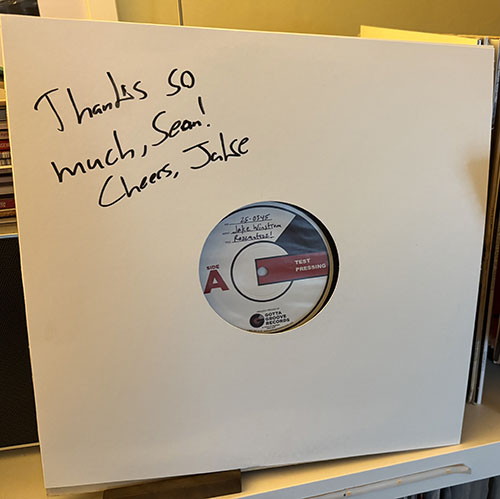
Razzmatazz! is released on August 8 on limited edition 150-gram black vinyl and digital platforms.
https://jakewinstrom.bandcamp.com/album/razzmatazz
https://www.instagram.com/jakewinstrom/