‘I approached this record like it would be my last’

Marc Carroll

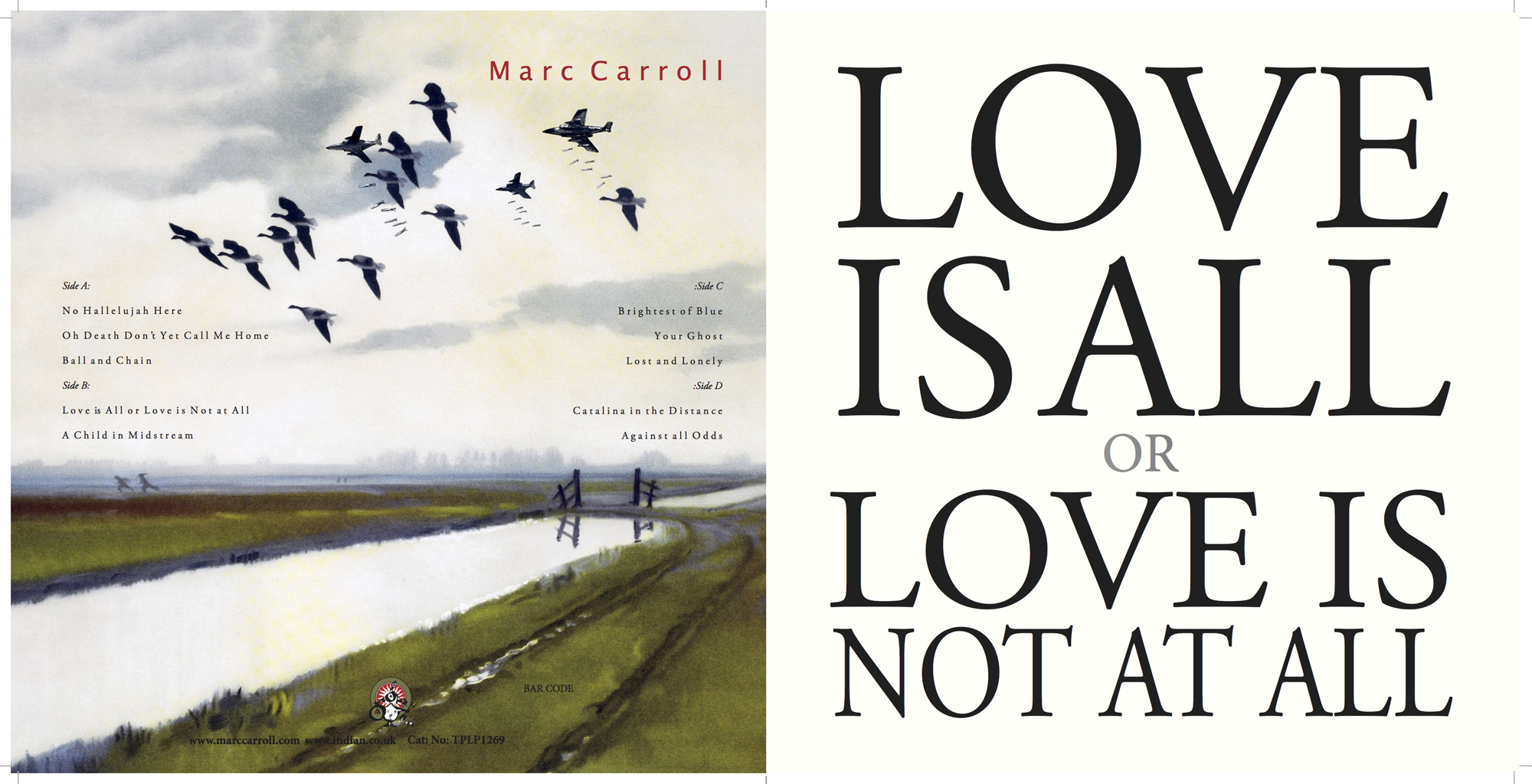
Dublin-born singer-songwriter Marc Carroll’s latest album, Love Is All or Love Is Not At All, is his most political record yet.

A collection of songs that ruminate on how love can triumph over adversity, it includes haunting, atmospheric ballads, a spoken word collaboration with Crass’s Penny Rimbaud and joyous, jangly power-pop.

I asked Marc about love, life and living in Los Angeles…


I’m really enjoying the new album. Several of the tracks are protest songs – the opener No Hallelujah Here is about four young boys who were killed while playing football on a beach in Gaza last year, while Ball and Chain is a call for unity and harmony in the world. Why did it feel the right time to make a record with a more political message than some of your previous albums?

Marc Carroll: I think at the moment there is a sense of possibility for change – a telling of truth to power. This is going on all over the world. People everywhere are saying enough is enough. This record is of its time and that hope and sense of protest is the zeitgeist of the time.

Recent events in the British political system also reflect this. I believe the tide is possibly turning and the few may well become the many.

Like all sane people, I was horrified by the killing of those little boys. I could barely move for several days. but we must remember that it is not an isolated incident. This happens to men, women and children all over the world on a daily basis – we just don’t see it and the media certainly don’t report it.

But I don’t equate politics with empathy, and essentially, this record – and some of the songs – is a calling for empathy and compassion.

From the title track, to some of the other lyrics on the album, it feels like you’re trying to say that love can conquer all – it can overcome adversity. This feels like a positive, hopeful record. Would you agree?  How did you approach this album? What frame of mind were you in when you wrote it?

MC: The title of the song and the album is almost a blanket of protection. Who would possibly argue against it?

I certainly hope it is perceived as a positive record, but we live in very cynical times. I suspect any negativity aimed at this record will inevitably reflect back on the critic, so they should choose their words very carefully. I approached this record like it would be my last.

As for the frame of mind I was in, well, it was the same frame of mind I always have when I make a record  – is it any good? Will anyone listen? Will anyone care?

But those concerns were duly trumped when I realised that does it actually matter. Is there a cure for cancer?

There are some very atmospheric, haunting and widescreen/ panoramic songs on the record – it has a big, epic sound in places. What were you aiming for with tracks like No Hallelujah Here and Oh, Death, Don’t Yet Call Me Home?

MC: That panoramic, almost filmic, quality came naturally to many of the songs. I love drones and other atmospherics in any music.

I am particularly drawn to the music of Florian Fricke from Popol Vuh – imaginative soundscapes. That was something of a conscious approach to the record.

Apart from that, I’m never sure of what I want to hear when I record my songs, but I do have a relatively good idea of what I don’t want to hear. I really don’t plan anything out or have a grand plan of how things should be. The songs themselves dictate the way forward.

Both the songs you mention were sung in one take. I knew what they were about and how they should be expressed. The music and title for No Hallelujah Here actually goes back to 2005 for the World On A Wire album, but only realised itself as an actual song of substance with this new record.

On the songs I just mentioned, there are also traces of your Irish roots. There’s a slight Celtic mood or atmosphere…

MC: Being Irish and using a minor chord every now and then means I am never far from the aesthetics of that music whatever actual style the song might be.

I have a strong, and natural, gravitation towards melancholy. It’s a very big part of the Irish DNA. Although I don’t think melancholy is specifically an Irish trait.

Ball and Chain and Lost and Lonely – my favourite song on the album – return to the power-pop sound of some of your earlier records…

MC: Ball and Chain was page after page of dialogue with myself. The lyrics simply followed the melody, which to me anyway, seemed very uplifting, and I wanted the words to reflect that and I believe they do. They came from a very internal place because I don’t watch the television or read the daily horror from the print media.

Lost and Lonely – that’s simply back to the previous melancholic reference, but minus the minor chords.

To be honest, I had never heard of the term ‘power- pop’ until quite recently. It always confused me as to why I would be associated with it. I’m still not sure. Is it powerful pop?

Jody Stephens from Big Star plays drums on Lost and Lonely. How was it working with him?

Like me, are you a huge Big Star fan? Did they influence you – especially early on in your career, with your band The Hormones?

MC: Jody is a lovely man. I met him at the opening of the Big Star documentary in Los Angeles a few years ago.

It was one song that I thought he would be perfect for, and, of course, he was. I have always loved Big Star and I suppose their influence comes through on several songs over the years.

Let’s talk about the title track of the new record, which is a departure for you. It features a spoken word part from Penny Rimbaud of the punk band Crass.

How did you come to work with him? Are you a Crass fan?

MC: It started off as an instrumental piece, which is something I do every now and then. I’d actually like to make an instrumental record.

I’ve known Crass for 30 years of my life. They were – and still are – a huge influence on the minds of millions of people around the world, including mine. I asked Penny would he like to contribute to the record and maybe read one of his poems over the piece of music. He agreed and he delivered something spectacularly beautiful.

He is one of the great poets and writers of our time and one day will be recognised for that I am certain. Gee Vaucher [Crass designer] also designed the artwork for the album. They are very kind, generous, warm-hearted people to be around and I love them dearly.

In the early days, you used to play in punk bands in Dublin? What you can remember about those times? 

MC: Punk is the best place to start.

What was the writing and recording process for the new album like? Where did you make it and did you have all the songs written before you entered the studio? 

MC: The writing process is as it always has been – part joy, part anxiety but mainly mind-crushing frustration.

The recording process was initially problematic – the record was recorded twice. The first sessions in Los Angeles ended up sounding like some dreadful American FM dirge. It was recorded by somebody whose only cultural reference was that fool, Howard Stern. All I heard were things like ‘Hell yeah, Pink Floyd, dude’. Needless to say, his services were no longer required.

In the end, you co-produced the album with Graham Sutton (Bark Psychosis, These New Puritans). How was that?

MC: Graham mixed a record of mine back in 2009 and he was the first person I called when things went so badly wrong in America.

Graham is the type of producer/musician that wants to help you make the record you want to make, as opposed to thinking it is his record, his vision and his opinion that counts.

That is the problem with most so called ‘record producers’. How could any of these people possibly know more about the songs than the person who wrote them? Having said that, I care only about serving the songs.

marc new size

There are guest appearances on the record from drummer Pete Thomas (The Attractions), jazz trumpeter Noel Langley (Bill Fay) and keyboardist Bo Koster (My Morning Jacket), who played on your last album. How did these collaborations come about?

MC: Again, I try and work with people that I think will serve the songs. Pete could provide that full on, powerful repetition and machine gun precision that was essential for Ball and Chain. He was in Los Angeles when I started this record, so the schedules worked out.

Bo is someone I worked with before – a good fellow. I wanted the keyboards to have the sensitive, melancholic quality that he provides.

Working with Noel was most fortuitous. I heard some of his work on the recent Bill Fay record, which I love, and knew it was the sound we were looking for on the particular songs. He was fun to work with, very creative and completely understood what was needed for the songs he played on.

You now live in L.A. Do you like it there? Do you miss the UK?

MC: I have spent the majority of my time – the last seven years anyway – in Los Angeles. It’s full of narcissistic, self-obsessed, dangerous, psychotic lunatics, and that’s just the police!

I like it a lot. It’s a fascinating place and a very beautiful city. I find most of the people to be open and extremely trusting, but if you are white, living in Silver Lake and doing yoga 29 times a day, then I’m sure life must be wonderful. If you are Mexican and washing the yoga mats, it may be a different story…

I spend enough time in London not to miss it. It’s one of the great cities of the world. I haven’t lived in Dublin for over 20 years, but it’s still in my heart, somewhere…


Love_Is_Artwork new

This is your seventh solo album. How does it feel to be seven albums into your solo career and how do you feel about the new album now it’s (almost) out there? It’s released on November 6…

MC: I don’t think about it too much to be honest. It’s what I do and I feel no different about this record coming out than any of the previous one…other than time to move on.

Throughout your career, you’ve had great critical acclaim, but not broken through into the mainstream? Why do you think that is? Does it bother you?

MC: I don’t really look at music or creativity in that way. I removed myself from the industry of music a long time ago.

There are some very good people in it, but most operate in a way I can’t relate to. I like to communicate with people, not the business of people … hence, perhaps, my anonymity. The music on the other hand, speaks for itself.

I first came across you in The Hormones, back in the late ‘90s. Do you have fond memories of those days? Any good stories?

MC: We toured a lot – the Japanese loved it.

And, finally, Marc: what is love?

MC: Something that defies ownership.


Marc Carroll’s new album, Love Is All or Love Is Not At All, is released on One Little Indian on November 6. 

http://www.marccarroll.com/

‘I love jangly guitars!’

Nick Piunti
Nick Piunti

Detroit power pop supremo Nick Piunti tells me about the writing and recording of his new album Beyond The Static – the follow-up to his critically acclaimed record 13 In My Head

It’s great to chat to you again, Nick. When we last spoke, back in 2013, you’d just released 13 In My Head – your second solo album. It was one of my favourite records of that year. And now you’re back with the follow-up – Beyond The Static. Did you feel any pressure when you were writing and recording the new album?

Nick Piunti: Thanks, Sean. I think there’s always the hope that the next album will be better than the previous one, but I wouldn’t call it pressure, just the desire to make a good album. And, of course, the hope is that the new album will be as well received as the last one, but, ultimately, we made an album that I like and am proud of.

13 In My Head really raised your profile in the UK, didn’t it? It picked up some great press…

NP: The attention and press that 13 In My Head received in the UK and Europe was amazing. And there are a lot of people to thank for that. Having a song on the Mojo magazine compilation CD Songs in the Key of Paul definitely raised my profile in the UK and beyond.

And for Markus Holler from Sugarbush Records to release the album on vinyl, that was a boost as well. Yourself, Robin Wills, Wayne Lundqvist Ford, the Madrid power pop community, Luis deOry, Power Pop Pedro and Rock and Roll Circus – all were instrumental in spreading the word.

Rest assured, fans of 13 In My Head will definitely love Beyond The Static – it’s more of the same; infectious power pop songs, with big guitars, harmonies and strong melodies, isn’t it? Like its predecessor, it’s very instant. The first three tracks don’t mess around – Things don’t really slow down until track four, Six Bands…

NP: I’ve been recording for so long and have pretty much stayed true to the music that initially inspired me. I think the trick is to not be too obvious with your influences, but to meld them into something of your own. If it’s not catchy it doesn’t usually end up on one of my albums.

I noticed a country influence on Six Bands – is that pedal steel on it? Musically, it reminds me of REM. Can you tell me more about that song? I love the opening lines: ‘’She’s in six bands – none of them good. Tries to sing, only if she could. But she’s drowning in a talent pool – chasing dreams can be so cruel.”

Is it aimed at anyone in particular? Is it a comment on the shallow and ruthless nature of the music industry?

NP: Thanks – yep, pedal steel courtesy of Dave Feeny, who owns a great studio called The Tempermill. He’s produced some of my favourite Detroit artists who also are my friends (Chris Richards, Ryan Allen, Friendly Foes, American Mars) and he plays pedal steel. I felt that he could add a cool vibe to the song, which he obviously did.

The song isn’t about anyone in particular. I was reading a local paper, The Metro Times, and there was an article with a story about a girl who was in four bands. So I exaggerated it a bit. But the song isn’t about her – it’s about the struggle that bands and artists have these days and how many are a bit delusional. When I was in my early twenties I moved to L.A. with my childhood band, so maybe some of the lyrics were autobiographical, but I only had one band and we were pretty good.

Where did the album title – Beyond The Static – come from?

NP: Well, I was struggling to find the right title for the album. The phrase “beyond the static” comes from the song Something’s Wrong. My daughter Megan picked up on that line, so there you go.

I love the song Time Machine – I had a sneak preview of it last year, as a teaser to the new album. If you had a time machine, where would you travel to?

NP: That’s a good question. It would have to be the future, wouldn’t it? If we travelled too far back in time, I think we would find that the good old days weren’t what we thought they would be. Except for maybe seeing The Beatles at The Cavern.

Your song Heart Stops Beating has some vintage synth sounds on it, doesn’t it? It has a bit of a New Wave feel to it. Did you wear a skinny tie while you were recording it?

NP: My skinny tie days are behind me, but, yeah, I think I was going for a Cars feel with the muted guitar – Rickenbacker – and the synth, which is actually doubled with guitars, as well. It also has a Weezer vibe, which makes sense since Ric Ocasek [from The Cars] produced a few of their albums.

Something’s Wrong is a rocker. It has a swagger to it, with heavy guitars and plenty of attitude…

NP: I almost left that one off the album, because I thought it didn’t quite fit with the rest of the songs, but I’m glad my rock side prevailed.

There’s some jangly, chiming guitar pop on the album, too – like Quicksand. Didn’t you record an alternative version of Time Machine, with a different guitar sound? Will that alternative take come out in the future?

NP: I love jangly guitars – there’s a bit of 12-string on the album, but mostly capos and the right kind of six strings – Matchless and Vox amps get the job done. We did record another version of Time Machine with a more jangly feel, and I was going to include it on the album, but I didn’t want one song to be featured more than once.

Can you tell me about the writing and the recording of the new album? How did you approach making Beyond The Static? What did you want to achieve with it?

NP: World domination – ha! The writing process stays the same. Some days you hammer away for a couple of hours and nothing comes of it, while on other occasions the minute I pick up my guitar a lyric, melody or a riff come together at the same time, and those are the songs that make it on the album. I wrote all the songs, but Geoff Michael [producer] spent some time deconstructing a couple of the songs, so he was credited as a co-writer on those.

Donny Brown re-arranged It’s A Trap – he turned the second part of the original chorus into the bridge, so he’s credited on that song as well. And the other co-writer is my 16-year-old daughter Megan. She didn’t actually sit down and write with me, but I stole her line, “I fell for you and I can’t get up” and turned it into a song [Fell For You]. I didn’t want her to be denied the writing credit like Ringo – he came up with the phrases “hard day’s night” and “eight days a week”. That’s what I think I read anyway.

Who was involved with the record this time around? Was it the same guys who worked with you on 13 In My Head?

NP: Once again, Geoff Michael produced the album – at Big Sky Recording in Ann Arbor, Michigan. He also added guitar and keyboards on two songs. Donny Brown – again – played drums on all but one song. He also recorded the drums for a couple of the tracks at his home studio, as well as adding some awesome background vocals and synth lines on Time Machine.

For this album, Andy Reed played bass on every track, which he recorded at his own studio, Reed Recording Company. Andy’s studio is a two and a half hour drive for me, so it’s easier to send the tracks to him. He lays down the perfect basslines and sends them back to Geoff – they’re always great.

Andy and I also tracked some guitars, keyboards and noises on Head in the Clouds, at his studio. Ryan Allen sang on four songs and added guitar on Something’s Wrong.

Chris Richards also sang on a couple songs as well. Steve Mullan played keys on a song and a young drummer named Billy Harrington appears on Anything But Easy.

One thing that I don’t do is to tell any of these amazing guys what to play. I like to see what they bring to my songs. Since they’re such great songwriters in their own right, they instinctively know what can make a good song better.

I didn’t actually rehearse with anyone individually before the recording. I would either send demos or tracks from the studio and they each came up with their own parts. Despite what some may say, I’m really not that much of a control freak. For this album I even decided not to be there for the mixing sessions.  Geoff did the mixing, would send the tracks to me, and I would make a few minor suggestions and he would tweak away. So, ultimately, I had the last word, but relied on the talents of many.

Nick Piunti & Ryan Allen

Which albums and bands were you listening to when you were writing and recording the new album. Have you heard anything new that you’d recommend?

NP: I’m always looking for something new that inspires me. My friend Ryan Allen has just released a new solo album called Heart String Soul that I love. He sent me the original demos as he was writing them, so I was there for the inception.

Chris Richards, Andy Reed, and Keith Klingensmith recorded their debut album, The Legal Matters, which is a great pop album that found its way on to a lot of Best of 2014 lists. I even played guitar on a couple of songs.

There’s a Brooklyn band called Nude Beach that I really dig. Their new album is called 77 and, yeah, it sounds like it could have been recorded in 1977.  The new Spoon album, New Pornographers, The Both, New Mendicants (a handsome chap named Sean Hannam introduced me to them!) and Jason Narducy’s band/solo project Split Single is right up my alley. It’s indie-rock and power pop influenced, as well.

Will you be playing some gigs to promote your new album? Do you think that you’ll get to play in the UK? We’d love to have you over here…

NP: There will be a few shows – for sure. The UK and Europe would be awesome, but it would have to make financial sense. Making music and financially responsibility don’t usually mesh in the independent music world, unfortunately.

Good luck with the new album – it’s a great record. What are your plans for the rest of the year?

NP: I’m halfway done with songs for the next album and maybe I’ll collaborate with a friend or two on something new as well.

I’m fortunate to be able to keep making new music and really lucky to be hitting my stride when most sane people would have given up years ago.

I still have the passion and I have friends that inspire me, so why would I stop? Oh, and most importantly, I have the most incredible wife in the world. That is not to be underestimated.

Beyond The Static will be released on March 14 (Two Brains Recording Co.). There are plans for a vinyl version later this year. 

http://www.nickpiunti.com

https://soundcloud.com/nick-piunti

http://nickpiuntimusic.bandcamp.com

10931225_10203421569402520_6001303865988711727_n Beyond Static