It’s been a busy year for English singer-songwriter and pianist, John Howard. He’s published the second instalment of his autobiography, Illusions of Happiness, and released his latest album, the brilliant To The Left of The Moon’s Reflection.
The new record – his seventeenth – is a collection of wistful, reflective and pastoral, piano-led ballads, chamber pop and folk songs, with sparse percussion and layered, atmospheric arrangements and harmonies. Howard sings lead and backing vocals and plays all the instruments.
To The Left of The Moon’s Reflection was written and recorded in his home studio – he lives in a 100-year old cottage in the Murcia region of southern Spain – during the winter of 2019 and spring 2020.
Howard, who is 67, grew up in Lancashire and trained as a classical pianist from the age of seven – he started playing when he was four. His debut album, Kid In A Big World, featuring the single Goodbye Suzie, was recorded at Abbey Road and Apple studios in 1974 and came out the following year.
“The only thing I envisaged in my twenties was becoming a gigantic star! It was what drove me from my first gigs when I was 17. I was very ambitious,” he tells Say It With Garage Flowers.
“I thought I’d be selling millions of albums and doing concerts at The Carnegie Hall, playing at huge stadia around the world, packed with thousands of fans and headlining at massive festivals. So the fact that I’m still recording without all those ‘trappings of success’ is a very nice surprise.”
Q&A
During the summer, you published the second volume of your autobiography, lllusions of Happiness, which goes up to 1986. There’s a third and final instalment planned in the not-too-distant future. How have you found writing the books? Has it been cathartic? What have you learnt from the process?
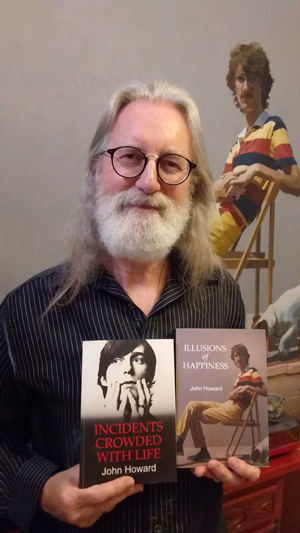
John Howard: To be honest, I didn’t know there’d be a second volume when I wrote the first one, Incidents Crowded With Life. It was intended as an online chapter-by-chapter series of events in my life up to my accident, when I broke my back, in 1976. I was astonished when Fisher King told me they wanted to publish it. But reviews were excellent and Fisher King asked me to write a second instalment.
Originally, it was going to go from 1976 to 2000, covering my recovery from the accident through to returning to recording with Trevor Horn and Steve Levine and my move into working in the music business in A & R and Licensing through the ‘80s and ‘90s; meeting my husband Neil, leaving London for Oxfordshire, and finally in 2000 for Pembrokeshire. But Fisher King suggested I split it into two books. So I decided to end Illusions of Happiness in 1986, just before I met Neil, having split from my then partner of eight years, changed jobs and moved into my own apartment. It seemed a good narrative point to finish the book.
‘I love writing, words come fairly easily to me – lines of songs arrive in my head while I’m ‘busy doing other things’, as Lennon once sang’
I love writing, words come fairly easily to me – lines of songs arrive in my head while I’m ‘busy doing other things’, as Lennon once sang. So writing the book felt very natural, and yes, a little cathartic. It sounds silly in a way, but quite a few members of my family have suffered from Alzheimer’s, so being practical, I wanted to get as much of my life down in writing now just in case there comes a time when “I can’t even remember my name”, as a line in the song Injuries Sustained In Surviving [from the new album] goes.
I didn’t really learn anything from writing the book, as I knew it all already! But it did help put some things into a clearer view in my mind. What I never did, in either book, was comment or judge, I just told what happened – as I saw it – and let the reader decide on who was right or wrong, on whether I, and other people in my life at the time, made the right decisions. What was, was. What happened, happened. There’s no changing that. I just wanted to put it down on paper.
Hopefully, the third book will be published sometime in 2022 – there were two years between books one and two being published, so I’m guessing there’ll be a similar gap before the third is out there. It’s more or less written – there’s just some tweaking and editing to do over the next weeks and months.
The new album is very reflective, nostalgic and melancholy at times. What kind of headspace were you in when you wrote the songs? It has a lot of reminiscences on it… Do you think writing your autobiographies made you write more songs about your past?
JH: I think writing the two autobiographies – so far – certainly put a lot of things in perspective. I have an excellent memory but actually writing stuff down that happened 40, 50-plus years ago captured those memories for good and finally gave them placement and sense.
As I say, I’m not one to look back most of the time, but being ‘forced to’ when you’re writing your life story – or a bit of it – did remind me of people, events, experiences, and that would automatically seep into my songwriting. The two processes sit side by side.
Getting older too, of course, one remembers and reflects, rather than anticipating a whole lot more! It is a strange feeling knowing I have probably – if I’m lucky and healthy – another 20, or 25, years left, whereas in my twenties that was indeed a lifetime, with 60 years ahead to look forward to and plan for. It isn’t being maudlin or morose admitting that – it’s a fact.
The album has a pastoral theme – there are a lot of references to nature in the lyrics and also the title…
JH: Yes – the album does have a pastoral theme, definitely. My surroundings and the simple, rural way of life here are certainly reflected in a lot of the songs. My city days are over.
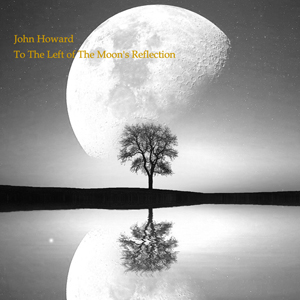
The album title is taken from a line in the song Water, which is the closing track on the record and features the sound of crickets on it. Why did you choose it for the name of the album?
JH: Water is based on a dream I had, floating above a lake like a watching spirit. I wrote the lyric as an observer of a scene in which he/she is gradually drawn in until they’re completely part of it. I wanted the track to have an atmosphere of stillness, of silently watching something develop before your eyes – something you don’t understand at first.
Our skies here are very dark at night, so there is always a sense of connection to ‘the beyond’, being able to see the universe above us, watching the shooting stars, listening to the crickets all round us every night, and feeling a kind of wonder about it all. As a songwriter that must affect me.
Once I’d finished the album and needed a title, the line in Water’s lyric, “What’s that beam of light on the lake, to the left of the moon’s reflection?” described for me the vibe of the album – the second part of the line especially. It also lent itself to a sleeve design very well too.
The song My Patient Heart is about living in Pembrokeshire, Wales, where you and your husband, Neil, used to be based, and also references Murcia, in Spain, where you live now. Can you tell me more about your inspiration for it?
JH: It’s one of my scene-setting songs, describing life here in the village, which is still very rural, families working in the olive and almond groves, the local church ringing its bells every day on the hour – usually about ten minutes slow!
Our neighbour gives us bottles of his homemade olive oil, others bring us home-grown spinach and various vegetables, and a chap in his nineties gives us jars of his home-made honey. When we had hens we gave people eggs and every summer families from the village come and collect fruit from our Chinese Meddler tree. They seem very pleased to have us as part of the village, which is heart-warming.
But the song also looks to Wales and our life there, which was also very rural. Though no one worked in the fields any longer in Pembrokeshire, everyone had an orchard, cherry trees, gooseberry bushes, wild berries growing in hedgerows. And seasons!
That’s what I miss the most – the seasons. They were definite, expected and regular as clockwork. It’s November here and in the mid-twenties. Sounds great, I’m sure, but my Northern English psyche still expects it to be minus two! I’m not sure I will ever lose that natural expectation. Neil and I do intend to return to Wales, someday, hence My Patient Heart. Everything is about timing, when it’s right. We’re very lucky to be in a position where we can decide when that is.
Let’s talk about Injuries Sustained In Surviving. It’s a great song – quite folky – and I love the title…
JH: Thanks. It was the first song I wrote and recorded for the album. I had Marrakesh Express in my mind when I wrote it, and carried that through to the vocals, where there are no ‘backing vocals’ per se, more three-and-four-layered harmony lead vocals. I became Crosby, Stills & Nash for a day!
The narrative covers childhood, youth and ageing all in one. I have memories of the railway lines behind my parents’ house in Heywood in the ‘50s and going out on day trips as a family in an old Austin jalopy. We went all over the place in that old car until finally one of its wheels fell off and dad abandoned it in a garage, getting ten quid for the scrap value!
The song develops through to more recent thoughts, “Yes, kid, I remember the fire burning, I recall every song I was singing” – I’m talking to myself really.
There’s a bit which is a reflection on my dad’s recent Alzheimer’s, “Don’t wait until your body is a shell of a stranger locked inside a lonely cell, with a thousand silent tales he’ll never tell.” But it ends on a higher note, “Sometimes good things come along you’d never planned, somebody might just sprinkle stardust in your hand.” There’s always a chance.
I think Echoes of Pauline sounds like a standard, or maybe something from a stage musical. What inspired it? Who is Pauline?
JH: Pauline is a real person. I was at school with her in the ‘60s in Lancashire and we were very close, like brother and sister in many ways. She introduced me to artists like Joni Mitchell, Dylan and Simon & Garfunkel.
I’ve written about her before, in The Flame on Kid In A Big World, and in Pauline’s Song, which I wrote in 1970, but only recorded in 2009. She also gets a mention in a line from Small Town, Big Adventures… “I was Toad, Eniluap was Mole”, referring to when we were both in the school play Toad of Toad Hall in 1968. We always called each other by our names backwards. Don’t ask me why. We were young and did daft things!
We fell out badly in 1970 and our friendship didn’t recover. I can’t actually remember now why we had a row, a really bad argument, but I’m sure it was my fault. I think of her still and hope she’s okay and happy. She was a great person. I did try finding her on Friends Reunited years ago to no avail. Echoes of Pauline is my way of offering her a way back to our friendship if she ever hears the song, which she’s unlikely to do of course. That’s how the lyric began really, a letter to a friend, which will probably not be read.
I wanted the track to have the same vibe and feel as Cilla Black’s Alfie, keeping the piano quite restrained, not using it to drive the song along with rhythmic chords, but as an occasional texture, letting the song develop slowly without driving it. I used a simple string wash and sparse percussion to build to its more rhythmic end.
‘I wanted the track Echoes of Pauline to have the same vibe and feel as Cilla Black’s Alfie’
I think that track took me the longest to get right. I knew exactly how I wanted it to sound – I listened to Cilla’s track several times before going into the studio – but it was a new way of working for me. I also wanted the lead vocals to be multi-tracked and very smooth, with just occasional harmony lines, using no backing vocal ‘oohs and ahhs’.
I also developed a different way of singing for it, keeping my vocal restrained, not ‘soaring’ which is my usual style, singing from the back of the throat – more soulful rather than a dramatic pop style.
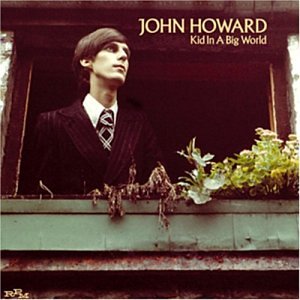
Your latest album is your seventeenth and, this year, it’s 45 years since you first started your recording career. How does that make you feel? You’re in your late sixties now. As a young man in his twenties, did you ever envisage you’d still be making records when you were a pensioner?
JH: Yeah! Who’d have thought it? But in some ways 17 albums in 45 years doesn’t sound that many!
Of course, I had a 20-year break in the ‘80s and ‘90s, when I worked ‘on the other side of the desk’, in the music industry. In the ‘70s I only made three albums – and two of them went unreleased – so 14 new albums since 2004 sounds much more impressive! The ‘70s and all that went on then feels like a lifetime ago, as though I’m watching it all happen in a movie in my head. I guess 45 years since my debut album came out makes me feel…in my late sixties!
The only thing I envisaged in my twenties was becoming a gigantic star! It was what drove me from my first gigs when I was 17. I was very ambitious. And yes, I did imagine I’d still be recording now, but I thought I’d be selling millions of albums and doing concerts at The Carnegie Hall, playing at huge stadia around the world, packed with thousands of fans and headlining at massive festivals. So the fact that I’m still recording without all those ‘trappings of success’ is a very nice surprise.
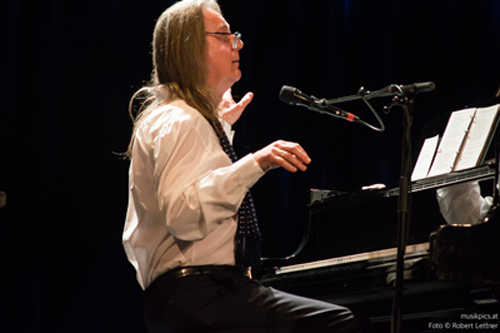
What have you learnt during your career? What have been the highs and lows?
JH: What have I learnt? I guess not to look back too much. I always try to look forward to the next project, the next album – though that’s sometimes difficult when people still – of course – want to talk and reminisce about Goodbye Suzie and Kid In A Big World. Nostalgia is very comforting for people, though my memories of those days are not so rosy. It was a very frustrating and disappointing period for me on the whole, in terms of what eventually happened in my career anyway.
The other thing I’ve learnt is not to have regrets. I’m still in one piece, physically and mentally – most of the time – thank goodness – which many of my contemporaries when I was starting out are not.
‘The only thing I envisaged in my twenties was becoming a gigantic star! I thought I’d be selling millions of albums and doing concerts at The Carnegie Hall, playing at huge stadia around the world’
Fame would have been fun, of course, I would’ve loved it, but would I still be around to tell the tale? I’m not sure about that! Leaving that world of recording in the mid-‘80s and ‘getting a proper job’ in the industry gave me a different perspective – a security I’d never had before.
Also, working as I did with so many established artists over those 20 years and hearing from them how their careers and the music business had treated them, often not well at all, gave me a view of life from the top. I saw it from a different angle – someone else’s experience of what fame can do to you. I think I became less selfish during that time than I had been as a recording artist, when my everyday had been all about “Me, me, me”.
Having to think about and be responsible for other artists’ careers and record releases taught me to be more considerate, more measured. It was my job not to have a meltdown when something didn’t go quite right. I became other people’s buffer, which is quite strengthening.
Now I’m a recording artist again, I happily don’t have the pressure I’d had the first time round from managers, promoters, big record execs and, deadlines. Recording now is done on my own terms, when I want to, how I want to. It’s much more relaxing and no longer about ambition. Being largely unknown does have its plusses! ‘Niche’ is good.
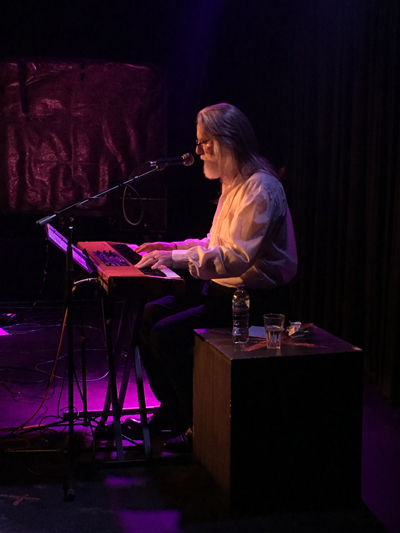
As a professional musician, in the light of the Covid-19 crisis, are you worried about the future of gigs, tours and venues? Will things ever get back to normal? What are your hopes and fears for 2021 and beyond?
JH: I don’t actually gig very much at all – never have. I love performing, but the opportunities haven’t arisen very much in recent years, just the occasional gig in London whenever I’m invited to perform. The last one was at The Lexington in 2019, with Vinny Peculiar, Simon Love and Rogers & Butler, which was really enjoyable.
I gigged a lot in the early ‘70s when I lived with my parents in Lancashire, but once I got to London and signed with a management and record company, recording became my way of life – and it still is.
But yes, I do feel for musicians and bands who can’t gig now. Those who have been gigging for years must feel completely bereft, and financially it affects them because gigs are where most independent artists sell their albums. So a whole income stream is cut off straight away.
Who knows where this will all end? Certainly, there will be venues which close and can’t afford to open again. It’s really sad. My husband is a retired actor, and he too has seen friends in the theatre who haven’t worked for months, with no sign that things are going to change for the foreseeable future. Pretty grim.
‘I feel for musicians who can’t gig. Those who have been gigging for years must feel completely bereft, and financially it affects them because gigs are where most independent artists sell their albums’
Home shows have helped some musicians, in terms of being able to perform and staying connected to fans, and some artists have monetised their performances, which keeps some income coming in at least. Who knows when we’ll be able to step back onto a stage in front of a live audience again?
What music – new and old – have you been listening to recently? Any recommendations?
JH: A lot of the music I listen to now is old. I will always love and enjoy hearing The Beatles, The Searchers, The Kinks, Joni Mitchell, Laura Nyro, Marvin Gaye, Judee Sill, Barry White, Paul Simon, Kate Bush and Roy Harper. They never grow old in my mind – the albums still sound as fresh today as they did when I first bought them, though my vinyl collection was sold off before we moved to Spain, I’m sad to say. Finding room for over 40 boxes of LPs was no longer viable. But I replaced all my favourites with CDs, and that’s still how I listen to music most of the time.
We recently bought a record player, simply because some of my albums, new and old, were being issued and reissued on LP and I wanted to hear them in that format. That led to us buying some of our old favourites on vinyl again. Also a lot of my friends were releasing their latest albums on vinyl – Robert Rotifer and Ian Button’s Papernut Cambridge, for example – so I wanted to hear those on LP.
More recently, I’ve become a big fan of the band Ex-Norwegian – they have a lovely Syd Barrett psychedelic-pop vibe. I’ve also fallen in love with the music of the French singer-songwriter Olivier Rocabois, the highly talented Joel Little and John Cunningham, whose album Fell, is gorgeous. The Norwegian singer-songwriter-pianist Cecilie Anna, who my friend, the poet Robert Cochrane introduced me to, is also remarkable. I have two of her albums and they’re beautiful.
Finally, you’re a very prolific songwriter? What’s on the horizon? Another album? Any other projects you can tell us about?
JH: ‘Prolific’ is my middle name! Though I do often take months of doing nothing between albums, once I have a project in my head I work for weeks on end until it’s finished. I’ve been having a lovely time recently recording vocals and piano for various friends’ projects, doing tracks and writing occasional songs for them. They’re all hush-hush at the moment and due out next year, but they are very diverse!
‘The next album will be a – wait for it! – concept album! Gasp! Are there still such things? I have no idea, but I’m doing one!’
What I can give you a heads-up on is a very exciting project for me. Kool Kat Musik in the States, which issued To The Left of The Moon’s Reflection in August – my first US release – will be putting out a 2CD ‘Best of JH’ next spring. It will be my first commercially-released Best Of! Edward Rogers (of Rogers & Butler) is curating the collection, Ian Button will be mastering it and doing the artwork, and Ray Gianchetti will be releasing it on his Kool Kat Musik label. I’m very excited about it! Edward has put together an intriguing collection of tracks from across my career, some of them never released commercially on CD before. Watch this space for more details early next year.
I’ve also been sketching out some new song ideas over the past few weeks, which I will start recording probably at the end of this year, or early next. The next album will be a – wait for it! – concept album! Gasp! Are there still such things? I have no idea, but I’m doing one! The story is set in my head, the characters are developing in my mind and, the narrative is growing, I just need to sit at the piano and see if it sounds any good! It will be a challenge, but I love a challenge. Otherwise I might discover what boredom feels like. I can’t have that. Put the pipe and slippers away!
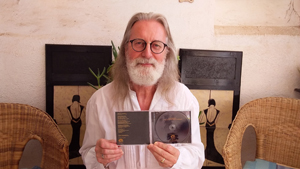
To The Left of The Moon’s Reflection by John Howard is out now on CD – in the UK, it’s released on his own label, which is also called John Howard. You can find out more information at his website: http://kidinabigworld.co.uk/
The album is also available in the US – on CD – via Kool Kat Musik, and can also be purchased from Spanish label You Are The Cosmos, which has released several of his albums already.
His latest book, Illusions of Happiness – the second volume of his three-part autobiography – is published by Fisher King Publishing.


 Say It With Garage Flowers