

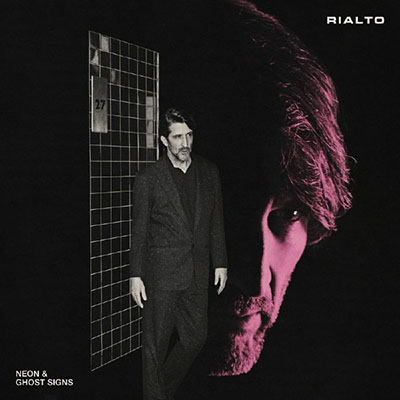
Nineties cinematic pop band Rialto are back with a brand-new album, Neon & Ghost Signs – their first record in 24 years.
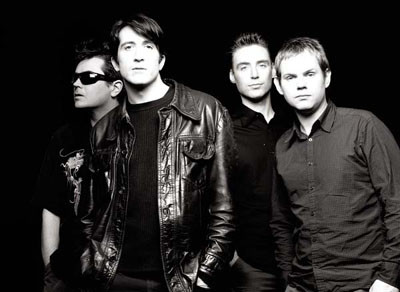
Fronted by singer-songwriter, Louis Eliot, the group split up in 2002, but reformed in early 2023 and played a handful of comeback shows, including the Shiiine On Weekender indie festival in Minehead and a couple of London dates.
Following on from the success of those gigs, Rialto signed a deal with independent label, Fierce Panda Records, and are releasing their third album, which is the follow up to 2001’s Night On Earth, this month.
Neon & Ghost Signs sounds like a natural step on from its predecessor, which flirted with moody, Bowie-like electronica and Duran Duran-style ‘80s pop, as well as the dramatic, widescreen influences of John Barry and Ennio Morricone, which were all over Rialto’s 1998, self-titled debut album, but it also explores some new territory.
Comeback single and album opener, No One Leaves This Discotheque Alive, is a big statement of intent – over handclaps and a pounding disco groove, a lascivious Eliot is on the prowl in a nightclub, playing “the hound of London town, where the sheets are stained with gold.”
It’s like a darker, sleazier cousin of Sophie Ellis-Bextor’s Murder on the Dancefloor.
The song was partly inspired by Eliot leaving behind a long-term relationship to immerse himself once more in London nightlife – a theme that has always played a large part in the band’s music.
There’s an urgency and a celebratory feel to a lot of the songs on Neon & Ghost Signs – this is down to a near-death experience Eliot had six years ago, when he was rushed to hospital for emergency surgery while on holiday in Spain.
“What you might think is if you have a very close to death experience you want to start looking after yourself,” he says. “I just went chasing full speed after my youth. I was just like, f*** it, I might not be here next week, so I’m just going to dive in!”
I Want You is a glitter-soaked, glam rock stomp, and there’s more epic disco on the shimmering, ABBA-flavoured, Taking The Edge Off Me, with its cascading piano and soaring strings.
The edgy and European-sounding, Put You On Hold, is John Barry-meets-the-Bee-Gees, while Cherry is delicious, futuristic robo-funk that struts the same catwalk as Bowie’s Fashion.
There are some reflective moments amidst all the dancefloor shenanigans. The album’s gorgeous title track, which is cocooned in warm, pulsing synths, is a bleary-eyed, comedown ballad that’s one of the best things Eliot has ever written – an ‘us against the world’ love song, like 1998’s The Underdogs.
Sandpaper Kisses is another relationship ballad, but it’s about love gone wrong:“Sandpaper kisses, stinging on your lips. The one you want to hold in your arms is slipping from your grip.”
Eliot juxtaposes the barbed lyric with a charming and nostalgic tune that has echoes of ‘50s instrumental rock and roll duo Santo & Johnny, complete with a great, twangy guitar solo.
‘There are some reflective moments amidst all the dancefloor shenanigans. The album’s gorgeous title track, which is cocooned in warm, pulsing synths, is a bleary-eyed, comedown ballad that’s one of the best things Eliot has ever written’
The atmospheric and romantic ballad, Remembering To Forget, is so beautiful that Scott Walker could’ve sung it, while second single, the glam strut of Car That Never Comes, is another of Eliot’s songs about escaping and driving through the city under the cover of night – it can be parked alongside The Car That Took My Love Away, from 2000’s mini-album, Girl On A Train, and Drive from Night On Earth.
In an exclusive interview, Eliot speaks to Say It With Garage Flowers about writing the new album, and shares some of the influences and inspirations that shaped the songs on Neon & Ghost Signs.
“I genuinely think this album is the best one,” he tells us. “It’s a grown-up record but perhaps not a graceful one…”
Q&A
When we last spoke, in January 2024, after Rialto had reformed and played some comeback shows, which included some new songs, you said you were hoping to make a new album… Well, now it’s here and it’s being released by Fierce Panda Records…
Louis Eliot: Yeah – the new songs went down well live and Simon Williams from Fierce Panda was at some of the gigs, which was great… I was going to say he jumped on board, but he moved slowly but assuredly… (laughs). I immediately liked Fierce Panda – Simon and I got on, and he seemed to have the right attitude.
So, really, it was finishing off something that was already started. Some of the new songs were written since we spoke last year, but most of them were written in the last three or four years, and even further back. A couple of the songs had been knocking around for a while, but they felt like they fitted. There’s been a lifetime between this album and the last Rialto one, but what a luxury to have.
You told me you hadn’t originally set out to make a new Rialto album, but that the songs you were writing had more in common with Rialto than your solo work or the songs you’d done with your band, The Embers... So, was it a case that Rialto reformed by accident because the songs you’d written dictated it?
Louis Eliot: I’d say that’s true – it was a combination of different things coming together at the same time, and it just made absolute sense for it to be Rialto. I just felt that the songs were revisiting the same world but 20-odd years later, and I’ve got a slightly different perspective, and people have probably got a different perspective of me. A lot of it is about searching for thrills, isn’t it? But it’s also about heading out into the night to search for the person that you think you might’ve missed out on being… but what you find is some bruises in the morning…
A few years ago, you had a near-death experience in Spain and ended up in hospital, which made you re-evaluate your life. Some people decide to take it easy after a health scare, but it made you want to get back there and make the most of it while you still can, didn’t it?
Louis Eliot: There was definitely a feeling of that. It was quite a traumatic thing… It’s funny, but, after a few months, I felt pretty much like I’d recovered, and those clichés, like ‘life’s not a rehearsal,’ were resonating pretty deeply, so there were certain things in my life that I changed at that point. So, I dived in and I found myself back in the city at night, exploring and looking for something, although I’m not sure what…
The song Car That Never Comes is about hanging on for someone or something to carry you away. I think there are a few songs on the record that visit that feeling.
Car That Never Comes is the latest in a series of songs you’ve written about escaping at night by car… I’m thinking of Drive and The Car That Took My Love Away…
Louis Eliot: I need to come up with some new ideas… (laughs). I think the first imagery that I came up with for the song was the headlights going past the window… Songs find themselves as you write them – you’re often not sure what they’re about and then it starts becoming clear… That song is about hanging on for something to happen, although whether it does or not…
The phrase ‘waiting for a car that never comes’ could also mean that someone is no longer famous – the car that used to pick them up to take them somewhere glamorous isn’t coming anymore…
Louis Eliot: Absolutely. I think there’s a feeling of the inevitable in that song – you know the car isn’t coming, yet you still hang on for it. That’s the double-edged sword that goes with that hedonistic pursuit.
The album has some of the classic Rialto hallmarks we know and love – the title alone, Neon & Ghost Signs, is very Rialto – but you’ve also added in some other influences, like disco and glam rock.
The first single and opening song, No One Leaves This Discotheque Alive, doesn’t mess around – we’re plunged straight back into that seedy world of London nightlife that Rialto inhabit, but it sounds like the dark, sleazy cousin of Murder on the Dancefloor by Sophie Ellis-Bextor…
Louis Eliot: I’m happy with that. I think that song came from when I was working on something for a friend, but I ended up using it for me. What can I say? I can definitely hear what you’re saying about Murder on the Dancefloor… I was thinking of ‘80s Leonard Cohen, but backed by Benny and Bjorn! I wanted a song that had that idea of knowing you’re on thin ice but you’re going to do a pirouette anyway! I hope it’s amusing – it’s not too dark and I hope people find some humour in it.
‘In a lot of ways, glam rock and disco are connected – they just wore different trousers…’
The album wouldn’t be a Rialto record if it didn’t have the things that people liked about Rialto from the past, but there wouldn’t have been a whole lot of point doing it if I hadn’t brought new things to it.

I think it feels like the natural successor to Night On Earth, even though it’s 24 years on.. You were exploring Bowie influences on that album, and the song Cherry on the new album has that feel – it reminds me of Fashion... It even has the ‘beep beep’ line in it…
Louis Eliot: I probably shouldn’t have done that, but it made me laugh. I shouldn’t laugh at my own jokes… I’d written this line: ‘you’re standing in the headlights, sleeping with the wrong types…’ When I was singing it, I found myself saying, ‘Beep, beep…’ It’s clearly a nod…
If you sit down with a record and try and rip it off, it’s never going to have any magic… In my head, I was actually doing something that was a bit Talking Heads when I was making that tune… Lyrically I was trying to do something that was impressionistic – like snatches of conversation at a party. I was trying to paint a picture and put you in the scene, and, of course, there’s a Bowie influence, but I was thinking of Prince if he’d hung out with Bowie…
Put You On Hold has a disco feel, but a cinematic, European sound too…
Louis Eliot: I think you’re right – I agree.
It’s Barry Gibb meets John Barry…
Louis Eliot: (laughs): It’s John Barry-Gibb! That’s a good name for a band.
As well as disco, there’s some glam rock on the album: I Want You and Car That Never Comes…
Louis Eliot: Yeah. In a lot of ways, glam rock and disco are connected – they just wore different trousers… One followed the other really. I think there’s a spirit in both of them that crosses over. That glam shuffle is just a great groove, isn’t it?
One of my favourite songs on the album is the title track, Neon & Ghost Signs, which is a classic Rialto ballad – an ‘us against the world’ love song that’s set against the backdrop of a rain-soaked, nocturnal London. I think it’s one of the best songs you’ve ever written…
Louis Eliot: Thank you. It’s one of those songs that came quite easily. Ghost signs, as you know, are those faded advertising hoardings that you see on the side of buildings, so Neon & Ghost Signs is about looking forwards and backwards at the same time – it’s the thrill of the neon and the draw of the night ahead, but you’re carrying the past with you. I was trying to write a song that isn’t just about a fleeting love – it’s somehow about a bigger love that comes about the older you get. It’s when you realise you have a connection with people and it’s about your experiences with them, regardless of whether you’re in a relationship, or whether you’ve moved on… All of that stuff counts and should be respected. I guess it’s coming to terms with that and singing the praises of those connections you have with people – even if it’s just on a night out. And I don’t just mean a romantic connection – it can be platonic… It’s the stuff that counts.
It’s also quite possibly the first pop song to mention ‘Nytol…’
Louis Eliot: (Laughs). Yeah – I want a sponsorship deal from them.
Remembering To Forget is another great song on the new record – it’s a ballad that’s so beautiful Scott Walker could’ve sung it… It has a lush, romantic ‘60s feel and then you make it a Rialto song by singing about vapour trails in the city… That’s a nice contrast…
Louis Eliot: Thanks – I hadn’t thought about that. I’m happy with that. It’s quite a sad song but it also has a funny feeling about it – it has something…
Sandpaper Kisses is a highlight for me – it’s another ballad, and it has an atmospheric ‘50s sound, with twangy guitar. I could imagine Richard Hawley singing it…
Louis Eliot: I didn’t set out to write a ‘50s crooner ballad, but, of course, it’s got some of that, but it’s offset with a drum machine. I’m really glad you like that song because I was toying with putting it on the record or not, and I’m now glad I did because it’s gone down well. People have said it’s like Little Anthony & The Imperials or Patsy Cline.
 So, are you pleased with the album? You should be… it’s great…
Louis Eliot: I am. I genuinely think it’s the best one. I know bands always love the latest thing they’ve made, but I think it’s a good album and that age has helped me write a better record. I’ve had more experiences and I’m better at writing somehow. And why not? Leonard Cohen carried on writing great records…
It’s an unalloyed look at being middle-aged. It’s a grown-up record but perhaps not a graceful one.
It has its tongue in its cheek at times, and it’s also celebratory… It’s occasionally melancholy and reflective, but not self-pitying…
Louis Eliot: It’s like a mid-life crisis, but I like it! It’s not packed with obvious jokes but I hope people can sense that it’s not taking itself too seriously and neither am I. I think I do have a melancholic strain in my writing…
You’re playing some UK gigs this year, including some supporting Sleeper. Will you be going to discotheques after the shows?
Louis Eliot: Why ever not?
Neon & Ghost Signs is released on April 25 (Fierce Panda Records).
For Rialto live dates, visit www.rialtomusic.com



 Say It With Garage Flowers