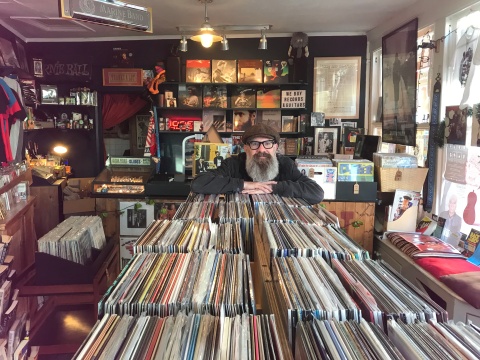
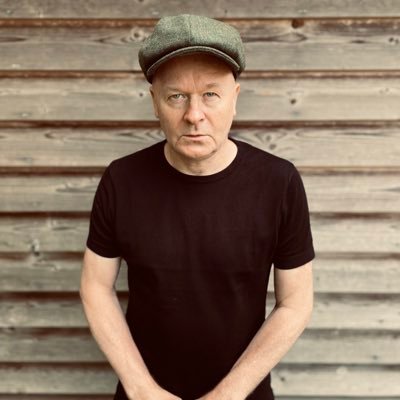
 “I’ve got pheasants following me around – they’re not pets, honestly,” says Matt ‘the Hat’ James, former Gene-drummer-turned-singer-songwriter, speaking to Say It With Garage Flowers on the phone from his garden in the East Sussex countryside, shortly before the release of his debut solo album, Breaking The Fall.
Despite the local birdlife, he hasn’t turned into an eccentric rock star recluse, although after the demise of Gene and his next band, Palace Fires, several years ago, he did leave the music business to pursue a career as a wine merchant, but he’s recently been tempted back into it, and, in 2019, he started writing songs on his own for the first time and rekindled his passion. Three years later, the results are now out in the wider world.
“Having the record out there is the best feeling – I can’t stop looking at the vinyl,” he enthuses. “Musically, I think it’s strong enough to win over new fans.”
It’s hard to argue with him. Listening to Breaking The Fall, which is one of our favourite albums of the year so far, it’s clear that he’s got his mojo back.
Although it’s a debut record, it sounds like a best of collection – 10 memorable, varied and, at times, very personal and emotional, songs that embrace folk, country/ Americana, soul, indie-rock, Spaghetti Western soundtracks and ’60s pop.
‘Having the record out there is the best feeling – I can’t stop looking at the vinyl. Musically, I think it’s strong enough to win over new fans’
Occasionally it recalls Gene – the country-soul of A Simple Message and the anthemic ballad Different World – but most of the time, it’s the sound of someone experimenting with different styles and enjoying being in the studio again after a long time away.
“I’m sort of trying everything out – I have thrown it all in there. Perhaps on future albums I’ll take more of a single direction,” he says.
Stepping out from behind the drum kit to put himself in the spotlight for the first time, Matt has relied on some old friends to help him out.
Former Gene band mates Steve Mason (guitar) and Kevin Miles (bass) are along for the ride, as is keyboard player, Mick Talbot, (The Style Council, Dexys Midnight Runners), who played live with Gene and on radio sessions.
Production duties are taken care of by former Gene associate, Stephen Street, (The Smiths / Morrissey, Blur, The Cranberries) – sonically, the album is rich, colourful and diverse – and there’s some guitar work by James’s friend, Peredur ap Gwynedd (Perry for short), from electronic rockers Pendulum.
We got Matt to talk us through the writing and recording of Breaking The Fall, share some of his thoughts on the songs and let us know what it feels like to be back in the game…
 Q &A
Q &A
I was expecting the album to open with a big song, but the first track, From Now On, is quite low-key, with a country/Americana feel. It’s stripped-back…
Matt James: I deliberately wanted that – it suits the nature of the lyrics, which are about coming home. It’s a little folky number and the song is a metaphor for me returning to do music. That’s a general theme on the album.
I didn’t want a big bang at the front – I wanted it to be like the Badly Drawn Boy album [The Hour of Bewilderbeast] with something little at the beginning, before one of the big tunes.
The song sounds like it has an accordion on it…
That’s Mick Talbot doing an accordion sound on the keyboard. He’s multi-talented and he’s good to hang out with – he’s so funny. He has a brilliant sense of humour and his stories are immense. He’s full of energy and the moment he plays, it lifts any room. It was quite a moment having Mick there, because I hadn’t really seen him since he played with Gene.
Champione was written about your dad…
MJ: Yeah – he was someone that I loved but he was plagued with problems, and it was quite difficult being his son. Throughout his whole life, he continued to go downhill, and he ended up getting quite desperate and being very needy of everyone else, without going into details.
‘I’m more likely to better communicate the things I want to talk about in my songs if they’re about highly personal subjects. That’s the great thing about writing – it’s a cathartic experience’
He was a difficult character – the song starts off being quite angry. I call him “champione of none” but I end up forgiving him. When someone has passed away you have the choice to remember the good stuff – if you want – but it’s tempered with the difficulties. I now think of him fondly most of the time, but I really wanted to get it out in this song.
I’m more likely to better communicate the things I want to talk about in my songs if they’re about highly personal subjects that are unique to me. That’s the great thing about writing – it’s a cathartic experience.
High Time is another autobiographical song. It’s about the serious road accident that your pre-Gene band, Spin, were involved with, back in 1991, and it also mentions the first time you met Martin Rossiter – who went on to front Gene – in the Underworld, in Camden…
MJ: Yes – that song and Champione were two hard ones to write. I’m quite glad I did it – I hadn’t done it before and I didn’t know how it would feel. I was determined to put some real emotions and some reality in them. On those particular songs on the LP, I think I’ve made that connection the best. There are touches of comedy in some of the lyrics.
High Time is dark and atmospheric…
MJ: It’s a difficult subject matter – I wanted a sombre, driving feel and I was thinking Johnny Cash. The song is about random events – good and bad. Things that you don’t have any control over, but they can completely change your life. It’s an interesting concept.
The title track is one of the darker and saddest songs on the record – a big, anthemic ballad. Why did you choose that one to name the album after?
MJ: It was mainly because of the lyric – me returning to music. I’ve never written songs completely on my before. I’m a pretty happy guy and I’ve got a good life… but I looked at myself and, under the exterior, I was really quite sad about never doing music again, because, if I’m honest, I think it’s probably what I’m best at.
People I knew were making a stand and doing their music, and I wasn’t doing anything, so I took a decision to reverse that. That’s what Breaking The Fall is about – it conjures up the sadness of it. I’m drawing under a line under it, but it’s a long journey back and I think I will improve a lot from here.
When did you first start writing songs on your own?
MJ: 2019. The first song I wrote was Snowy Peaks – it was a joyful one. I wrote the verse while I was on holiday and it was sort of a love song. I played it to Steve Mason and he said: ‘That’s really good, but you need another bit…’
That was the turning point. I wrote a lot of songs for the album. It was a bit like with Gene, when, for some albums, we would write 20 or 25 tracks. I remembered that you have to do that to have a strong record. After I finished the album, I had songs left over and I’ve written quite a few more.
The album is very varied in styles. Born To Rule has mariachi horns on it and a bit of a Spaghetti Western feel..
That’s me experimenting – I’m sort of trying everything out. Perhaps on future albums I’ll take more of a single direction.
I think the two songs that most remind me of Gene on the album are A Simple Message and Different World…
MJ: Yeah – I didn’t want to do too much like that. I was aware of it. I was channelling Gene with A Simple Message – I had that kind of guitar style…
It was also the first single you released from the album…
MJ: Kev said that song was his favourite – I knew it was a strong song. It’s definitely one of the best on the album.
On Different World, I was channelling Burt Bacharach and Dusty Springfield – that’s sort of where I was coming from. Whether I succeeded or not, I don’t know…
I can definitely hear that.
MJ: It also has a strong and simple lyric.
Sad, which has a soul feel, is one of my favourite songs on the record. It has Mick Talbot on keys, which gives it a slight Jam and Style Council vibe. The chorus is great…
MJ: My niece, Olivia, who is still at school, sings backing vocals on it. She stepped up… she loves musical theatre. She’d never been in a recording studio before and it was really good fun. She came up to London and it was a great day – she sang on two tracks, Sad and Snowy Peaks.
‘On Different World, I was channelling Burt Bacharach and Dusty Springfield – that’s where I was coming from. Whether I succeeded or not, I don’t know…’
The last song on the album, Fireships, starts off stripped-down, but it soon builds and turns into an epic…
MJ: It’s a song about a breakup – I’m wallowing in self pity. Many people will understand that. I really do like the end section – it’s probably my favourite bit of music on the album. I’m a real sucker for an anthemic song that builds.
It’s a nice way to close the album. The whole record feels like a complete piece of work – 10 songs, bang-bang-bang and no messing around. It works well on vinyl too – five songs on each side. Like the old days. I think too many acts make albums that are overlong. Ten or 12 songs, at a push, will do me just fine..
MJ: I agree – you don’t need to outstay your welcome. Put them on another album or an EP. I think 10 is about right. It felt good for this record. I don’t think I put even the best songs on there but it’s the 10 that worked at the time. I know I have some other really strong songs.
Let’s talk about recording the album. You made it at Stephen Street’s studio, in Latimer Road, West London, but do you also have a home studio?
MJ: I have my drum kit and guitars in my office, but the only thing I record on [at home] is my phone. I went to proper studios to record the drums – not at Streety’s because he doesn’t have a drum room.
 Steve Mason and I tend to send things to each other via WhatsApp – he recently sent me an absolutely brilliant riff that’s really bluesy. I love it!
Steve, Kev and Mick all came to Streety’s studio in Latimer Road – Damon Albarn does his Gorillaz stuff there upstairs – we saw him around. He was nice. I haven’t been in that world for so long.
How did it feel being back in it?
MJ: It was really nice, but there were times when I felt a bit shy being back in a recording studio.
How was it working with Stephen Street?
MJ: He’s a real grafter – he puts a proper shift in and can put his hand to anything. He works his arse off until about six o’clock at night. I remembered that from when I worked with him in the Spin days – we were signed to his record label.
‘I’m basically a wine merchant who’s putting music out’
He took the demos for my album – he went through everything and picked what he wanted. Some we rerecorded completely. Streety produced the whole album, but it’s not a big-budget production – I couldn’t afford that.
Perry from Pendulum plays guitar on the record…
MJ: He’s a mate and is a super talent. For someone who is quite a metaller, he can play so much – he can shred it and go super-fast, but he was a session musician for many years, playing on so many different records, like Natalie Imbruglia.
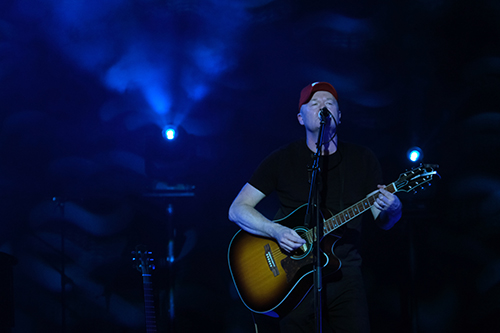
The album’s available on vinyl and digital. Any plans for a CD version?
MJ: Not at the moment – I’m basically a wine merchant who’s putting music out. I don’t have any management, but everyone’s helped out and stepped up. I feel that it’s very early days.
I think the album will be a word of mouth record…
MJ: Musically it’s strong enough to win over new people. Some Gene fans will be supportive but they’re fans of Gene – they’re not fans of me. They might wish me well, but they like to hear Martin singing! [laughs].
I’ve got to find my audience – I’ve drawn a line in the sand and I’m making my way back. Every little thing that comes in just cheers me up. It’s not like I’ve just been signed by a major label and they’re saying, ‘You’ve got to do bloody well, mate, or you’re out on your own…’ It’s a nice feeling – let’s see where it goes.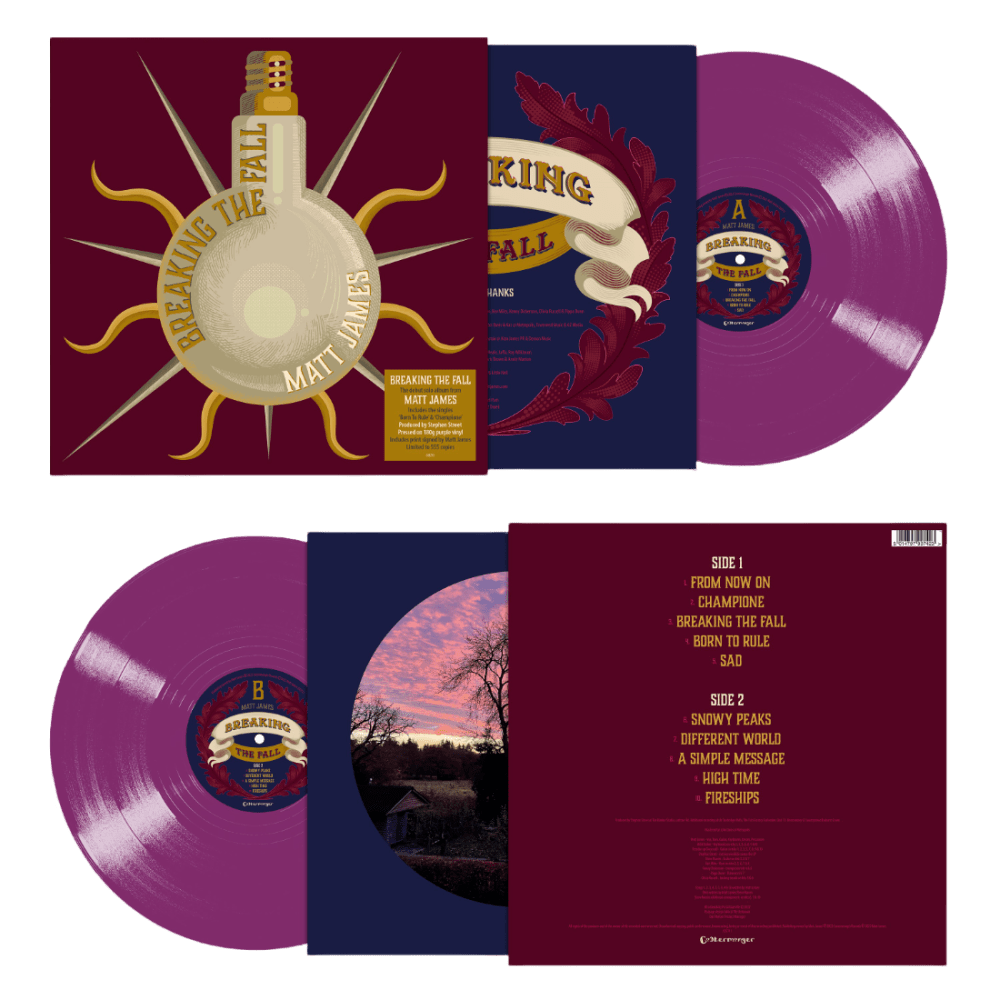
Breaking The Fall is out now on vinyl and digital (Costermonger Records)
https://musicmattjames.bandcamp.com/


 Say It With Garage Flowers