

‘I’d rather see us in the charts than Gina G’ [Richard Hawley : Oct ’96]

richard-hawley_show_info

Before Richard Hawley found fame as a solo singer-songwiter, he was the guitarist in Sheffield indie rockers Longpigs. Back in October 1996, I spoke to him about the Sheffield music scene, the Longpigs’ debut album, The Sun Is Often Out, and touring America…

Imagine the clumsy and naughty fumblings of a young boy…

“My father said I couldn’t touch it, but I got it out one day and he came into the front room and I was playing with it – I was only six,” says Richard Hawley of Sheffield band Longpigs.

That was the day he first played his father’s guitar.

“He said, ‘do you like it, then?’, he showed me some chords and that was it,” says Richard. “When I opened the guitar case, it looked like a spaceship. I didn’t give a shit whether it caught rhinos, or made tea for me mum – it was what I wanted to do with my life. It was a good job it was a guitar and not something that you caught rhinos with, ‘cos I’d ‘ave had a bit of a job finding rhinos round ‘ere.”
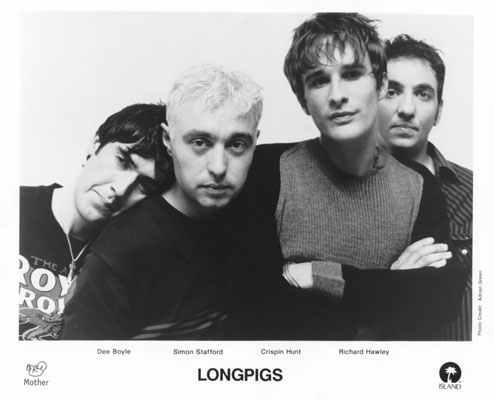
longpigs_promophoto


Sheffield may not be known for its rhino population, but it has become a breeding ground for Britpop acts such as Pulp and Babybird.

“Sheffield’s never been famous for anything except steel and Joe Cocker,” says Richard. “The thing that’s beautiful about the city is that you can isolate yourself really easily – you don’t have to be part of a scene. There’s us, Pulp, Babybird, Blameless… That’s a pretty eclectic bunch, really. Just recently, Sheffield has kind of popped its head up again in popular culture. Pulp and Babybird have been knockin’ around for a long time and we’ve been going for three years. Sheffield seems to be a city that produces old men of rock.”

Longpigs have had a pretty tough few years, due to a string of unfortunate events and record company wrangles, but they now seem settled and comfortable and things are finally looking up for them.

‘There was a very dark period where we all nearly got killed in a car crash and we lost our record deal’

“We’re appallingly contented,” says Richard. “There was a very dark period in the past, where we all nearly got killed in a car crash and we lost our record deal. The company closed down in the UK after spending so much money on Police Academy 93 or whatever.

“In retrospect, all those things were quite cathartic. What was important to us was sticking together and making music. We believed that what were doing was good. I’m glad we did. I’d rather see us in the charts than Gina G.”


The band released their debut album, The Sun Is Often Out, earlier this year. The songs range from indie rock and pop to torch song ballads, folk and modern blues.

“Crispin [vocals/guitar and main songwriter] fancies himself as Cole Porter. He comes along with his nice songs and our job is to ruin them. That’s it, really,” says Richard, who has also recently turned his hand to songwriting.

“Me and Crispin are co-writing stuff and that will probably flourish. It’s still mainly Crispin writing the songs. His twisted outlook on life is definitely something I couldn’t do.”

This December, Longpigs will be shutting themselves away to write new material for their second album.

“We’re looking forward to the next record,” enthuses Richard. “God knows what it’s going to sound like – it will just happen.”

Longpigs have recently returned from a tour of the US and also played in Canada with The Bluetones.

“We don’t hope to break America – we want to mend it,” says Richard. “The two main exports from the US are the beefburger and rock and roll. I definitely prefer rock and roll.”


The original version of this article first appeared in Splash! magazine in October 1996.


‘Britpop’s dead – it’s a rotten corpse lying on the floor’ [Sleeper: Feb ’98]

sleeper_95.jpg

Back in February 1998, it looked like it could all be over for Britpop band Sleeper. Their last few singles had hardly set the world on fire and some of their gigs had been cancelled, due to a lack of interest. But despite all this, when I spoke to frontwoman Louise Wener, she was adamant they weren’t splitting up… In fact, they called it a day a month after this interview…

Are Sleeper well and truly down the dumper?

Last month, rumours about the band’s demise appeared on the internet, and in the NME, a representative from their US record label hinted that there was tension between frontwoman Louise Wener and drummer Andy MacLure, who is also Louise’s boyfriend.

The rumours come as no surprise, though – Sleeper’s last two singles, She’s A Good Girl and Romeo Me, barely dented the Top 40 and two of the dates on their current tour were cancelled due to poor ticket sales.

Despite this, Louise is adamant that Sleeper aren’t about to disintegrate…

“We haven’t got any plans to split up. The press are evil little shits – that’s my response to the rumours,” she says, talking to me on the phone from London.

“We’ve got various problems with our American record company, but it’s not as bad as some people would have you believe.

“Things appear on the internet all the time. The thing about me and Andy splitting up was utterly made up by the NME. I was angry about it for half an hour, but I’ve got used to things like that.”

‘We haven’t got any plans to split up. The press are evil little shits – that’s my response to the rumours’

So, there are no plans for a Louise Wener solo album, then?

“I’ve done 10 solo albums already,” she jokes. “No. I’d have to fight it out with the other pop star called Louise. I wouldn’t know what to call myself. Send your answers on a postcard…”

So is the current mood in Sleeper a healthy one, then?

“Yeah – it is. We’re making plans for the next thing we do, which will probably be quite radically different. We’re pretty up about it – we’re still relevant.”

I ask her if she’s disappointed by the poor performances of the band’s recent singles and the lack of interest in their gigs.

“It was kind of our turn,” she says. “Every band goes through up and down phases. It’s just life and you have to get on with it. We think that we made a really great album [Pleased To Meet You]. You have to go forward with your own belief in what you do. Things just go up and down – that’s the nature of most bands’ careers.”

Ironically, Sleeper’s latest album, Pleased To Meet You,  is their best yet. Although by no means a classic – and it could hardly be described as a massive departure for the band – it’s more eclectic than their past offerings.

She’s A Good Girl touches on soul, Romeo Me is all-out, Pretenders-style guitar pop, Firecracker is Alvin Stardust-esque glam, and Breathe and Because of You are haunted by the ghost of trip-hop.

Does Louise think that Sleeper should’ve overhauled their sound more dramatically to fit into the current post-Britpop climate?

“Britpop’s dead – it’s a rotten corpse lying on the floor,” she says. “I think it’s good that it has gone and that everything’s changing. It’s really interesting to see what’s going to happen next. That’s why music’s exciting.

“Maybe we didn’t change enough to go with it. We kind of thought we’d come back and everything would be exactly the same. Maybe we lacked some foresight.”

Pleased To Meet You did see a big shift in Louise’s lyric writing. No longer was she penning observational songs about commuters and office workers – instead she addressed more personal issues.

“I couldn’t keep writing about other people, ” she says. “It [observational songwriting] was the essence of what Britpop was about, but that kind of life is alien to me now. It’s not something that belongs to me anymore.”

‘We might just get an Uzi and kill a few people’

This month, Sleeper are heading out on a national tour and, after that, there’s going to be some serious rethinking on the musical front.

“Me and Andy are planning to go and live in America for six months to write and do some other stuff,” says Louise.

“Whatever happens next, it will be quite different. It will be a good thing. We’ll be shaking ourselves up a bit.”

So what can we expect?

“We might just get an Uzi and kill a few people.”


The original version of this article first appeared in Splash! magazine in February 1998.