
Amerikana Arkana, the debut album by The Magic City Trio, is a haunting record, in more ways than one…
Its wonderful orchestral arrangements recall the dramatic ’60s pop of Nancy Sinatra and Lee Hazlewood, (Black Dog Following Me), the moody Spaghetti Western soundtracks of Ennio Morricone (Cousins’ War) and Mexican Mariachi music (Trav’ler), but these story songs are also steeped in the dark traditions of murder ballads, old country and folk laments, outlaw tales and hillbilly blues.
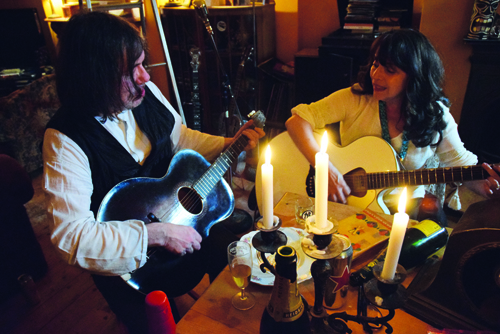
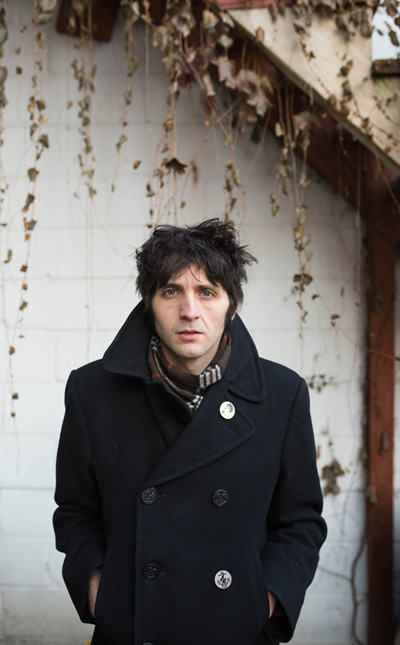
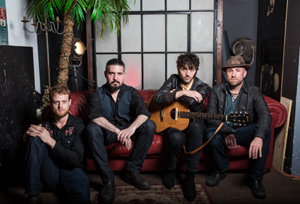
This band of London renegades comprises Frank Sweeney (guitar, vocals and fiddle), Annie Holder (guitar,vocals and autoharp), Adi Staempfli (bass and vocals) and Charlotte Burke (drums and percussion). Guesting on the album are Johnny Butten (banjo) and Eddy Dunlap (pedal steel).
In an exclusive interview, I spoke to Frank, who was a member of ’80s indie pop outfit The June Brides, and played on records by Primal Scream (Imperial) and Felt (Space Blues), to find out the full story behind this magnificent and, er, magical album…
Q & A
Amerikana Arkana is one of my favourite albums of the year. It’s a big-sounding record – I love the orchestrations…Musically, it often harks back to the lush ’60s pop of Nancy Sinatra and Lee Hazlewood, and the Spaghetti Western soundtracks of Ennio Morricone. There’s also folk, country, hillbilly and murder ballads.
When I first heard it, it was like someone was going through my record collection and referencing some of my favourite artists… I guess that, like me, you’re big fans of Nancy & Lee and Morricone? Why do you love them so much?
Frank Sweeney: I think Lee Hazlewood was a genre all to himself. He ploughed his own particular furrow and didn’t really care if it was fashionable. He was a great songwriter and producer, but he never felt the need to be in step with current trends or the mainstream. And he still managed to make a lot of classic hit records. Although he always maintained that his main motivation was to make money, he still managed to make great art sometimes.
Ennio Morricone uses a very ‘pop’ sound in his orchestration with unusual instruments. A whistle and a twangy guitar and you immediately evoke his western soundtracks. And loads of his soundtracks have at least one great catchy and evocative tune. I also love Nino Rota, who, in my view, is the other great Italian soundtrack composer. His stuff with Fellini is just as evocative, but on a less epic scale.
‘The amount of inter-band romances were comparable to Fleetwood Mac, and led to us going our separate ways’
How did The Magic City Trio first come together?
FS: During the tail end of indie-dance and the dawn of Britpop, I was playing viola in a band which played Eastern European music, when there were only two bands doing it in London. Adi Staempfli played bass, and Annie joined after I had left. The amount of inter-band romances were comparable to Fleetwood Mac, and led to us going our separate ways. I met Annie a few years later, and we eventually married in Las Vegas.
We hadn’t done any music together for a good few years. I was (trying to) learn Blind Blake [blues and ragtime guitarist and singer] stuff to up my game on the guitar, and from there we got interested in other pre-war music, what became known as ‘the old weird America’. From there we did a set of pre-war music (Carter Family, Hawaiian, Emmett Miller) at the Easy Come, which is a well-established open mic night in South East London. But we didn’t take it any further than that. We began including our own songs – Oliver Curtis Perry Part 1 was an early one. It was mainly so we could do stuff that other people did not have in their set. Adi returned from Switzerland and joined us in 2013.
We had a gig in Berlin – that was our first as The Magic City Trio. The name originated from a pre-war fiddle band called Dyke’s Magic City Trio. I had one of their records on a 78 rpm.
We thought that we would only use the name for the Berlin gig, as people were more likely to go and see a band, rather than just Frank and Annie. We didn’t intend to keep the name, since Dyke’s Magic City Trio are relatively famous, it would be like calling yourself The Kinks or The Who in about 2045, but the name stuck…
Let’s talk about your album in more depth. I admire your grand ambition and the fact that you’ve gone all out with the orchestral arrangements. How did you approach this album when you came to record it? What did you want it to sound like?
FS: Black Dog Following Me was completed before our 2015 EP [A Funnel Cloud In Albuquerque], but I didn’t like the orchestral sounds, so I scrapped it all, apart from the singing. Once it was redone, we decided to follow suit with the rest of it, instead of making it just an acoustic LP. The orchestral sounds are a mix of samples, live instruments and recordings of actual notes that are stitched together. Oliver Curtis Perry had the least amount of strings and things, as Johnny Butten playing banjo was an orchestra in itself.
‘I was looking for the Chet Atkins ‘Nashville sound’, which is stylistically unfashionable now’
The arrangements all began with a basic piano track with chords, and then we added everything else. I‘m a huge fan of baroque ‘60s pop, so a harpsichord nearly always got in there. Once all the orchestral stuff was done, we put on the live instruments, which is the opposite way it would be done with a live orchestra.
The other sound I was looking for was the Chet Atkins ‘Nashville sound’, which is kind of stylistically unfashionable now – the song 22 was my attempt at that.
Now you mention it, the album does have a lot of different styles of orchestration on there. Trav’ler is like the stuff David Angel did on Love’s Forever Changes, Down In The Willow Garden was looking for a Pearls Before Swine-type of sound, and Billy Strange and Jimmy Webb all are referenced on there somewhere.
With The June Brides and the other stuff I did for Creation Records, I was trying to do large string parts, but limited by budgets and my lack of skill on the viola. But on those records you can hear me trying to do something that I just can’t quite pull off. I nearly got there with This Town (June Brides), Space Blues (Felt) and So Out of Touch (Joe Foster).
The dramatic opening track, Black Dog Following Me, is pure Nancy & Lee. I’m guessing it’s about depression? ‘Black dog’ is a term that Winston Churchill used to describe his dark moods. What can you tell me about that song?
FS: Yes that’s it, more or less – a dialogue where one person can’t see a way through, but the other won’t let it get on top of them. The arrangement is pure Billy Strange with Nancy & Lee. I didn’t think they did enough stuff like Some Velvet Morning, so this was my addition. In the same way that Jeff Lynne didn’t think The Beatles did enough stuff like I Am The Walrus.
Cousins’ War has a definite Ennio Morricone feel, but with a country edge…
FS: Annie started that song, after reading a book about the Wars of the Roses Originally it sounded a lot more folky. I thought of it more like the Hatfield-McCoy type of scenario. I did the last verse after seeing a Twilight Zone episode where all the American Civil War dead are walking on a road. That’s why in the LP booklet, there is a picture from a Civil War bubblegum card called Painful Death. The line about the sowing the hydra’s teeth is from Jason and the Argonauts, which explains the fighting skeleton picture in the booklet.
The chorus is adapted from [folk song] Darlin’ Cory. The instrumental sections do give it that Morricone sound – it’s the low male vocals that do it I think, which are reminiscent of Story of a Soldier [from the soundtrack of The Good, the Bad and the Ugly].
I love the descending twangy riff that kicks off Dust of Mars – it sounds like a nod to Nancy Sinatra’s These Boots… and The Kinks’ Sunny Afternoon…
FS: At the time, I didn’t think that sequence of notes was particularly unique to Sunny Afternoon – it must have been used in loads of other places. So I didn’t think I was taking anything from that song that hadn’t been used somewhere before. But as time has gone on, I have to conclude that the sequence is not particularly common in pop music, and is more or less unique to Sunny Afternoon. I’m glad I made it so obvious, but it’s a bit like using the opening riff from Day Tripper on a song…
Oliver Curtis Perry Part 1 has a hillbilly vibe. Where did this outlaw song come from? What was the inspiration?
FS: Oliver Curtis Perry was the first person to rob a train single-handed, in New York in the 1890s. The song tells his story, with a little bit of artistic license. The words are on our website. I first read about him when I was 11 years old, in a book by James D Horan, a noted Western writer. There wasn’t much detail given. The – wonderfully named – writer Tamsin Spargo read the same book as a child, and years later published Wanted Man, which tells the whole story.
The song 22, which sounds like a Johnny Cash and June Carter country duet, also reminds me of Kirsty MacColl…
FS: I didn’t think of that – I’m only familiar with her hits. It’s probably the vocal harmony that gives it that. She was a great singer and writer, with a unique voice. This was our attempt at getting the Chet Atkins Nashville sound. The demo we did sounds like the Carter Family – we recorded it on a four-track cassette using pre-war Gibsons to sound as old as possible. The demos are interesting as they show how the song developed – each version is different. The plot is from a short story by Daniel Woodrell about someone who suspects his neighbours of murdering his child.
Talking of murders… Down In The Willow Garden is a classic, traditional murder ballad. I know it from The Everly Brothers album, Songs Our Daddy Taught Us. Why did you decide to cover the song for your record?
FS: My grandmother’s name was Salley – I was looking for the origins. I came across a poem by Yeats called In the Salley Garden, which is adapted from Willow Garden, and I found the various versions. Most of which sounded a bit too jolly melodically.
The Everly Brothers recording sounded suitably bleak. So we worked on a minor key version. We had to change the harmonies as we were still smokers and couldn’t reach the notes – since we have now quit we can get there!
I wanted to do a Pearls Before Swine-type arrangement. Songs Our Daddy Taught Us is a brilliant album. They recorded it to get out of their contract without giving away any hits, and they ended up with a masterpiece.
Where did the title of the album, Amerikana Arkana, come from?
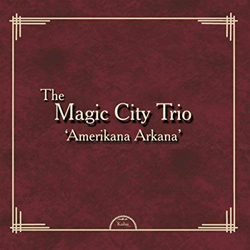
FS: I always loved the album cover of Agents of Fortune by Blue Oyster Cult, with a man holding Tarot cards. Though the real agents of fortune are the 52 standard pack of cards, the Tarot decks are called the lesser and greater arcana. The greater arcana features all the well-known picture cards. The songs were going to be very loosely based on the Tarot cards – death, confusion, fortune, justice, the sun, change etc, but they all didn’t quite fit with that… I like a rhyming title like Nilsson Schmilsson. The presence of the K always implies a slightly twisted ‘bizarro superman’ type version of the actual thing. The LP booklet also has all sorts of clues and images that link in some way with the songs.
Can you talk me through the songwriting process and the arranging and recording of the album?
FS: We had not got together as a band to do our own songs – we were doing pre-war country and other songs from the ‘20s and ‘30s. We didn’t want to write songs in that style, lest they sounded like a pastiche.
In 2011 I read a biography on Blind Willie McTell and in the book he revealed his method for writing and I followed it.
Cousins’ War was started by Annie, but discarded, as we couldn’t figure out a proper narrative, but we brought it back and worked on the chords.
Trav’ler was originally called Chinese Traveller – it had also been discarded, due to the lack of a decent tune, but Annie pushed on with that because it had a good story. But it’s usually one of us kicking off an idea and then discarding it. And if it’s halfway good, Annie will resurrect it and suggest improvements. We’re not the most prolific of writers, but work in fits and starts.
I write out the orchestrations on a music score writing [software] package, which plays samples of string and brass, and we put the real instruments on top of that.
Recording at home is cheap, but it gets slow – there is no clock ticking and no budget being eaten up. So you can spend all day recording a track and edit 10 versions of a guitar part into the best one. Dust of Mars ended up with 40 tracks, which produced its own set of problems trying to mix it. Recording is the easy part…
You recorded and mixed the album in London and Hove. What was that like?
FS: It was a long process. With a few exceptions, all the recording was done at home over a two-year period, which began after completing our first EP. But some recordings were started a lot earlier – Black Dog… and Oliver Curtis Perry were first demoed in 2012, with no plans to release them other than on Soundcloud.
The 2012 version of Black Dog... was stripped back to the vocals and all the other tracks replaced, and with Oliver Curtis Perry all we kept was the drums. The banjo, trumpet, pedal steel and washboard were recorded remotely and the tracks sent to me. The orchestral sounds are a mix of real players and sampled instruments, but the whole thing was written out on a score rather than played on a keyboard. Nearly all the recording was completed by the end of 2016.
I started mixing it early 2017, and gave up due to the complexity of the task. In Easter 2017, I took it to Bark Studios, in London (where Primal Scream’s Screamadelica was done), with Brian O’Shaugnessy mixing it.
So, it was mixed once, with a full set of backing tracks. Then most of it was mixed again. The mixes were much better than mine, but I wasn’t happy with the balance of some of the sounds. I thought if I went back to Bark Studios again we would end up playing whack-a-mole with the mix,
In-between that time we put the steel drum on Sun Comes Shining Through, and stuck the slow intro on Cousins’ War, so it could join up with the end of Black Dog...
So I started mixing it again myself, Having learned a thing or two from Brian, my mixes were OK, but lacked oomph. In summer 2017, I approached Paul Pascoe in Hove, for whom I had done some strings for, and asked him to master some of my mixes and the Bark mixes. Paul liked it enough to offer to mix and master it. This time I stayed away from the studio, which was a much better idea. We used the Bark version of Oliver Curtis Perry, but, other than that they are all Paul Pascoe’s mixes. Sonically there isn’t much difference. So, excluding my mixes, there are a couple of alternate mixes of the LP, plus the backing tracks and also Paul’s mix of Oliver Curtis Perry.
I admire your effort and dedication. The album is full of ambition and drama – it sounds great and it soars. Would you agree that so many modern pop records lack ambition? They just sound so bland and unadventurous when you compare them with some of the pop music of the ’60s…
FS: I think people are always going to write great songs, Pharrell Williams’ Happy is a great song, and the Curtis Mayfield sound makes it even better. But production-wise, most of the envelopes have been pushed, so commercial productions are going to end up sounding very homogenised.
It’s like the thing that Frank Zappa said, that in the ’60s, the record companies were still being run by cigar-chomping execs who were hoping to find the next Frank Sinatra. They signed bands and released music that they didn’t understand, in the hope that they would sell some records. The profit motive was still the driving force, but you had more of a chance of producing art.
Nowadays companies are releasing music that is similar to stuff that was recently successful, so it can all start sounding the same. Particularly when you have producers, accountants, advertisers and product placers having a financial interest in the music sounding attractive and familiar to the masses. It’s the same sort of thing in the film industry, where films that can be turned into a brand seems to be where the money goes.
‘Record companies in the ’60s were being run by cigar-chomping execs who were hoping to find the next Frank Sinatra. They signed bands and released music that they didn’t understand’
The common factor is that cinema audiences and music buyers have decreased dramatically over the years, so the studios are less prepared to take any risks.
In the golden age of cinema, you could release a film like The Best Years of Our Lives and it would be a blockbuster in terms of the people who saw it. Nowadays, a big studio would not put the money into a three-hour film about war veterans returning home. Cinema audiences were much bigger then, and were loyal to the stars in the film. Under the studio system everyone was on salary, so you could churn out loads of films, and sometimes they would produce art, And although the films were censored and bowdlerised, they showed a lot less but told a lot more. Look at films like Sunset Boulevard and In A Lonely Place – they were churned out under the studio system but are really dark and deep films.
American TV seems the place where you are seeing really original stuff, most of it does at least one season which is still around 13 hours of drama. If you pitched a 13-hour film called Freaks and Geeks (a much loved show that only did one season) you would not get very far. British mini-series seem to all be stuck trying to remake Prime Suspect. I digress…
So what are the band’s plans for the rest of 2018? Any thoughts on a follow-up album?
FS: We need to get more gigs, as a lot of our record sales are done in person. But a third of them have gone in a few months already, and they are still selling, so that’s encouraging. Our first EP has nearly sold out, I have to be careful to make sure I don’t sell my own copy!
As far as another LP is concerned, there were quite a few stage favourites left unrecorded. The original plan was to have a double LP, but it would have taken too long to record and we wouldn’t have a hope in selling it at gigs. We have another LP’s worth of songs, but it might be worth waiting to see if we come up with something better. Ive got to write a score without repeating myself, or other people. Ha ha ha.

Finally, what music – new and old – are you currently enjoying?
FS: Old music: Ogden’s Nut Gone Flake, by The Small Faces, which I have recently discovered, after not being that interested in it up until now. The Everly Brothers’ Songs Our Daddy Taught Us – the Bear Family Records reissue – and Neil Young’s Tonight’s The Night: Live at the Roxy.
New music: Boarding House Reach by Jack White and Fake Sugar by Beth Ditto.
Amerikana Arkana by The Magic City Trio is currently available on Kailua Recordings. For more information, go to http://themagiccitytrio.com/


 Say It With Garage Flowers