‘I wanted sad bastard songs sitting alongside frivolous rock ‘n’ roll’

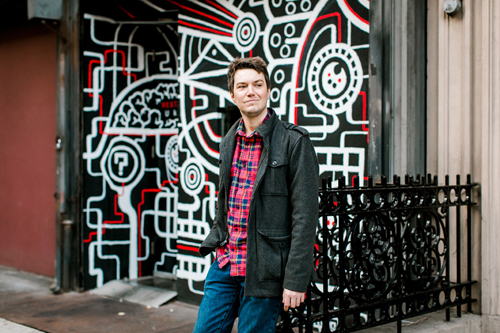
New York-based singer-songwriter Jake Winstrom’s second solo album, Circles, is one of our favourite records of the year. This time around, the former frontman of  Tennessee band Tenderhooks has cranked up the guitars and embraced his love of classic rock ‘n’ roll, power-pop and country rock. 

Speaking from his New York apartment, which he describes as “a shoebox”, he says: “I think my first solo record [Scared Away The Song] suffered a bit from the inclusion of maybe one too many “serious songwriter” type songs, without enough fun, uptempo, jangly rock ‘n’roll to serve as a counterbalance, so I wanted to make sure there was room for that on this record.”

He’s certainly achieved his goal – recent single, the brilliant What’s The Over/Under?, is an infectious power-pop song  – “I’ve never had too much of a handle on what I want until I fuck it up” – with jangly, 12-string Rickenbacker guitars and punchy, soulful horns, while on its predecessor, the chugging glam-rock-country-boogie of Come To Texas She Said, which was inspired by a long-distance infatuation that derailed before it could become something more, reedy-voiced Winstrom does his best Marc Bolan impression.

Circles is full of highly melodic, guitar-heavy tunes with a retro feel – Winstrom cites ’70s Neil Young and Crazy Horse as a major influence, which is obvious if you listen to the Zuma-style guitar solo on My Hiding Place, a song about addiction, and the brooding, epic album closer, Kilimanjaro.

Tom Petty and Bruce Springsteen are also artists that Winstrom admires – his song Washed My Face In A Truck Stop Mirror, a raucous blast of rock ‘n’ roll, has echoes of both of them – while Think Too Hard is reminiscent of The Beatles, circa Revolver, as well as Detroit power-pop songwriter – and Say It With Garage Flowers favourite – Nick Piunti.

Winstrom, who is 37, also looks to the ’90s and early Noughties for inspiration –  on the moving, cello-assisted ballad, I Walk In Circles, he channels Elliott Smith.

Two years in the making –  writing and recording –  Circles was produced by drummer Jeff Bills (The V-Roys and Steve Earle), who also worked on Winstrom’s debut album. The songs were committed to tape just before the coronavirus hit. 

‘The world needs another rock ‘n’ roll record like it needs a hole in its head right now, but I needed this one’

“We were lucky for sure – we were basically 99 percent done, so we were able to lean on some very talented friends with home studios to add the odd overdub here and there,” he says.  “And engineers John Harvey and Mary Podio were super-savvy to invent a new workflow that let us finish mixing remotely.”

He adds: “We were really fortunate. I mean, obviously, the world needs another rock ‘n’ roll record like it needs a hole in its head right now, but I needed this one.

“For my own sanity, I feel like I’ve been working up to this album my whole life. I’m 37 years old – it’s 37 minutes long. Coincidence? I think not. But I do feel like a good chunk of my lifetime is living in these songs. The highs, lows and in-betweens, to quote Townes Van Zandt. I hope folks dig it. I do.”

Q&A

How are you doing? Congratulations on Circles – it’s a great record.

Jake Winstrom: I’m good – just chugging along and trying to stay safe, like everybody. Thanks so much. I’m very happy to hear you dig the record.

You’ve said that your first solo album, Scared Away The Song, had too many “singer songwriter” type songs on it and not enough fun, uptempo, jangly rock and roll tunes. With Circles, that’s not something you can be accused of. How did you approach this album?

JW: I definitely wanted to broaden the musical spectrum on this album. The last one, maybe due to time and cost constraints, ended up veering a bit too much toward what folks call “Americana”, I guess – lots of acoustic guitar-based, rootsy-sounding songs and what have you.

I had several more rock songs written for that record, including What’s The Over/Under? but we ran out of time on the day we tracked with a full band. So with this one we moved full band, electric songs to the top of the pile. And I wanted more moments of fun and levity in the songwriting. I think I had Bruce Springsteen’s The River in mind. What’s the saying? Shoot for the stars but settle for the moon? Hah. I wanted sad bastard songs sitting alongside frivolous rock ‘n’ roll.

How were the recording sessions? You worked with drummer / producer Jeff Bills again on this album. What did he bring to the process? Why do you like collaborating with him?

JW: The recording sessions were so much fun. I love recording and Jeff is just fantastic. He brings so much to the process. He has a real ear for songwriting and arranging.

I’d send him my four-track demos as soon as they were done and then we’d start ping-ponging arrangement ideas. And his production process is all about the song. He’s not afraid to get into the weeds on minute lyric edits and things like that. He really hammered this record into existence. He also has a great talent and Zen-like patience for mixing. Which I do not. Hah! So it’s a good musical marriage.

You have a great band on the album. How did you choose the musicians that you wanted to work with?

JW: We did have a truly great band for these sessions. Putting it together was easy – I just rang up my friends and they very graciously all said yes. On the last record, Jeff and I had kind of a rotating cast of musicians from song to song, depending on the sound we were going for. On this one I wanted more cohesion, but we didn’t have time to rehearse.

I knew we’d need a versatile group that could hammer out arrangements on the fly. We ended up with a veritable wrecking crew: Jeff on drums, Peggy Hambright on keys, Dave Nichols on bass, Greg Horne and George Middlebrooks on guitar, and Jeff Caudil on backing vocals. That’s some serious muscle.

Some of the takes are live, aren’t they? Do you normally record that way? My Hiding Place was done in one take, wasn’t it? 

JW: Everything started with us playing a song three or four times to get a good live take. My Hiding Place was one where it all just kinda fell into place in the room – even the vocal. I think it must’ve been the mood lighting in Scott Minor’s studio. Hah.

‘The studio where we recorded half a dozen songs is sadly no longer with us, but it was a great room. It definitely had some spooky magic’

Where did you make the album?

JW: We did it in Knoxville [Tennessee], with the exception of some vocals recorded in Brooklyn. We started at Scott Minor’s Wild Chorus studio, early last year. We recorded half a dozen songs there. The studio is sadly no longer with us, but it was a great room. It definitely had some spooky magic. I wanted to record there because one of my favourite bands, Count This Penny, did their absolutely gorgeous album A Losing Match there.

It had a live room with no dividers between the guitar amps and drums, which made Jeff a little nervous, but I loved it. To quote the Rolling Stones – let it bleed! A little Telecaster in the cymbal track never hurt anyone. And that’s where My Hiding Place was recorded. It definitely has that room’s stamp on it.

We recorded the second batch of songs at Top Hat Recording [in Knoxville] last fall. The engineers are a super-sweet married couple – John Harvey and Mary Podio – who built a house with their dream studio inside. It’s a fabulous, comfy place to hunker down and make a racket. We mixed the entire thing there too. We still had six songs to mix when lockdown hit, but John and Mary were very savvy and invented a new workflow that allowed us to finish things up. They’re really smart, great people.

Luckily, you pretty much finished the album prior to the Covid-19 lockdown. How was isolation for you? Did you write any new songs during lockdown? Did it inspire you?

JW: It’s been fine for me. I’m thankful to still be gainfully employed. I guess I’ve mostly been entertaining myself by getting this record finished and out into the world. So after September 25 [album release date] it’s time to find a new hobby!

I’ve written a little bit. Unfortunately I can’t say I’ve found it to be a particularly inspiring time. I miss hearing snippets of subway conversations and weird one-sided cell phone arguments while walking down the sidewalk.

You’ve relocated from Knoxville, Tennessee to New York? How’s that? Do you like living in New York? How has it influenced your writing and music?

JW: I love New York! I’ve been here for eight years now, I think. I reckon once I hit the decade mark I’ll be ‘official’. Hah. I like to think about songs while I’m walking, so New York is perfect for that. You can get into kind of an unconscious rhythm zigzagging through neighbourhoods while turning things over in your mind. I remember coming up with What’s The Over/Under? and My Hiding Place while making my way through the East Village.

What’s The Over / Under? is one of my favourite songs on the record. What can you tell me about the track? It’s a great power-pop song, with a killer chorus, Rickenbackers and horns. 

JW: I think I was in a hardcore Buddy Holly phase when I wrote that. I wanted to write lots of strummy, propulsive, open chord songs without too many minor chords. It’s easy to disappear down the minor chord rabbit hole sometimes. I remember coming up with the chorus, then having to Google what “over/under” actually meant. I don’t do sports betting or anything. It’s funny the things that tumble out of your subconscious mind sometimes…


The first single, Come To Texas She Said, reminds me of T-Rex – it’s a glam-rock-country-boogie!

JW: Hah – that’s awesome! “Glam-rock-country-boogie” sounds like my ideal genre. I was ruminating on the title Come To Texas She Said for a while. And once I kinda broke the verse melody everything else fell into place. It’s a song that’s gotten a big reaction live since I started playing it a year or so ago.

Jeff and I had many conversations about the arrangement. He actually went rogue – as he is wont to do – and initially produced a whole different version from his home studio, overdubbed on top of my four-track demo. It was actually really cool. The track included a mini V-Roys reunion, with Paxton Sellers laying down a groovy walking bass part. It had horns too. But ultimately we felt it was too Americana-y. Too much like the last record. I wanted to let it rip.

We recorded what became the album version during the Top Hat sessions. Dave Nichols’s elastic bass line really makes it for me. And Peggy Hambright’s call-and-response electric piano is so great – it reminds me a little bit of Harry Nilsson’s records.

‘I always bring up Neil Young and Crazy Horse in the studio. I love the rawness of those mid-’70s albums, like On The Beach and Zuma’

There are several classic rock ‘n’ roll influences on the album. Think Too Hard reminds me of The Beatles, Revolver-era, Washed My Face In A Truck Stop Mirror has a Tom Petty / Springsteen feel, and My Hiding Place and Kilimanjaro have a Neil Young and Crazy Horse vibe. Are those artists all big influences on you? What were your musical reference points for this record? 

JW: Wow, thank you – that’s extremely high praise. Yes – I love everyone you just mentioned. I always bring up Neil Young and Crazy Horse in the studio. I love the rawness of those mid-‘70s albums, like On The Beach and Zuma. And I think Peggy channelled a little E Street magic with her organ part on Loose Change, so those were all reference points I had in mind.

It’s funny, though – Jeff absolutely hates it when I say something like “hey, why don’t we try playing this song like Tom Petty, or The Bangles, or Syd Straw?” He’ll really flip his shit! He thinks bringing up musical reference points cheapens the creative process or something. He’s a purist I guess – hah. So I have to go and whisper those ideas to the rest of the band when he’s not paying attention…

I Walk In Circles has an Elliott Smith feel, doesn’t it? Are you a big fan?

JW: It does. I was trying to emulate his kind of hushed, double-tracked vocals. His records are so beautifully crafted. I actually came to his music late. I saw one of my favourite artists, Marika Hackman, cover his song Between The Bars when her tour came through Brooklyn last year, and that kind of set me off on an Elliott Smith tangent.

Some of your songs have a country influence. Did you grow up with country music in Tennessee? What were your influences when you were younger?

JW: Going to college in Knoxville really opened my ears to country music. Before that I was pretty much solely focused on the British invasion and classic rock ‘n’ roll, with a smattering of post-punk bands, like R.E.M.

I think during my sophomore year I picked up Lucinda Williams’s Car Wheels On A Gravel Road at the Disc Exchange and fell in love with everything about it – the songs and the sound, which actually has some Beatles-y touches, thanks to the Twangtrust production. That led me to Lucinda co-conspirator and Knoxville poet laureate R.B. Morris, as well as The V-Roys.

Then it was down the yellow brick road to Gram Parsons, Emmylou Harris, Uncle Tupelo, Steve Earle, Waylon Jennings, Roger Miller, Dolly Parton, Kris Kristofferson, Hank Williams, Bill Monroe and on and on and on.

‘Going to college in Knoxville really opened my ears to country music. Before that I was pretty much solely focused on the British invasion and classic rock ‘n’ roll, with a smattering of post-punk bands, like R.E.M.’

What’s your songwriting process?

JW: Songwriting for me almost always begins with improvising – picking up a guitar and strumming/singing while I walk around the apartment. Maybe getting the gears moving by playing someone else’s songs and then seeing if I can hit on a melody or chord change that peaks my interest.

Those ideas will usually live in my iPhone audio notes for a while, waiting for words to flesh them out. That’s when I find it helps to walk around the block and get a change of scenery. Anything to trick myself into not thinking! Staring at a blank page isn’t the way to do it – at least not for me.

Are you hoping to play live when things get back to normal?

JW: I hope so. I’ve had offers to do outside things during the pandemic, but it’s just so dicey, safety-wise. Plus a lot of sweat and spit flies off me while I play, so I’m basically a public safety risk! We’ll definitely do something once life gets back to normal. It would be fun to play the record in sequence. Of course, by the time it’s safe to do that, I’m sure I’ll be on to the next album.

‘A lot of sweat and spit flies off me while I play live, so I’m basically a public safety risk!’

How hard has it been as a musician being unable to play gigs to promote your new record? Are you worried about the future of the live music scene?

JW: I’m lucky in that I have a day job. I’m gutted for my friends that make their living playing music. It’s a really brave, hard life. And then to have the rug yanked out from under you by this…

Yeah – I’m really worried for the small venues. The sweaty little clubs that are so important for artists honing their craft. I’m terrified that by 2022 all the ones here in New York are going to be replaced by Chase Banks and Chipotles. And watching concerts on Zoom and Instagram Live ain’t gonna cut it. The pandemic has proven that much.

What are your plans for the rest of the year? 

JW: Stay vertical! I hope to venture down to Tennessee to spend Christmas with my family. We’ll see what the state of the world is by then. Fingers crossed.

Can you recommend some music – new and old? What are you into at the moment?

JW: Ooooh – let’s see. X’s new album Alphabetland is frenetic and fabulous. Girl Friday, this L.A. band I saw last year and fell in love with, just put out their first LP, Androgynous Mary. It’s a total blast. Great harmony singing and fiery guitar playing with stellar songwriting and arrangements that twist and turn. I’ve also had the new Haim record on repeat since it came out this summer.

As far as oldies, Fire On The Bayou by The Meters has found its way back to my turntable many times this summer. I’ve also been digging into Linda Ronstadt’s Mad Love album, which includes several Elvis Costello covers.

Finally, have you heard Nick Piunti, who’s a power-pop singer-songwriter from Detroit? Your music often reminds me of his – I think you’d like him. I’m going to recommend that he checks you out. Have a listen to this:

JW: I haven’t. Thanks for the recommendation. I really dig this song! It reminds me a bit of Cheap Trick, in the best way. Total melodic confidence and barnstorming guitars.

Circles by Jake Winstrom is released on September 25 – it’s available on streaming and download services, as well as vinyl.

For more information, visit: https://jakewinstrom.bandcamp.com/


‘My first Dylan album was Blonde on Blonde. I’ve been under the sweet, sorrowful spell of Sad Eyed Lady of the Lowlands ever since’

Picture by Autumn Dozier

Emma Swift’s new album of Bob Dylan reinterpretations, the wonderfully titled Blonde On The Tracks, is one of the best covers records we’ve ever heard.

The Australian-born, Nashville-based country singer-songwriter has put her own [simple] twist on some of her favourite Dylan songs, but, unlike some artists who’ve covered his work, she’s remained reasonably faithful to the original versions, rather than radically overhaul them.

“Interpreting other people’s emotions is how I learned to sing and I’ve always enjoyed hearing Dylan’s songs from a female perspective,” she says. “You can learn a lot about melody and feeling by the way a singer chooses to interpret someone else’s song. You can learn a lot about words by singing someone else’s. I’m very influenced by singers like Sandy Denny, Joan Baez, Billie Holiday and Sinead O’Connor. There’s an art to interpretation.”

Produced by Patrick Sansone, multi-instrumentalist from Chicago alt-rockers Wilco, Blonde On The Tracks sounds intimate, warm and inviting – Swift’s voice is gorgeous and breathy. The eight-track album opens with Queen Jane Approximately – in a nice touch, Swift gives it a wonderful, Byrds-style makeover, with chiming 12-string guitar.

She slows down One of Must Know (Sooner or Later), turning it into a pleading, haunting, late-night country song, with pedal steel. Simple Twist of Fate gets a similar treatment, but with some understated, twangy guitar licks, as does the 12-minute epic Sad Eyed Lady of the Lowlands.

Swift even reinterprets one of the songs from Dylan’s latest record, Rough and Rowdy Ways, on hers – the reflective and stately ballad I Contain Multitudes. Her achingly beautiful voice is accompanied by acoustic guitar and minimal instrumentation.

“Like many of the great Bob Dylan songs, I Contain Multitudes is a magnet, a fly’s eye view of the cultural miasma in which we wander,” says Swift. “It’s magnificent and heartbreaking –  a love letter to words and art and music, to all that has been lost and all that might be redeemed. To me this song has become an obsession, a mantra, a prayer. I can’t hope to eclipse it, all I hope to do is allow more people to hear it, to feel comforted by it, and to love it the way I do.”

Blonde On The Tracks is a record that was born out of crisis, as Swift explains: “The idea for the album came about during a long depressive phase – the kind where it’s hard to get out of bed and get dressed and present [yourself] to the world as a high-functioning human. I was lost on all fronts no doubt, but especially creatively.”

She adds: “I’ve never been a prolific writer, but this period was especially wordless. Sad, listless and desperate, I began singing Bob Dylan songs as a way to have something to wake up for.”

Work on the album began at Magnetic Sound Studio, Nashville, in 2017, but it was the Covid-19 lockdown that brought the rest of the project to fruition. Swift worked with Sansone over email to polish up the six songs that had already been recorded, but her versions of I Contain Multitudes and Simple Twist of Fate were laid down in April and May this year, at home, and overdubbed via correspondence.

The album features guest appearances from Sansone, singer-songwriter – and Dylanologist – Robyn Hitchcock, who plays guitar, Thayer Serrano (pedal steel) and Steelism’s Jon Estes and Jon Radford on bass and drums, respectively.

Say It With Garage Flowers spoke to Swift during lockdown in Nashville, to find out why Dylan’s music means so much to her, why Blonde On The Tracks, which can be purchased via Bandcamp and from record stores, won’t be available to stream on Spotify and other digital music sites, and her plans for her new independent label Tiny Ghost Records.

Q&A

How has lockdown in Nashville been for you? How have you coped – both personally and professionally?

Emma Swift: I have been in lockdown and haven’t left the house since the beginning of March, so although I am technically in Nashville, it feels, in a way, like I am on an island. I don’t see any of my friends or colleagues or even venture to the supermarket. All communication – for food, for friendship and for work – has been done online and it’s definitely weird.

The idea of “coping” is one I struggle with because, in many ways, we’re still deep in this Covid experience, so it’s hard for me to have perspective on it. Am I coping? I don’t know. Right now, the virus is worse than it’s ever been in Tennessee. Each day brings new challenges. On the one hand, I’m extremely fortunate to be able to work from home, on the other, my primary source of income is as a touring musician and all that work is not going to return for a long time, so that weighs heavy on my mind. I am constantly seeking distractions. I read a lot.

I have insane, one-way conversations with my cat [Ringo]. “Who’s a good boy? Yes, Ringo’s a good boy! Oh, Ringo you’re such a good boy. Ringo have I ever told you what a good boy you are? Look at your little face! You’re such a good boy.” There’s a lot of that.

How did you first get into Dylan’s music and what does it mean to you?

ES: I’m not from the generation that grew up when Dylan began making records, so for many years most of my discoveries were made well after that – through albums I bought at record fairs and charity stores and songs I heard on the radio. My first memory of hearing a Bob Dylan song is The Byrds version of Mr Tambourine Man, which got played a lot on the golden oldies station I listened to as a kid.

I can remember watching clips of the Traveling Wilburys on music TV – I adored Handle With Care, though Roy Orbison was the one I was drawn to at the time. My first Dylan album was Blonde on Blonde, which I must have acquired when I was 17 or 18. I’ve been under the sweet, sorrowful spell of Sad Eyed Lady of the Lowlands ever since. My love of the artists that came of age in the ‘60s and ‘70s isn’t exclusive to Bob Dylan though. I’m just as influenced by Dusty Springfield, Joni Mitchell, Sandy Denny, Gene Clark and Lou Reed to name a few. I’m a kid of the ‘80s and ‘90s, but I’m quite old-fashioned really.

You’ve recorded a version of I Contain Multitudes, from Dylan’s 2020 album, Rough and Rowdy Ways. Isn’t it brave to tackle a brand new Dylan song?

ES:It didn’t feel brave to me – it just felt like a song I was utterly magnetised by and compelled to do. For me, it’s a love song to all that is great about music and art and poetry. It’s a confession, a hymn, a celebration. Like many of the Dylan songs I am drawn to, it’s a little bit funny and a little bit sad. I laughed out loud the first time I heard him sing: “I paint landscapes/ And I paint nudes.”

As for my interpretation of it, it’s very lo-fi. It was recorded in the lounge room at my place on a Zoom recorder, with Robyn Hitchcock on guitar, and then sent to my producer, Patrick Sansone, for overdubs. Patrick’s a brilliant man who can do a lot with not very much. I’m lucky to know him.

Interestingly, on your versions of the songs, you haven’t changed any of Dylan’s lyrics to make them sound like they’re being sung from a woman’s point of view. What was your thinking behind that?

ES:They are being sung from a woman’s point of view – mine. I just haven’t changed any of the gender pronouns to make it sound like it’s coming from a heteronormative context. It’s not how I view the world.

Picture by Autumn Dozier

You’ve said that you can learn a lot about melody by singing someone’s else’s songs? Can you elaborate on that? What has making this album taught you?

ES: I’m pleased that the record is coming out because historically it hasn’t always been easy for me to put music out. I can be apprehensive. I can be scared. I can be very self-critical. People can be brutal. And you have to feel safe enough in yourself to be able to say, ‘I like it and no-one else’s opinion matters’, to be able to release music. It took me a while to get to that point.

As for learning about melody, every time I put a record on I become a student. My ears are primed. For that matter you can learn a lot about harmony too, if you let the recording take the lead and try to find a different part.

Which other singers / artists do you admire, other than Dylan? Who inspires you?

ES:Marianne Faithfull, Cat Power, Sandy Denny, Nick Cave, Billie Holiday, David Berman, Robyn Hitchcock, Lucinda Williams, Vic Chesnutt, Leonard Cohen, Guy Clark, Patti Smith, Johnny Marr. Even though it’s music, I guess what inspires me musically is artists who really love words. Artists who read books. Artists who care about the world.

Am I right in thinking Blonde On The Tracks won’t be available to stream on Spotify and other digital music sites? You have strong views on streaming and royalties / payments to artists, don’t you?

ES: Blonde On The Tracks is available as a digital download, vinyl, CD and cassette. I’m selling it through Bandcamp online and it has distribution, so folks will be able to go and pick it up from their favourite local record store as well. There’s never been a better time to support small business.

You are right, I’ve been quite outspoken online about wage exploitation from mainstream streaming services. I’m tired of corporate music companies spinning a line that these outlets are good for “exposure”, while some of the best musicians I know find themselves now out of a job due to Covid-19. You can’t eat exposure! You can’t pay your rent with exposure. It’s just another bullshit argument for trickle-down economics – an argument which fails to take into account that the music industry is bigger than its bigger name stars.

‘I’m tired of corporate music companies spinning a line that mainstream streaming services are good outlets are good for “exposure.” You can’t eat exposure!’

What’s the latest on your planned album of original songs, Slow Dancing With Ghosts? Have you been writing any new material? Is there another record in the offing?

ES:Slow Dancing With Ghosts is all set for release in January 2022. I have recorded eight songs so far, but they are not quite finished as all the overdub sessions were cancelled due to Covid-19. There are some really lovely people playing on this record. I’m pleased to say that once my depression lifted I was able to write new songs, and that will be what is on offer here.

What music – new and old – have you been enjoying recently and how do you listen to it?

ES: I listen to music through digital downloads, the Bandcamp streaming app, vinyl and CD. Though it’s been brutal on other fronts, 2020 has been a great year for new music and I’ve been enjoying the recent albums from Marchelle Bradanini, Luke Schneider and Becca Mancari.

I just bought the Prince Sign o’ The Times 7in singles collection that Third Man is releasing and I’m excited about that. And I’ve got the new Dylan album, plus quite a large vinyl collection that goes back decades. I come back to Joni Mitchell’s Hejira probably more than any other record.

What are your plans for the rest of the year when things get back to normal?

ES: I have big plans to play this album – and my own new songs – live. I’m just not sure when it will be safe for me to make that happen.

You’ve started your own label,Tiny Ghost Records. Any plans to sign any other artists to it and put out their records?

ES: One of the main reasons for starting Tiny Ghost was because I am a mouthy brat and I like my independence. I couldn’t find a record label in 2020 that was artist-friendly enough for me. Even the cool ones are still in bed with the streaming services, so that wasn’t really an option. The new Robyn Hitchcock album will come out on Tiny Ghost in 2021. I’d love to sign other artists eventually, I just have to get the business off the ground first. I’d also encourage any artists who are looking for a label to consider starting their own. If it works for Gillian Welch and Courtney Barnett, it can work for you too.

‘One of the main reasons for starting Tiny Ghost Records was because I am a mouthy brat and I like my independence’

What are some of your favourite cover versions of Dylan songs?

ES:Okay so what’s wild here is that I could list versions of just one song and it would go on for pages. I could talk about Joan Baez’s Daddy You’ve Been On My Mind for days. Betty Lavette’s Mama You’ve Been On My Mind, particularly when sung live, is glorious. Robyn Hitchcock doing Visions of Johanna is pure heartbreak. I have to say, with this project, I couldn’t really listen to other people’s Dylan songs for a while because I needed to just be with the source material. I’m also not too interested in a rigid list of favourites – the list is ever changing.

Finally, did you ever think about calling the new album Blood On The Blonde? Maybe that could be your next record reinterpretations of Dylan’s murder ballads?

ES: [laughs] No, I didn’t…

Blonde On The Tracks by Emma Swift is released on August 14 (Tiny Ghost Records).

https://emmaswift.bandcamp.com/