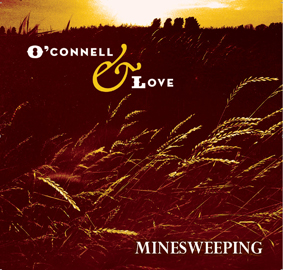
I speak to songwriting duo O’Connell & Love to find out how a stormy winter week in Hastings, afternoon drinking, Johnny Cash’s American Recordings and some serious hangovers all helped to create one of the best albums of the year…

Minesweeping – the new record by O’Connell & Love – is one of the most eclectic and richly rewarding albums of 2015.
A collaboration between Larry Love, the lead singer of South London country-blues-gospel-electronica outlaws Alabama 3 and songwriting partner Brendan O’Connell, it’s a hung-over road trip through the badlands, stopping to pick up some hitchhikers on the way – namely guest vocalists Rumer, Buffy Sainte-Marie, June Miles-Kingston, Tenor Fly and Pete Doherty.
It opens with the moody, Cash-like, acoustic death row ballad, Like A Wave Breaks On A Rock, visits Nancy Sinatra and Lee Hazlewood territory for the drunken, playful duet Hangover Me (feat. Rumer), travels across Europe for the sublime, blissed-out, Stonesy country-soul of It Was The Sweetest Thing, hangs out by the riverside for the gorgeous pastoral folk of Shake Off Your Shoes (feat.Rumer) and heads out to the ocean for the Celtic sea shanty-inspired Where Silence Meets The Sea.
An album that wears its influences on the sleeve of its beer-stained shirt, there are nods to late ‘70s Dylan (The Man Inside The Mask), Motown (Love Is Like A Rolling Stone – feat.Tenor Fly ), Leonard Cohen (Come On, Boy – feat. Junes Miles-Kingston) and The Band (If It’s Not Broken).
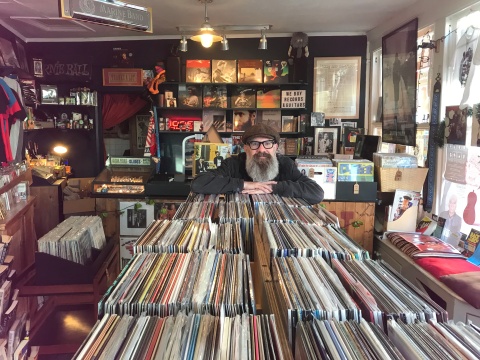
The essence of the album came together when you were holed up in the Sussex seaside town of Hastings, writing songs one stormy week in winter. Can you tell me more about that time? What was the writing and recording process for the record like?
Larry Love: What was interesting with Minesweeping was the use of hangovers in the recording process. Brendan was financing the project and, basically, at the end of the night, we’d chuck some drunken ideas down, but the most important stuff was done in the morning after. I knew that unless I did some songs in the morning, Brendan wouldn’t buy me a pint in the afternoon.
We’re pretty quick at getting ideas down. We’re too long in the tooth to fuck around, in terms of working out structures and the basic platforms of rock and roll.
We’re not meandering around like 17-year-olds, listening to fucking Bob Dylan, Kris Kristofferson and Ann Peebles records, trying to work out what the formula is. We have our formula very organised.
If anything, we had too many ideas – the challenge was to get them to coalesce. Hopefully that comes across on the record. It has a certain homogenous quality to it.
It does – it feels like a complete album, from start to finish.
You’ve said that the album was seven years in the making, due to other commitments… Were all of the songs written during that week you spent in Hastings?
Brendan O’Connell: A couple came after that and some had been hanging around for years.
You might recycle an idea that you tried to write 25 years ago, but that never really came to anything. You leave it and then come back to it years later, use it with someone else’s idea and it suddenly gets finished.
You might have an idea where the verse is really good, but you can’t get the next bit together… Then one day it suddenly comes from somewhere and you know it’s right.
LL: It was a bit like a pit bull that gets impregnated by a breeder. Eight little puppies come out and you think all the litter has been delivered. Then another five arrive two weeks later, in the ectoplasm!
So, Brendan, do you bring your musical ideas to Larry?
BO’C: Yes – some chords and a melody.
LL: A lot of them he might find in a charity shop. Sometimes the clothes don’t fit on that particular day – especially as you get older…
Lyrically, the album has a recurring nautical theme running through it…
BO’C: That must’ve come from Hastings.
The record was produced by Greg Fleming – aka Wizard – who’s worked with the Chemical Brothers, Dizzee Rascal and Chase & Status.Why did you choose to use a dance music producer on a country, blues and folk album?
LL: I really liked Rick Rubin’s recordings with Johnny Cash.
What did Greg Fleming bring to the record?
LL: He brought cynicism, pessimism and downright depressiveness to it because he’s generally used to doing this: (Larry suddenly makes loud, squelching dance music noises with his mouth!)
Any good stories from the recording sessions?
LL: Far too many – they generally involved me having rows with Brendan, who said I was irresponsible for staying up all night drunk. But, over the years, he has accepted that me getting drunk does add to the joie de vivre.
There are quite a few special guests on the album, including Buffy Saint-Marie, Pete Doherty and Rumer. How did you come to work with them?
LL: Whatever technology has taken away from us as musicians in terms of revenue, it’s also opened up many doors for collaborations – it’s not like you have to have a long, drawn-out scenario where you have to have everyone together in the same studio.
Buffy Sainte-Marie’s new album – Power In The Blood – was named after a song I wrote. I went to see her when Morrissey was curating Meltdown at the South Bank [in 2004] and I got invited backstage. I asked her if she fancied doing a song.
I’ve known Pete Doherty for years – he used to come and see Alabama 3 gigs back in the day. I got hold of his manager and said, ‘He fucking owes us one, so Pete, get down here.’
B’OC: We knew Rumer from Brixton, but she disappeared off to America and became a big star. My brother bumped into her in the street – she was a fan of the album we did before this one [Ghost Flight – released in 2006, under the name Robert Love] and she was keen to come and sing on a few songs.
Let’s talk about some of the songs from the new record. The opener, Like A Wave Breaks On A Rock sounds like Johnny Cash…
LL: I thought you said Clash! Yeah – what Rick Rubin did at the end of Johnny Cash’s career was very inspiring. It’s the same as when Bob Dylan worked with Daniel Lanois. Grizzled voices and ‘hip-hop’ production.
BO’C: To me, Like A Wave Breaks On A Rock sounds Spanish, rather than country, but Larry’s voice sounds like Cash.
LL: It has a ‘you’re on death row’ kind of vibe – I used to know someone who was on death row and I got quite involved with the campaign to release Albert Woodfox, who was from the Angola Three. He was one of the longest incarcerated members of The Black Panthers. It was around that time that I wrote the song. He was waiting on death row for years, but he’s now been reprieved.
One of my favourite songs on the album is Hangover Me, featuring Rumer. It has a Nancy Sinatra and Lee Hazlewood feel to it…
LL: Yeah – it ended up that way. We wrote it with Seggs Jennings (The Ruts DC), with hangovers. It nails our colours to the mast. We love hangovers – they’re very inspiring.
It was originally called The Ballad of Martin Lambert and was written about a friend of ours who died from a morphine overdose on Christmas Day at his mother’s. It was a tragic way to go. I sang at his funeral. We surround ourselves with people who are on the edge – they’re not living comfortable lives and selling houses to fucking yuppies.
The track It Was The Sweetest Thing has a great Stonesy country-soul swagger… It’s a good story song – a tale of lovers embarking on a European adventure…
LL: Lyrically, it’s about the inevitable nostalgia that comes from when you’ve lost something that you realise you should’ve held on to. I like to think that I’ve lost a lot of things I should never have lost and found things I should never have found…
BO’C: Or that you never deserved to have in the first place.
LL: Exactly. I had an Italian girlfriend, but things didn’t work out. I’d never been to Europe before – I flew to Bologna with a pocketful of Ecstasy! I didn’t know you couldn’t take it on the plane. It was inspired by that – as lovers, you can traverse continents.
In this day and age, with the refugee crisis, love does transcend boundaries. The nature of the song implies that we went everywhere, looking for love, but, ultimately, we found it nowhere.
The Man Inside The Mask, which started out as a very long poem, reminds me of late ‘70s Dylan…
BO’C: When I first played it on my own and sang some of the words from the poem, I thought it was going to end up sounding like Leonard Cohen, but it turned out quite Dylanish…
Let’s go back to your roots. How did you meet and start writing songs together?
LL: About 20 years ago, I was a recovering heroin addict. I haven’t done it since – touch wood. Brendan was in a band called Past Caring – I thought they were very innovative. If you’re familiar with narcotic withdrawal, it’s quite highly sensitised. I was in an Irish bar called Brady’s and I was really impressed by the strength and the quality of Brendan and the band’s performance. I used to sing Uncertain Harbour [the penultimate song on Minesweeping] as a guest vocalist. We were both habitués of South London – we knew the same pubs and the same problems.
What are your plans for the rest of the year?
LL: We’re letting the album gestate in people’s minds. I’m busy – I’ve got an Alabama 3 tour in October/November. We’re looking at doing an O’Connell & Love tour in January/February – up and down the country, with some skirmishes in-between. We’re definitely taking the band out on the road.
BO’C: And we’re writing some more songs.
LL: We’re going to do the next album in seven days – like the Lord. Doing Minesweeping has given us more confidence for the next phase. I don’t think it will have a nautical theme – it will be rain and Northern towns.
So, finally, what’s the secret of writing a great country song?
LL: Get a bad woman and a good hangover.

Minesweeping is out now on Mountmellick Music.
http://www.oconnellandlove.com


 Say It With Garage Flowers