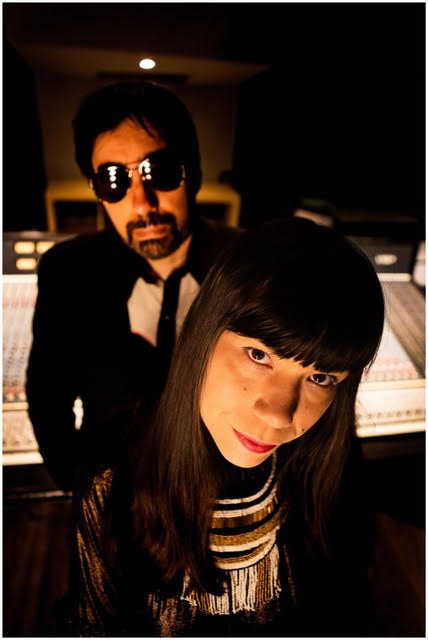
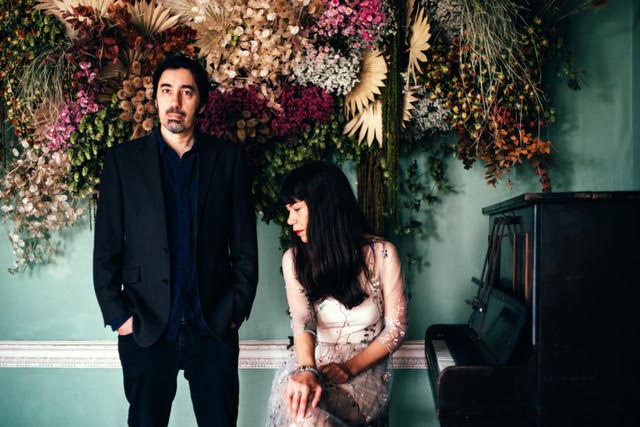
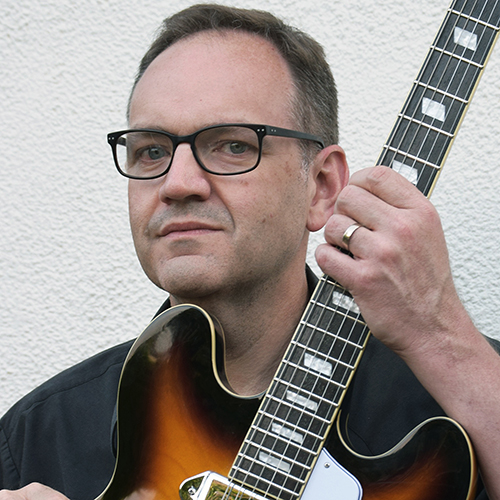
New Morning Blues are husband and wife duo Ian de Sylva and Joanna Backovic.
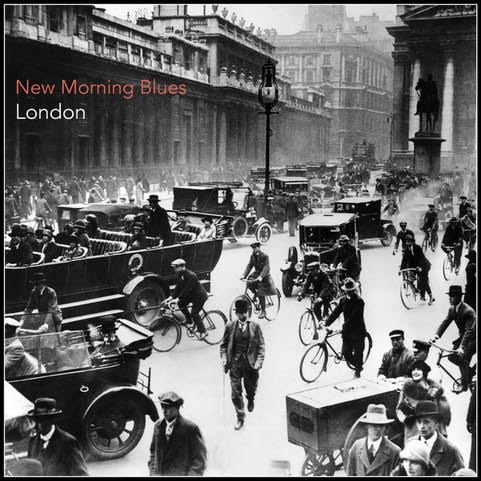
The pair, who released their debut album, London, this summer, run a recording studio together in Soho, and are independent artists in their own right, but this is the first time they’ve collaborated musically.
“To be honest, we’ve always been pretty busy with our own music projects, and it never really occurred to us to work together,” says de Sylva, in an exclusive interview with Say It With Garage Flowers.
“I had a song called Polestar. It wasn’t something that really suited my voice, so I asked Joanna to sing it. It sounded great, so I just kept writing with two voices in mind rather than one. So far, I’ve written the songs and we’ve arranged the vocal parts together.”
Backovic is a composer and performance artist who creates scores for theatre and film – she also performs under the name ArHai – while de Sylva’s first band, Silver, released a single on Rough Trade Records.
Signed to Medicine/Warner Bros, Silver recorded their debut album with producer Craig Leon (The Ramones, Blondie). They toured with The Cranberries and Elastica, and de Sylva also recorded two solo albums.
London is an impressive and arresting debut, from the ‘take no prisoners’ opener, Fortune Teller Blues – primal, White Stripes-style, blues-rock with mean organ and dirty guitar – to the beautiful and spectral folk ballad The Mirror, with shades of Nick Drake; the twangy, widescreen country-pop of The New Messiah; the cinematic psych soundtrack that is A Face In The Mirror, and the dramatic orchestration of On The Horizon.
There’s a haunting, atmospheric and autumnal quality to most of the record. “It’s pretty much autumn all year round in England, so that may have come through in the songs,” muses de Sylva.
Q&A
How are things? Have you got ‘new morning blues’?
Ian de Sylva: No – we’re both feeling pretty good today.
How did you find lockdown and are you getting back to some sense of normality?
IDS: We actually enjoyed lockdown up to a point, as it gave us both a lot more time to work on our music, which is what we love to do.
How has it been running a studio in Soho during the past year?
IDS: It’s been fine really, as we’ve been able to use the space for our own music more, so all good.
‘It’s pretty much autumn all year round in England, so that may have come through in the songs’
How did you approach the album musically?
IDS: It developed very naturally, without a definite vision or plan sound-wise. I think it reflects music we both love, from psychedelia to country, folk and blues.
Can we talk about some of the songs? I’ll pick a few, give you some of my thoughts on them, and then can you give me yours.
Fortune Teller Blues: This is a raw, electric blues song – the heaviest track on the record. It has some great dirty guitar and organ on it…
IDS: It was written more as a kind of Dixieland jazz-type thing, but once I had the guitar riff, then it changed into something more bluesy. I wanted to write something upbeat and hopefully danceable.
The Mirror is one of my favourite songs on the record. It’s a haunting, folky ballad, with shades of Nick Drake…
IDS: We’re both fans of Nick Drake and love all his albums. Vashti Bunyan is also a big influence and I think that comes through on this one.
The New Messiah is another highlight for me. It’s jangly country-pop. It has a bit of a Nancy and Lee / mid-’90s Jesus and Mary Chain feel, circa Stoned & Dethroned. I love the twangy guitar solo.
IDS: We were watching a few of Tarantino’s movies and to me it sort of sounds like it could be in one of those films – definitely the guitar solo.
A Face In The Mirror is moody and cinematic, with a dramatic string arrangement…
IDS: This is more of a psychedelic influence. I think maybe it owes a lot to Arthur Lee.
What did you learn most from making a record together, and would you make another one?
IDS: We’re already recording a follow up-album, and working together on music has just been great so far. You hear a lot of stories of how being in the same band breaks couples up, but we don’t feel any need to write our The Winner Takes It All just yet.
What are your plans for the rest of the year?
IDS: More recording over the next few months, then some gigs this autumn.
‘We actually enjoyed lockdown up to a point, as it gave us a lot more time to work on our music, which is what we love to do’
What music – new and old – are you enjoying? Any recommendations?
IDS: We’ve been listening to John Grant, The War on Drugs, a great Spanish band called Carino, Kilimanjaro by The Teardrop Explodes, Scott Walker and Sandy Denny.
Finally, why did you call the record London?
IDS: It just seemed like an apt title. Having both lived in the city for a long time, it’s inevitably had a big influence on us, both as people, and our music.
London by New Morning Blues is out now on Berwick Music.
Exclusive interview with Bob Collum and the video premiere of his new single, Parachute – out today (July 2 – Fretsore Records).
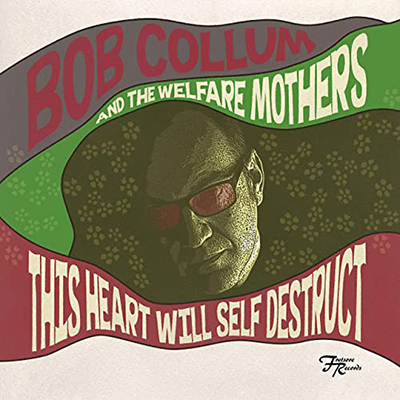
On his latest album, This Heart Will Self Destruct, Olkahoma-born, but Essex-based Americana singer-songwriter, Bob Collum, covers lyrical themes including anxiety, hope, fear, humour, uncertainty, love, disappointment, redemption and faith.
Judging by the subjects he’s chosen to tackle, you won’t be surprised to find that the record was mostly written during the first Covid-19 lockdown. Collum says the album “began life on the cusp, before the insanity of 2020”, adding: “I think it captures the last year quite well.”
Impressively, on the opening track, and brand new single, Parachute – the video is premiering on Say It With Garage Flowers today – he manages to cover off hope, fear, humour, uncertainty, love and faith in the one song.
It’s a mid-paced, rootsy, country rock shuffle, with violin, on which Collum tells a potential partner: “It’s a leap offaith, you know that much is true, but I’ll share my one and only parachute with you.”
“Parachute is me writing a more positive type of song, but with an escape clause,” he says, in an exclusive interview with Say It With Garage Flowers.
“I wish I could write a really upbeat love song, but they’re very difficult. This is as close to a feel-good song as I’ve written. It’s about the uncertainty of life. Sometimes it helps to have somebody there to face it with you. It’s an universal theme, but I liked the image of a parachute.”
Surely the classic country song take on it would be to have a parachute that doesn’t open?
“Absolutely. The answer song would be Who Packed the ‘Chute?” he says, laughing.
‘Parachute is me writing a more positive type of song, but with an escape clause. I wish I could write a really upbeat love song, but they’re very difficult’
Recorded with his band, the Welfare Mothers – “although only one is a mother, and none are on welfare at the moment, they remain the tightest band this side of the Thames Delta” – the album was produced by Pat Collier at his Perry Vale Studios in South East London.
Most of the recordings were done intermittently, with safety taking priority. “At our age, most of the band were in the danger zone,” muses Collum.
The Welfare Mothers comprise Mags Layton (violin and vocals), Martin Cutmore (bass) and Paul Quarry (drums and percussion). Honorary member, guitarist Martin Belmont (Graham Parker and the Rumour, Nick Lowe, My Darling Clementine) plays the Fender Stratocaster and Fender VI bass on the album, adding a mean, Duane Eddy-style, twangy solo to the jaunty Shake It Loose.
Belmont’s ‘70s pub rock influence comes across on Giving Up, which is an infectious power-pop song – kind of New Wave meets country.
Elsewhere, there’s tongue-in-cheek country (the title track); echoes of early R.E.M (Second Fiddle); a sad and reflective country ballad inspired by the likes of Johnny Cash (From Birmingham) and a raucous, fiddle-fuelled rockabilly cover of Saved, which is an R&B-flavoured song written by Leiber and Stoller and first recorded by Lavern Baker in the early ‘60s. Elvis Presley and Joe Cocker have released versions of it.
Collum also dips into blues (Tall Glass of Muddy Water) and soul territory (Spare Me). On the latter, he’s joined by Peter Holsapple (The dB’s and R.E.M.), who plays a mean Hammond B3 organ and also sings backing vocals. The song was an intercontinental collaboration between him and Collum.
Say It With Garage Flowers got to spend some quality time talking with Collum before his heart self-destructed…
Q&A
How was lockdown for you and how has Covid affected your plans as a musician?
Bob Collum: Lockdown provided a focus – the new record was pretty much written during the first lockdown.
It was like being stuck in a weird alternate reality, which stripped everything back to basics. I missed rehearsing and playing gigs – that’s part of music. We do it because we like that aspect – the commonality of sharing a love of music. Maybe now we’ll appreciate every single gig even more than we did before – the chance to play music live is going to be really special and nobody will take it for granted again.
I started thinking about life and what I enjoyed doing. I was able to sit down and be focused in a way in which I haven’t been for years. I did home demos and there was a lot more space to be creative.
That was really interesting. I’ve also managed to write another new record – I have more than enough songs for another one.
When we signed to Fretsore [record label] we going to put out an EP before we did an album. We recorded three or four songs in December and then we were going to go back into the studio in January, but we had to reschedule for late February and then Covid hit.
So we held off until things were safe, but then I picked up my guitar and started to write – the songs started happening, and the band liked them, so we thought ‘let’s do a full album’.
We did a session in late summer, when things opened up a bit, and it went really well, so we did the whole album and finished it up – then things went crazy again. It’s interesting how this record came to fruition – it was a happy accident, I guess.
The album was produced and recorded by Pat Collier at his Perry Vale Studios in South East London…
BC: We’ve been working with Pat for years – he’s one of those classic producers. He did his apprenticeship in the late ‘60s/ early ‘70s at Decca – he was around when all the stuff that we love was being done, but he’s also fully up to date, with Pro Tools and everything. He’s not a slave to the old-fashioned way of doing it. His bag is that he wants to record a band playing together by using the technology that makes it easier to do so.
The record really captures the performances well – it almost feels like a live album…
BC: I really appreciate that – when I started making records, back in the ‘80s, everything was done a track at a time… The performance is part of the recording. The most important part of the producer’s job is to make everyone feel comfortable and have fun – that’s what Pat’s really good at it.
To be a good producer and an engineer, you have to be good at psychology because, like any other conglomeration of human beings, in a band there are all sorts of things going on and you need to know how to keep things moving and how to appeal to the different egos. Pat manages to massage everyone into giving a great performance and he never gets flustered.
The title track is one of my favourite songs on the record…
BC: Thanks, man.
It’s a tongue-in-cheek country song, isn’t it?
BC: Yeah – I love the great soulful and emotional stuff, like George Jones, but he also wrote crazy, almost novelty, songs, like I’m A People, or Love Bug. Humour has always been a huge part of country music, but one of the problems is that in the past 15 or 20 years, the humour has gotten really stupid and crass. If you like all the great writers, like Shel Silverstein, their songs always have a wry side to them.
And they’re self-deprecating…
BC: Yeah – that’s the perfect word for them. If you have a sense of humour, you can get away with all sorts of stuff. Having that ability to wink at yourself is very important, because then, when you are being serious, people realise that you are serious.
I like the title, This Heart Will Self Destruct, which is a nod to Mission Impossible, isn’t it?
BC: My co-writer, Dave Bailey and I were sitting around and talking about the great country writers of the ‘50s, ‘60s and ‘70s – a lot of the time you could tell that they started with the title and worked backwards. It’s a great way of writing – it’s like starting a puzzle with the outside edges.
We were talking about phrases… I’m a big Mission Impossible fan – the TV show with Martin Landau. I’ve not seen any of the movies.
I was thinking about a guy who wanted to warn someone that things were going to end badly – ‘I’ll end it first before you have a chance to hurt me’. That kind of thing. The phrase ‘This heart will self-destruct’ just popped into my head. We wrote the chorus, then filled in the blanks.
There are some blues and soul influences on the album, particularly on the songs Tall Glass of Muddy Water and Spare Me... On the latter, you sing the great line: “I’ve got work to do like The Isley Brothers. What makes you think you stand in front of all of the others?” And Peter Holsapple plays organ on it… How did you get to work with him?
BC: I was a huge dB’s fan back in the day. I met him in the ’90s, at SXSW. We swapped numbers and our friendship developed over time. We did a gig together the year before last, which turned out be really fantastic, and, out of the blue one day, he said to me: ‘I’ve got this song – do you want to help me finish it?’ And he sent it to me. We did it and then he asked if me and guys wanted to record it, so I said, ‘of course!’ I like the groove it has – it’s not what you’d you expect from us, but it still sounds like us.
Holsapple played with R.E.M, and I think your song, Second Fiddle, has the feel of early R.E.M…
BC: Yeah – you can’t be alive at our age and not be influenced by them. They were a band in the ’80s that were a touchstone. Peter Buck plays guitar like you want a guy to play guitar. He’s an influence. When I play arpeggios on guitar, it comes directly from Buck and Roger McGuinn [The Byrds.]
The Byrds are an important band – probably the most important American group of the ’60s. They were fearless when it came to their influences. They had no problem crossing the line.
They were the American Beatles…
BC: Exactly. They did something nobody else were doing and they influenced The Beatles. You’d also be hard-pressed to find a group of guys who were as perfect as The Beach Boys.
What’s your approach to songwriting?
BC: I try to avoid it! [laughs]. There’s no real way of doing it. I’m not like Paul Simon, doing it 9 to 5, with a yellow pad in front of you, or like Peter Case, who calls it ‘skywriting’ – waiting for the inspiration and song to come.
‘The Byrds are probably the most important American group of the ’60s.They were fearless when it came to their influences‘
The way I’ve been doing it lately is by coming up with a melody and some key words and phrases, putting it down on GarageBand, doing the lyrics off the top of my head, and then editing them as I’m doing it, and recording a demo. It’s a similar process to the way you’d write in the studio, but the studio is in my phone.
I don’t think there’s a set way of writing a song. There comes a time when you say, ‘how the hell did I write that?’ That’s life – when you get older, you don’t do anything the way you did when you were 20, 21 or 22…
As writers it’s difficult to maintain the same style. People say there’s a formula – yeah, there is, but sometimes you forget the recipe. Elvis Costello couldn’t make a record now like he did in 1978 if he tried, but he could make one that sounds fantastic, which is what he’s doing. It doesn’t sound like he’s aping his past.
Who are your songwriting heroes?
BC: Lennon and McCartney, Costello, Dylan… I always find it weird when people don’t like Dylan. It’s like a writer saying they don’t like Shakespeare.
What music – new and old – have you been enjoying recently? Did you have a lockdown soundtrack?
BC: Dylan’s Rough and Rowdy Ways has been a hugely important record. I don’t think it could’ve been better timed – it did so much for so many people I know who listened to it. Dylan exists out of time and space – he just does what he wants to do.
You said earlier that you’d written another album. Are you hoping to record that this year?
BC: Yes, but realistically it will be autumn or winter, when things get back to normal.
What have you been writing about?
BC: Fewer love songs, but more ‘what the hell’s going on?’ songs. I should call the next record 12 Angry Songs. They’re not angry songs, but they’re more ‘what the heck?’ I’ve sent demos to everyone – Martin Belmont said it’s some of the most melodic stuff I’ve ever written, which is pretty cool.
Finally – this interview will self-destruct in 10 seconds. What’s the last thing you’re going to say to me?
BC: I just hope you like the record, man. During these crazy times, music has held me together more than I ever thought it would – I think it’s done that for a lot of us. If just 10 people hear it, it’s important.
This Heart Will Self Destruct by Bob Collum and the Welfare Mothers is out now on Fretsore Records.
June 19 – The Plough, Shepreth
July 6 – The Horns, Watford
August 1 – The Geese & Fountain, Croxton Kerrial (solo)
August 28 – Thornton Hough Village Club
September 5 – Southchurch Park Cafe, Southend
September 12 – The Flying Pig, Cambridge
September 18 – Queen St Brewhouse, Colchester
October 16 – The Grove Inn, Leeds
October 30 – The Smyth Arms, London
November 25 – The Betsey Trotwood, London


 Say It With Garage Flowers