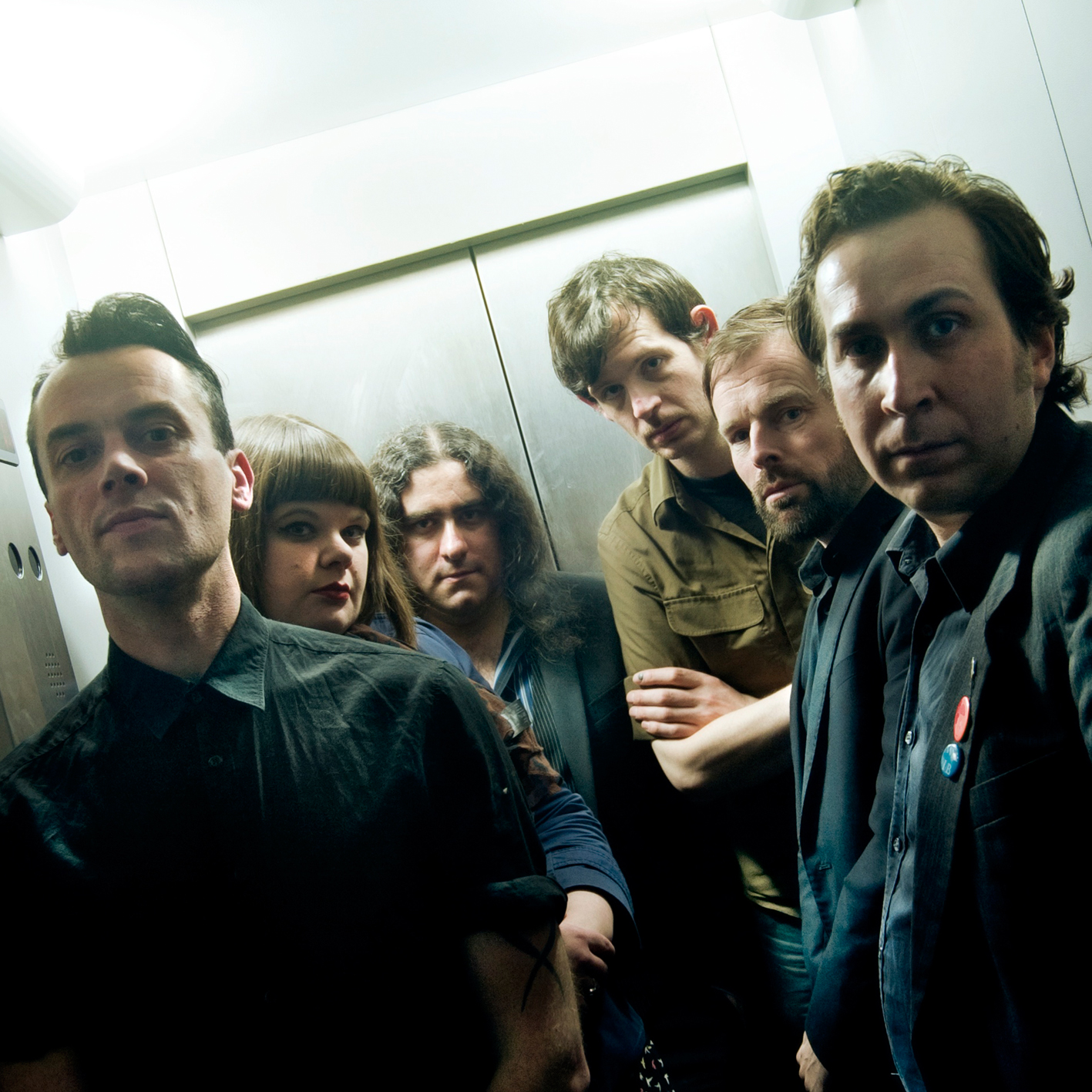
Recorded in a ”dark satanic mill ” in the north of England, Caul – the new album from Manchester’s Last Harbour – is a brooding, cinematic masterpiece that recalls Bowie’s Berlin period, the industrial, electronic atmosphere of Joy Division and the gothic splendour of Scott Walker and Nick Cave. I spoke to singer Kevin Craig and guitarist David Armes to find out more.
Let’s talk about your new album Caul, which is out this month. For this record, you made the decision to ‘do it yourself’ – rather than work with a producer – and you made the album in your own self-built studio, which is in an old mill, in Stockport. Why did you take that approach and what was the experience like? What did it do to the creative process?
Kevin Craig: This was DIY to the logical extreme. In that immersion, in the studio, which was full of equipment, we were locked away, testing things, re-configuring and reassembling. So the studio and the record were coming together in unison. We were writing songs as walls were being built. The studio isn’t large. It’s fairly intense in that sense. We were closeted away. I think all of that comes through in the music we’re making. There was a fair amount of improvisation and self-sufficiency.
David Armes: The studio belongs to James Youngjohns, who plays viola, guitar and synth in the band. It would be underplaying it somewhat to say he’s a multi-instrumentalist. He’d outgrown his home studio, so we all worked together to build this new studio in an old mill complex.
You’ve probably got visions of dark, satanic mills in the cold north, right? Spot on, the cliché is sadly true in this case. Even in a large, semi-empty mill, our space is hidden away and quiet, so it feels very much like entering our own world. There are no windows so you’ve no idea what time it is and you can get completely immersed in a project. That felt necessary for these songs.
We’ve been a band for so long that, while of course we have influences and our songs will remind people of other artists, we think the band’s biggest influence at this point is itself. We have that common language.
Let’s talk about your influences… Lyrically and musically, some of the songs remind me of Joy Division. I’m thinking of the tracks Guitar Neck and Before The Ritual – with its vintage synths. Even the title – Before The Ritual – is very Joy Division. Was the ghost of Ian Curtis hanging over this record? Joy Division also recorded in Stockport…
DA: By the time we come to write and record, we’re rarely thinking of specific artists – we focus on the songs themselves, what they need melodically and texturally, how the lyrics inform the music and vice versa. But, of course, your influences will make themselves heard somehow and usually other people can hear that where you can’t.
Joy Division and Curtis are probably no exception and, personally, I’m a fan. What Martin Hannett [producer] did with them was exceptional and deeply unusual in a lot of ways. I’m from near Manchester and can remember watching repeats of Something Else on Granada. I can vividly recall seeing that version of Transmission and being blown away by the urgency of it.
For me, some of the tracks on Caul harks back to late ’70s Bowie, like Low and Heroes. There’s a dark, brooding atmosphere, with some electronic sounds. Was Bowie a big influence on this record?
KC: I think Bowie’s Low, Heroes, Station To Station and Lodger were all influences. Also Eno from the early ’70s and Roxy Music. Those albums have a certain scale and ambition to them, in their arrangements and designs – that cinematic sound and a sense of place. It’s a kind of private world, in a way. These were all influences on me, certainly.
There are some great haunting choir and vocal arrangements on several tracks, such as Fracture/Fragment and on your 13 minute epic The Promise. The latter even has ‘doo-wop’ backing vocals. Can you tell me more about this musical addition to your sound?
KC: The choir arrangements were by Michael Doward. He plays bass [for Last Harbour], but he’s also a songwriter and a performer in his own right. We were lucky enough to have Claire Brentnall from Shield Patterns and Anna and Tammy (formerly of Samson & Delilah) sing for us. So, with Michael and Gina (Murphy – piano, vocals), they spent a day building these parts into the record. Fracture/Fragment suddenly came alive when they added those parts.
We had always considered one section of The Promise to be faintly disco, and the doo-wop vocals just accentuated that. Deep down, I think that The Pressure is a nod to the The Shangri-Las, so the girl-group ‘ooooohhs’ that sit back in there make sense to me. Those choir arrangements kind of counterpoint the synthesisers.
Horse Without A Rider – my favourite song on the album – has a ’60s/’70s Scott Walker-doing-country vibe, albeit with some darker diversions…Can you tell me more about this track? What’s the story behind it?
DA: That’s a lovely comparison – thank you. Musically, we like songs that come in sections and that don’t necessarily resolve or return to the beginning. The first section is one of those pieces where the basic progression is very simple and doesn’t change, but the arrangement and interplay is what carries it forwards. You don’t need to keep making dramatic changes to make a point.
KC: Lyrically, it’s about a friend of ours who was a boundless source of creativity and potential, but without direction. He was a coiled knot of ideas and possibilities, but the moment anyone tried to pin those ideas down, the interest was gone. It was a kind of untamed way of thinking, of creating. And the song builds, then never quite resolves, drifts into different areas, fails to return. But there’s still a kind of happiness to it.
What was your intention with this album – thematically, musically and lyrically? Did you have definite ideas about what you wanted it to sound like before you went into the studio?
KC: I think we had some ideas of what it could sound like, as we were going in. Thematically we wanted something which had a thread which ran through the whole album. We drew a map, very early on, to work out what kind of tension would appear at certain points – what push and pull would affect the music or the lyrics. It wasn’t coldly decided, the map was never really looked at again, but the idea of that remained somewhere.
Lyrically I wanted something more obtuse, less narrative driven. I think that came from Modernist ideas- synthesised sounds and concrete utopias. Partly the environment, partly what was happening personally. Fracturing was part of the process of writing- I was trying to break down narratives, but still maintain a feeling, or a tone.
You made the record over a year, between 2013 – 2014. That’s quite a long time to make an album, isn’t it? Why did it take so long?
DA: We were building the studio while writing, so the two were intertwined. It took a long time because most of the songs were rehearsed in close detail before we got near the recording stage. We tried multiple arrangements, interrogating ourselves over what worked best. We felt that in the past we’d had a tendency to be too happy too quickly, so we needed to take our own sweet time on this one. The exceptions were Guitar Neck and The Deal, which appeared right near the end of recording and were created by adding elements around the basic tracks. In contrast, The Promise took a long time to come together – it’s three or possibly four songs in one, so it needed to be built brick by brick.
Where did the title Caul come from? Does it refer to the piece of membrane that can cover a newborn baby’s head and face? What’s the meaning behind it?
KC: Yeah, that’s the kind of caul. Although it also means just a covering of the head. A child born with a caul was said to never be able to drown – to be different from birth. But cauls were also traded and preserved. Sailors bought them, like some kind of talisman which would keep them safe. Strange little magics. Hidden things. People marked out. There were just these little connotations with the word. Also that it’s a homonym, ‘caul’ and ‘call’, interested us.
As well as being mournful and funereal at times, the album also has a brooding feel to it – like a gathering storm… Do you agree?
DA: I’m really not sure we’re the best judges of how it appears to other people. Adjectives usually get applied by people after the fact – we’re never aiming for anything specifically. I can tell you how it feels to be inside the music – it needs concentration but, at its best, it feels exhilarating and weirdly automatic. It can also be joyous and uplifting.
KC: I think that feeling might come from the building, overarching themes which run through the record. It’s all building. I hope it comes across as a complete piece, rather than a collection of songs. I think that is what we wanted.
So, what are Last Harbour’s plans for 2015? How do you see the year shaping up? What can we expect from your upcoming live shows?
DA: We have a couple of album launch shows in February – London and Manchester. We’re learning how to play the album as we speak. It’ll be a seat of the pants ride for us, as always, but we can pull it off. Then we plan more shows in April, including getting further into Europe.
Beyond that is open, but a mini-album of other songs from the Caul sessions will come out in the autumn with, hopefully, another trip to mainland Europe to coincide. Those are songs we were equally happy with, but which didn’t fit the same themes as those on Caul. Songs are like families – they have their own personalities but they have to stick together in the end.
Caul by Last Harbour is out now on Gizeh Records.
Last Harbour play The Old Blue Last, London – Feb 11 & Soup Kitchen, Manchester, Feb 14.



 Say It With Garage Flowers