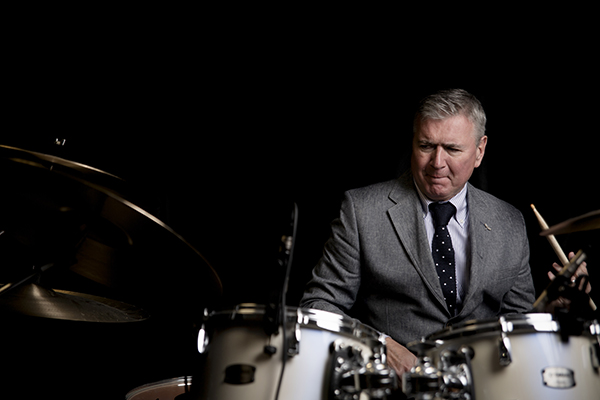
Steve White is considered one of the best drummers of his generation. Best known for his long association with Paul Weller, he first played with The Style Council at the age of 17, on the 1983 hit single ‘Long Hot Summer’, before becoming a permanent member.
He contributed to Weller’s biggest solo albums such as Wild Wood, Stanley Road, Heavy Soul and As Is Now, but has also recorded both jazz and soul under names such as Trio Valore, The Groove Train and The Jazz Renegades – his late ‘80s hard bop outfit that recorded an LP for Polydor and another for Acid Jazz precursor label, Re-Elect The President, as well as an EP for Acid Jazz.
Along the way he has also played with artists including Working Week, Galliano, The Young Disciples, Carleen Anderson, the James Taylor Quartet, Squeeze, The Who, Ian Dury, Oasis and Jon Lord (Deep Purple), and he was a member of supergroup The Family Silver, alongside guitarist and vocalist, Matt Deighton (Mother Earth), and bassist, Damon Minchella (Ocean Colour Scene).
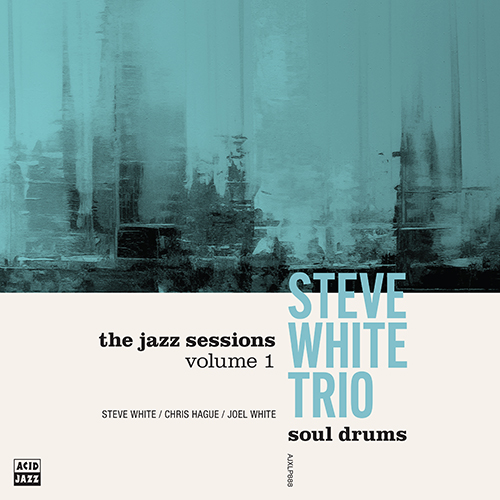 This month sees the release of Jazz Sessions Volume 1: Soul Drums – White’s first album as a bandleader.
Credited to the Steve White Trio and recorded with Chris Hague (guitar) and Joel White (keyboards) – AKA duo, Hague & White – the instrumental record pays tribute to White’s jazz roots, as well as filmic influences and soul grooves. Inspirations include the early British, Hammond organ-led R&B of Graham Bond and Brian Auger. Steve Beighton guests on sax, horns and flute.
First single, the funky and summery ‘Changes’, with its horns and jazzy piano break, has a touch of Lalo Schifrin; ‘Cough Up’ could be a long-lost, hip Mod R&B club floor-filler; ‘When The Tourists Leave’ has a late-night, smoky European jazz club vibe; ‘Eye To Eye’ sounds like the theme to a ‘60s spy caper set in the French Riviera, and the frantic ‘Running’ could quite easily be played over a car chase scene in a groovy heist movie.
There’s also a mellow reworking of The Style Council’s ‘My Ever Changing Moods’ – a fitting tribute to White’s fellow Councillors: Weller, Mick Talbot and Dee C. Lee.
In an exclusive interview with Say It With Garage Flowers, White shares some insights into the making of Soul Drums, reflects on the early days of The Style Council and chooses some of his favourite music moments that he’s played on.
“It’s proving to be a great year – I’m putting out or playing on new music and I absolutely love it. I couldn’t ask for anything more,” he tells us.
Q&A
Soul Drums is your first solo record…
Steve White: It is – it came about after chatting to Eddie [Piller – founder/MD of Acid Jazz]. He surprised me… We were back in touch because of Dee C. Lee’s record on Acid Jazz and he said: ‘You should do a record,’ and I was ‘Oh, right…’
And then he explained that he was curating a series, which I thought sounded good – like the very old days of Acid Jazz, back at the start. It was all done fairly quickly – so I got together with Chris Hague and Joel White, formerly known as Hague & White, and we came up with the album.
As part of The Jazz Renegades, you released an EP on Acid Jazz, in 1988 – it was one of the first Acid Jazz records. How does it feel being back on the label after all this time?
It’s great, and even before that, as Eddie reminded me, I did an album with The Jazz Renegades on Re-Elect The President, which was before it became Acid Jazz. When the dust settles, I’m going to see if we can get those records rereleased, so they’re back out there.
Musicians today can record a track, get it mastered and delivered to a streaming platform and it’s up there for the world to consume tomorrow – that wasn’t possible in 1988, as there was always a process. The problem with the process now – being able to deliver something so quickly – is no one hears anything because there’s too much choice.
There’s clearly a lot of love and respect for the Acid Jazz brand and they have people there who work with you, as opposed to you – the musician – doing everything yourself. I embrace technology – I love it – but you shouldn’t ever forget that there’s no substitute for having something that works properly, with a proper structure and proper people who know what they’re doing.
At the end of the day, you want to be able to concentrate on the music, don’t you?
Absolutely.
Where did you record Soul Drums?
The record was made at Fox Den Studios, right in the heart of Kelham Island, which is a cool, up-and-coming area of Sheffield. Every time I go back, there’s another event space, restaurant or coffee bar… Fox Den is a great little studio, and Matt [Richens], the engineer, is fantastic.
The main batch of songs was done in one or two sessions – a couple of the songs had existed before, but in different guises, so we rebuilt them and added Steve Beighton, who is a fantastic saxophone player. So, we reengineered and repurposed a few things we already had, and I rerecorded the drums – probably half the record was recorded over two days, in a very jazz-like way. We wanted it to be spontaneous.
A tune like ‘Camera Obscura’ was a live take – it was old school, with no edits. We get the drums down and if we want to try something a little bit different… There was no click track – we just went for it.
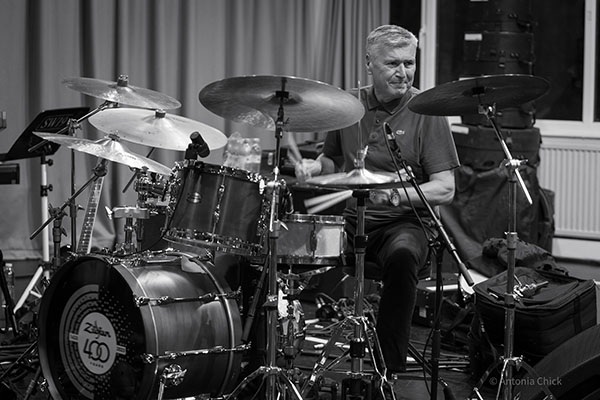
‘Half the record was recorded over two days, in a very jazz-like way. We wanted it to be spontaneous’
You mentioned ‘Camera Obscura’, which opens the album. Like a lot of the record, it has a cinematic feel. It sounds like it’s music from a ‘60s TV series set in the South of France – it’s lush and summery…
Yeah. I’ve never described myself as an overt jazz musician – I’m a big fan of Art Blakey, Philly Joe [Jones], Miles [Davis], Elvin [Jones] – all those people – but I’ve never associated myself with that kind of drumming.
I was talking to Joel about that, because he was saying, ‘Are we going to be doing jazz?’ I was like, ‘No – we’re not. We’re going to be doing instrumental music – and some vocal stuff – but think of it as British blues-jazz musicians taking an influence from [US] jazz. Think of it as more like Brian Auger or Graham Bond – we’re not trying to be Blue Note.’ Joel was like, ‘I’m so glad you said that…’
How did the tracks come about? Did you jam them in the studio, or did you write the music in advance?
Chris is a major part of the writing – he was responsible for a lot of it, as well as the production – but some of the stuff was jammed in the studio, around grooves, and then we took it away and did the top lines.
It would be so lovely to take five days, go in the studio, start some grooves off, see where it goes and jam it out a bit, but that’s just not viable – to be able to do that is a luxury. You’ve got to maximise your time in the studio and make it count. Hopefully, if we do another record, we’ll have more time to push things out there a bit more.
The first single to be released from the album was ‘Changes’, which has that classic, old school Acid Jazz feel, with a funky groove and a jazzy piano solo…
Yeah – the lovely little piano solo reminds me of Lalo Schifrin or [Eumir] Deodato. That kind of funky jazz thing. Jazz FM playlisted it and it’s been getting daily plays, which is brilliant. I’m really grateful for their support.
The second single, ‘My Ever Changing Moods’, is your take on The Style Council song…
Yeah – Eddie said it would be nice to do something by The Style Council. When he suggested it, I was racking my brain and thinking, ‘What can we do?’ Chris and I are huge fans of Khruangbin – that laidback, Texas jam feel – and we started playing around with ‘My Ever Changing Moods’, playing it a little bit slower.
With Chris’s help, what I wanted to do was to come up with something that was a little more reflective and wistful, and a little more respectful of the melody.
There’s the famous single version, which is more upbeat and Latin, and there’s the beautiful piano and vocal version, and I just wanted to put my own slant on it. I’m a bit older and a bit wiser, and I’m a bit less frantic. It’s a kind of thank you to Mick, Paul and Dee to say, ‘Yeah – that was good, wasn’t it?’ Everyone knows what a genius songwriter Paul is, but it’s nice to be able to pay a little tribute to him.
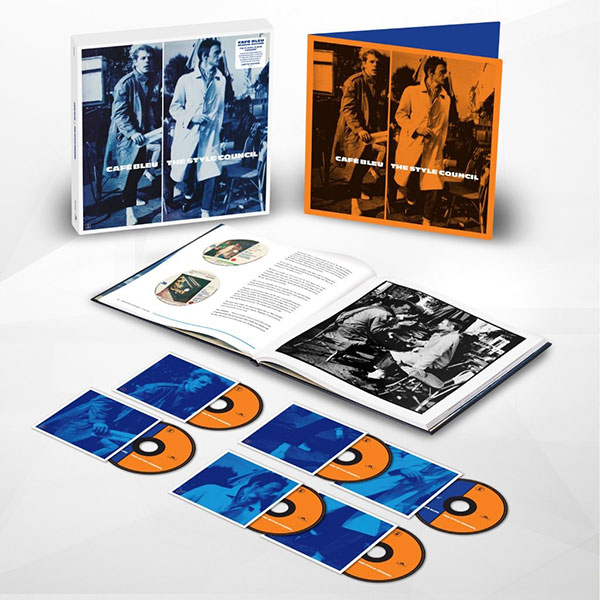
It’s timely too, as there’s a special 6CD and 3LP edition of The Style Council’s Café Bleu album out this year, and ‘My Ever Changing Moods’ was the first single from that record…
Yeah – it was. The synchronicity is nice, but, when we were talking about doing it, we didn’t know it would coincide with the reissue. It’s nice to see it and it was interesting listening to the performance of ‘Paris Match’ that I did with Mick and Paul on the Kid Jensen show – that was basically three days after I met them, in 1983, and I barged my way in to do the radio session. Paul was finding his way around the piano – he had just finished writing the song and said, ‘Follow me…’ Listening back to it as an official release, 43 years later, is mind-blowing.
You were 17 when you joined The Style Council…
I was. We played the Paris Theatre [in London] on Paul’s 25th birthday, which was just before my 18th. A couple of weeks later, we went to Paris to record the À Paris EP, then went off to Europe. I think we did Goldiggers in Chippenham, then the Dominion in London, which is also on the reissue. I can remember that show vividly – at that point, the Dominion was a happening venue, and I’d seen Weather Report there the week before. Then, a week later, I was on stage there and I was only a few months into my 18th birthday. It was incredible.
Let’s get back to talking about Soul Drums. The track ‘Something’ is fun and uplifting – it’s joyous, with a great organ groove…
It was originally a song – there’s a vocal version of it. Joel said it would make a cool Mod R&B instrumental. It’s got that upbeat, ‘60s Brian Auger feel. I really love playing that one – it’s got a strong melody and I love it when you get [instrumental] interpretations of strong songs, like ‘My Favourite Things’ by John Coltrane.
‘When The Tourists Leave’ is a nice track, with a late-night, smoky jazz club feel. It’s very atmospheric and European. The Style Council had a cosmopolitan sound and some of that carries across into your solo music…
I’m pleased about that, because, as I said, I didn’t really want to make a jazz album. Acid Jazz was never about jazz – it was a hybrid… rappers, songs, folk music… Lots of cool stuff.
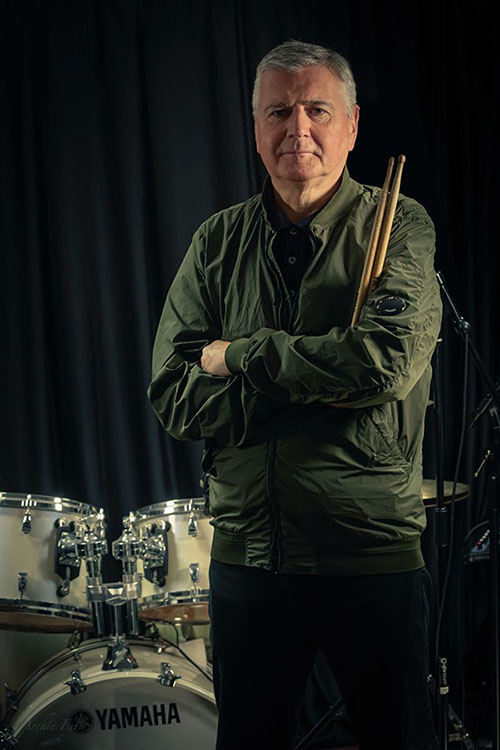
Café Bleu had nods to jazz and the influence it was having on us, and I think it’s a similar thing with this record [Soul Drums]. It’s got respectful nods to different styles and genres. Some of it is very cinematic and hopefully with strong melodies – that’s what we wanted. Nobody wants to listen to a drummer going nuts! It’s not a Buddy Rich album because that’s not me – and, as I’ve got older, my role is just to play on people’s songs.
‘I didn’t really want to make a jazz album – Soul Drums has got respectful nods to different styles and genres’
It’s proving to be a great year, starting with the [Café Bleu] reissue, and then the Steve White Trio album. I’ve also played on the Earth-o-Naut album [This is Nowhere. This is Everywhere], which is out in May on Agogo Records, and I’m playing on the record by the fantastic Lucca Mae, who has come out of the Marquis circuit with Laurie Wright and The Molotovs – her record is out in April – and I’ve just done an album with Phil Daniels.
His record is coming out in the summer, when he’s finished in the West End. We’re also chatting about a reissue of The Family Silver album [Electric Blend]. At this point in my career, I’m putting out or playing on new music and I absolutely love it – I couldn’t ask for anything more.
You mentioned Soul Drums having a cinematic feel – the track ‘Eye To Eye’ has a ‘60s film vibe. It sounds like it should be on the soundtrack to a spy movie or a thriller set in Nice or Monte Carlo, when the hero walks into a bar or a casino…
It will definitely be on the soundtrack of something – everything that’s original on the record is being added to our library for the television work that we do. These days you have to be multi-platform.
‘Running’, which is one of the more upbeat tracks on the record, could be the theme to a car chase in a late ‘60s / early ‘70s film…
Absolutely. It has some amazing sax by Steve Beighton and it was designed as a car chase theme. It’s closest to what people would say is a classic Acid Jazz track.
Yes – it’s like the James Taylor Quartet…
Definitely.
‘Song For Us Dads’ is mellow…
It’s bossa nova – when I joined The Style Council, Paul would say: ‘Don’t just play a backbeat – I don’t want ‘boom-da-boom-boom’, play something different…’ So, I would play a bossa nova and that got used on a few songs, like ‘The Whole Point of No Return’, ‘With Everything To Lose’ and ‘Have You Ever Had It Blue.’
When we were doing ‘Song For Us Dads’, there was a reference to Horace Silver too – Songs for My Father. We wanted to dedicate it to our dads, who are all no longer with us. Chris lost his dad some years ago, I lost mine two years ago, and Joel lost his dad before then too – Joel’s dad was a famous musician around Sheffield and Chris’s dad was big into music. My dad was a builder, but he used to come and watch Buddy Rich and Louis Bellson with me. So, that track is a little homage and tribute to our dads.
The last track on the album, ‘Cough Up’, has a kind of Booker T feel, and it also reminds me of the first Bangs & Talbot album that came out on Acid Jazz a few years ago – it has a groovy, ‘60s Mod/soul/R&B sound…
Absolutely – and that was deliberate. The drum fill has a hint of a backbeat and then a skip – that was prevalent with drummers like Idris Muhammad and Roy McCurdy, who played on some of the Blue Note records. It has a kind of soulful feel and I was doing that soul beat – that’s where I got the album title, Soul Drums, from.
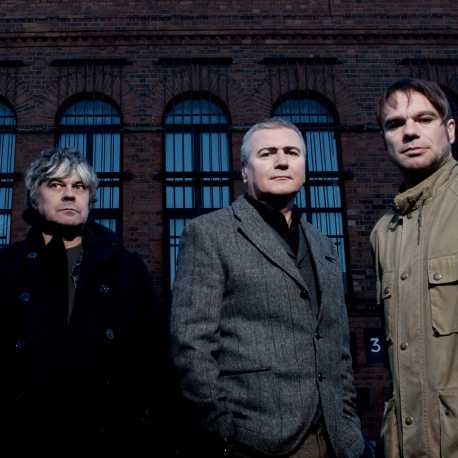
You mentioned The Family Silver earlier – is there a chance your debut album, Electric Blend, which had its 10th anniversary last year, could get reissued?
I hope so. Matt [Deighton] has compiled all the original demos that we did in Oswestry, which are really good, actually. There’s definitely a valid reason [to do it], with all the extras and some of the tracks that didn’t see the light of day.
‘I got to work with Jon Lord, which was amazing – no one rocks a Hammond organ like Jon’
You’ve worked with a lot of artists. Is there anyone you’d like to play with? How about Brian Auger?
I love Brian Auger! I think he’s a national treasure – an incredible musician. When I finished working with Paul, I got to work with Jon Lord, which was amazing – no one rocks a Hammond organ like Jon. I love the visceral thing that a Hammond organ does to a band.
I loved some of the things that I got to do with Damon [Minchella], like when we got up to play with Jimmy Page… My copybook is good, but I don’t think Kate Bush is going to call me… I keep asking, but it’s not going to happen. You never know, but I have very cheap rates, Kate.
I’m really happy where I am, and I still enjoy practicing and playing. I still love my vintage snare drums, and I love working on the television stuff with my lovely wife, Sally [Lindsay – actor]. We’re very blessed, we’re very lucky and very grateful. We’re just trying to keep our noses clean and keep working.
What are some of your favourite music moments that you’ve played on?
It’s contributions, really – to have contributed to something as brave as Café Bleu, as beautifully political as Our Favourite Shop, or as spiritual as the first Paul Weller solo album, which is a great record and a great personal statement. Things like ‘Clues’, off that album, where it’s just me and Paul in a room, facing each other, me on the drum kit and him with his guitar – all live.
Then there’s Wild Wood – what can you say about that? And Live Wood – what a band that was! And Stanley Road… I’m also incredibly proud of The Family Silver album… Some of the things are not necessarily commercially [successful].
I played on ‘Six Sharp Fists’ – the Galliano record… For me, it’s about being prescient on recordings. With 180 different tracks coming out this year – reissues and new tracks – that’s the sign of a successful year.
When I go, the 300 or so tracks I did with Paul, and the 400 tracks I did with Galliano, Working Week, Carleen Anderson, The Family Silver, Hague & White and the Steve White Trio… they are going to live on. That’s my legacy – I did it and that body of recording means a lot to me.
Jazz Sessions Volume 1: Soul Drums is released on March 20 (Acid Jazz): vinyl, CD, digital download and streaming platforms.
It’s the first album in The Jazz Sessions – a new series of small-group jazz albums masterminded by Acid Jazz founder Eddie Piller, showcasing his love of ‘60s and ‘70s jazz. Later volumes will appear by Matt Berry, Mick Talbot, James Taylor and others.
- Support for the tour, apart from the London show, is Matt Deighton.

 Say It With Garage Flowers