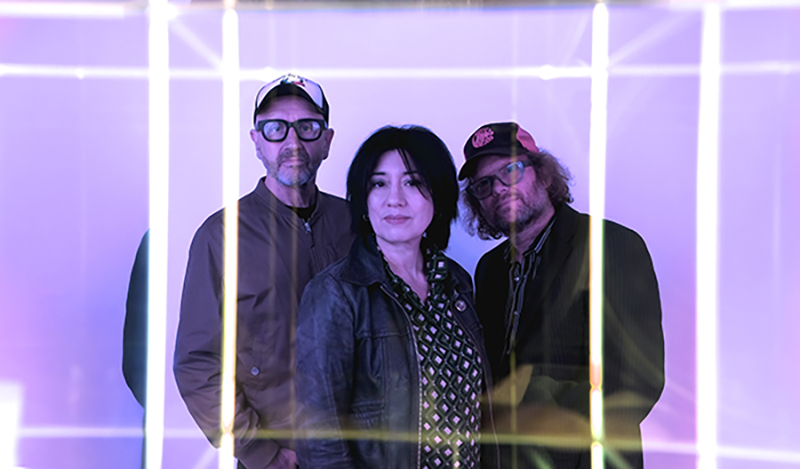
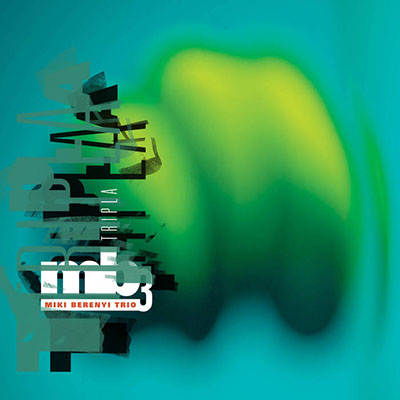
When it comes to the best debut albums of 2025 so far, Tripla by the Miki Berenyi Trio (AKA MB3) – out now on Bella Union – is certainly up there.
Fronted by the former singer/co-guitarist of Lush, MB3, which also features KJ ‘Moose’ McKillop on guitar (Moose) and bassist Oliver Cherer (Gilroy Mere, Aircooled), have made a dynamic and arresting record that draws on Berenyi’s and McKillop’s shoegaze and dream-pop past, but also adds electronica and dance music into the mix.
First single and album opener, the pulsing and shimmering 8th Deadly Sin, is an eco-protest song tackling issues including plastic pollution; the gorgeous and reflective Kinch is melancholy and cinematic; the sad yet sublime and gliding Vertigo – written about Berenyi experiencing depression triggered by the menopause – channels the ’90s electro-pop of the Pet Shop Boys and Dubstar; Gango is powered by a throbbing bassline and has shades of Massive Attack, while epic and atmospheric album closer, Ubique, has a soaring string arrangement by Bella Union labelmate, Fiona Brice.
MB3 emerged from the ashes of Piroshka, which Berenyi and McKillop formed in 2017 with drummer, Justin Welch (ex-Elastica), and bassist, Mick Conroy, (Modern English).
When Conroy broke his arm during the tour that followed Piroshka’s second album, Love Drips And Gathers, in stepped Cherer, who was Welch’s bandmate in Aircooled and had recorded as a solo artist, under aliases such as Dollboy and Gilroy Mere.
With Conroy moving to America, and Welch swamped by session work and live duties for The Jesus & Mary Chain and The Pretenders, Piroshka was put on ice, before the new trio – Berenyi, McKillop and Cherer – came together to play a handful of Lush songs whilst promoting Berenyi’s hugely-acclaimed memoir Fingers Crossed: How Music Saved Me From Success.

A bout of songwriting sessions followed, with the trio incorporating drum machines behind Berenyi’s and McKillop’s guitars and Cherer’s bass, which led to the addition of more electronic sounds.
After support tours with Gang of Four and The Wedding Present, plus headline shows, MB3 recorded their debut album at Cherer’s home studio in St Leonards-on-Sea, East Sussex, and Berenyi’s and McKillop’s rehearsal room in North London.
The album’s title, Tripla, takes its name from the Hungarian word for ‘triple’ – Berenyi’s father was born in Hungary – and reflects the three-way collaboration of the band’s songwriting. Tripla features nine songs – by sheer chance, each member initiated three tracks each: Gango, Hurricane and Kinch (Berenyi); 8th Deadly Sin, A Different Girl and Manu (McKillop), and Vertigo, Big I Am and Ubique (Cherer).
Say It With Garage Flowers spoke to MB3 to find out why they’re keen to avoid being seen as a heritage act, how they’re writing more reflective songs as they get older, and why playing gigs is the main impetus of the band.
“It’s interesting that this is the most electronic music I’ve been involved with, but it’s actually the most live and road-tested album I’ve ever done,” says Berenyi.
Q&A
How does it feel to be releasing a debut album so far into your respective careers?
Oliver Cherer: That’s an interesting idea… Realistically, for me it doesn’t feel like a debut album, but you’re right, technically, it is… I’ve made a lot of records over the years, but it’s definitely the start of something – it feels good. I think we’re all fiercely proud of it – it’s not just another record…
Miki Berenyi: Ollie releases a debut album every five years or so – he’s well used to it….
It’s a great album, and it’s a lot more electronic than I was expecting it to be… It’s a bold and surprising record, isn’t it?
Oliver Cherer: I hope so – to hear that assessment of it is music to my ears… That’s not quite a pun, but you know what I’m saying… Once we got started, for me, it was important that it surprised people. I think we’re all keen to avoid the whole ‘heritage act’ thing… Maybe that’s snobbery… I don’t know… but if the record is coming over as surprising, new and entering strange territory, then, brilliant – I think that’s where you always want to be.
Did the record, like the band, come together quite organically, rather than being deliberately thought out?
Miki Berenyi: Yeah – the band really started because of us playing a handful of Lush songs for events around my book. But there was no point in us trying to create what Lush songs were like originally, so we played around with some backing tracks and Moose wrote some new parts – we weren’t slavishly reproducing the songs.
So, when it came to doing the [new] songs, which were kind of written to play live… the album was a long way off, so it was more that we were being offered gigs, and we needed some songs to fill the set.
I think there might have some eggshell treading at the beginning, with Ollie saying: ‘Should I be contributing in a way that’s more like Lush or more like Moose, blah blah blah?’ but, it was more like, ‘No – let’s just do whatever takes our mood…’
So, it was quite organic, and although it started from that Lush thing, that wasn’t really a consideration… It was more that the Lush thing was trying to fit in with what we already wanted to do.
The first single, which is also the first song on the album, 8th Deadly Sin, is a big tune – dream-pop meets electronica and dance music. Lyrically, it deals with eco issues, including plastic pollution. Where did that song come from?
‘Moose’ McKillop: It’s probably the most overtly comprehensible song, if you know what I mean. It’s not heavy-handed – it’s got a reasonably light touch, but, yeah, it came from wanting to write about that. Musically, because we set out with just the three of us doing this, although you might think there are limitations with just three people in a band, by doing a lot of programming and using a bit of a electronica, in a weird way it opens things up. We know that the three of us can go on stage and go hell for leather. We’re all playing live, singing, jumping about and getting sweaty, but, behind us, there’s more than just a drum machine… It’s the kind of thing that you could expand as a live band, but if we wanted to do that we’d need a drummer, a keyboard player and a backing singer…
‘Although you might think there are limitations with just three people in a band, by doing a lot of programming and using a bit of a electronica, in a weird way it opens things up. We know that the three of us can go on stage and go hell for leather’
Oliver Cherer: That’s true, but I think that particular song has some stuff that a drummer couldn’t do – it’s got electronic dance music elements to it, which happened from a session in the studio where Moose and I sat together and he was referencing various pieces of music, and I said, ‘Oh – I get what you’re doing…’ So, we got a drum loop, we put a filter on the snare, and we got a Juno [synth]… We were specifically referencing dance music with that one, but it’s totally modulated by the fact that it’s got Moose’s ambient guitars all over it and Miki’s singing… So, it’s not dance music – it’s something else – some natural hybrid.
‘Moose’ McKillop: That’s a good way of putting it.
Do you write together as well as each bringing different songs to the table?
Oliver Cherer: Yes.
Miki Berenyi: The individual songs are all quite different – I think Moose’s songs, in particular, will be [already] worked out in terms of the structure and the meat of it, but Ollie will add a bassline, or I’ll add backing vocals… Moose will work out all the guitar sounds and focus on how that part of it will work – he has an overall view of what he wants to hear. Whereas a track like Big I Am started with Ollie doing the backing track and I added a vocal and wrote a vocal melody. I’ve been quite collaborative on Ollie’s songs, but a song like Kinch, I just wrote it… It’s that classic thing – you could sing it on an acoustic guitar, but Ollie brought the big sound to it and he and Moose transformed it… I’d run out of ideas with it (laughs).
Kinch is one of the more reflective and nostalgic moments on the album…
Miki Berenyi: I think there’s quite a lot of reflectiveness on the album lyrically, but the music is quite up because the songs were envisaged to play live.
Do you find you’re writing more reflective songs the older you get?
‘Moose’ McKillop: When you’re in your twenties, you’re writing songs about crushes and unrequited love, but you sound like a bit of a weirdo if you’re doing that at 62!
Some of the lyrics on the album, like Big I Am and Gango, deal with the pressures and issues caused by social media, including misogyny and anxiety…
‘When you’re in your twenties, you’re writing songs about crushes and unrequited love, but you sound like a bit of a weirdo if you’re doing that at 62!’
Miki Berenyi: You can feel a bit self-conscious and naff about writing about things like that, because they seem a bit desperate… Look at some 57-year-old trying to be relevant… but I think what’s overlooked is that it affects everyone – it’s not just a young person’s thing. Mental health and anxiety – all those things that are highly reported as happening to young people have an effect on our generation as well. To be honest, I’ve always kind of written about introverted, melancholy and difficult subjects, and I think it’s interesting to do that from the perspective of a person who’s a lot older. There is a nostalgia about looking back at your younger self and thinking, ‘I still haven’t worked all this fucking shit out!’
One of my favourite songs on the album is Gango, which takes its name from the band Gang of Four, whom you supported on tour. It has a big, heavy, driving bassline and weird synths, juxtaposed with Miki’s ethereal vocals. It reminds me of Massive Attack…
Miki Berenyi: After we toured with Gang of Four – they were amazing – I was quite taken with songs that start with drums and disparate parts that you don’t know where they’re coming from, but then they get resolved. It’s quite a basic thing…. there’s a lot of that in dance music but seeing it visually on stage was really compelling. Both me and Ollie had our own versions of songs inspired by it – he came up with Ubique, which has a mallet sound at the beginning and you don’t really know where the off-beat or the on-beat is, and I came up with Gango, which is….
Oliver Cherer: Mental.
Miki Berenyi: It is quite mental… The beauty of writing on Logic [software] is that you can move shit around without actually having to learn how to play it.
Oliver Cherer: I’d like to point out, though, that when you first presented it to me, I thought the bassline was quite complicated and I hoped I could manage it. I worked it out but then you said to me: ‘Can you play the same thing later in the song but one beat later?’ It’s quite complicated, but, actually, I don’t think it sounds anywhere as near as complicated as the construction of it, which is quite impressive.
Hurricane is less of an electronic track – it’s slightly more rock…
Oliver Cherer: There’s probably as much electronica on it as anything, though, but it does have a slightly different feel…
Miki Berenyi: It started out as a good garage-y song to put into the live set, but when it came to the album it didn’t really work, so Ollie went crazy with it to see what he could do to it…
Oliver Cherer: It’s like a remix, I suppose…
Miki Berenyi: It is.
Ubique is the perfect track to end the album with – it has strings arranged by Fiona Brice, which gives it a cinematic and epic feel…
Oliver Cherer: Every time we play it live, I find myself grinning. I’m very proud of it – it’s one of my favourites.
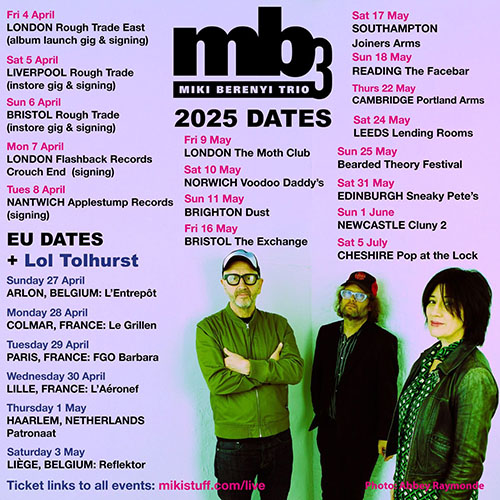
You’ve got some live dates coming up. Do you still enjoy touring?
Miki Berenyi: Completely – that’s the point of MB3. With Piroshka it was very difficult to get that band on the road and make it work because there were a lot of people and it was quite a cumbersome unit. The actual genesis of doing the whole MB3 thing was, ‘God – we can just actually play gigs…’
We were playing gigs for two years – we didn’t have a record out, and we had nothing to promote. We had one fucking T-shirt that we knocked up! Wanting to play was the impetus, and that’s the main impetus of the band. It’s interesting that it’s the most electronic music I’ve been involved with – it’s got that whole studio feel – but it’s actually the most live and road-tested album I’ve ever done.
‘Moose’ McKillop: For the past year, we’ve been able to play pretty much the whole album live – we can perform all nine songs on the album. If you came to see us, you might’ve recognised a couple of the Lush songs or a Piroshka one, but this time it will be different because the album is out and people will turn up, hopefully, and they will have got used to the songs. It will be a slightly different vibe at the gigs.
I like the fact that the album is only nine songs – it’s punchy and it doesn’t overstay its welcome. Far too many new albums these days are too long…
Oliver Cherer: I agree. The most useful tool for anybody making anything is savage editing. I’ll stand by that forever. You will always achieve a better result and you won’t regret it.
How are you feeling about 2025 and what lies ahead for the rest of the year? We’re living in turbulent times…
‘Moose’ McKillop: A lot of the year is scheduled and mapped out, so we kind of know what we’ll be doing at certain times, but, when it comes to the bigger picture, I’m fucking terrified! I’m scared to look at the news sometimes. I find it anxiety-inducing, depressing and sickening. Sorry to end on a downer… We’re going to have a nice year playing our music, travelling and going to festivals, but, bloody hell, once you open your eyes and look around, you don’t want to get out of bed!
Miki Berenyi: I do find that bad times are quite good for music, though. Look at Thatcher…
Oliver Cherer: True. Oh, God, yes – remember what Thatcher did for British music. It was brilliant!
Miki Berenyi Trio’s Tripla is out now on Bella Union.
https://mikiberenyitrio.bandcamp.com/

 Say It With Garage Flowers