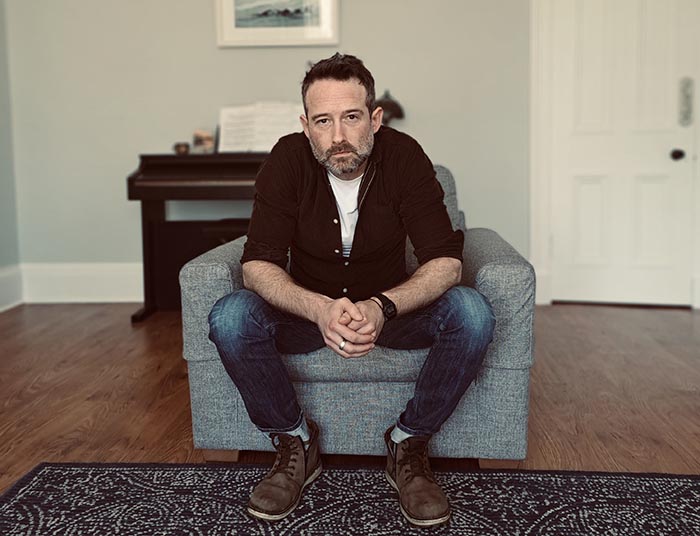
One of our favourite records of the year so far is Wayfarer Beware – the new album from Americana-folk act Reichenbach Falls, which is essentially singer-songwriter, Abe Davies, who is of Canadian descent but was raised in England.
On Davies’ third studio album, he’s joined by Jonathan Anderson, a producer and multi-instrumentalist who’s based in the greater Vancouver area at his studio, Protection Island.
Davies, who has also been part of the Oxford music scene, is currently living in a remote area of Scotland, and has a small recording set-up at home, where he demoed these songs, which started out as just acoustic guitar and vocal tracks.
The songs were then sent to Anderson, who worked his magic on them, creating inventive and inspired arrangements, adding instrumentation, including electric and acoustic guitar, piano, vintage synths, drums, pedal steel, organ and Mellotron.
“As far as I’m concerned, he is the co-writer, as he transformed the songs,” says Davies, speaking to Say It With Garage Flowers over a pint in a cosy Buckinghamshire pub, not too far away from our HQ.
“Some of them have arrangements that are similar to what I’d done, but some of the others are things that I couldn’t have imagined. He plays virtually everything – the guy’s a genius, but don’t tell him I said that…”
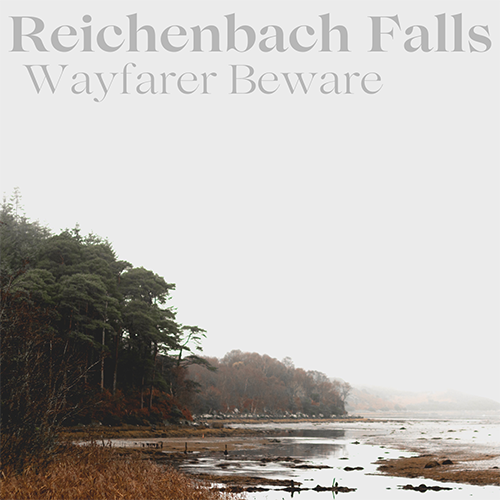 These cinematic, autobiographical and atmospheric songs, which often feature references to snow, woods, rivers, trains and Christmas, recount the breakup of a couple between upstate New York and rural Scotland over the course of a single autumn and winter.
However, as Davies explains to Say It With Garage Flowers, he didn’t want to make just another breakup album, so treated the record more like a screenplay – even going so far as to create a fictional character called Rosie, who is the daughter of the couple.
“I tried to tie the record together with conversations that they’re having between themselves, but also through Rosie,” he says.
“I was wary of doing another series of songs that were just about a sad, middle-aged, white guy, so, instead, it’s about a sad, middle-aged, white couple…”
Q&A
Wayfarer Beware is your first studio album in nine years…
Abe Davies: Yeah – it’s been a good while.
How did you end up becoming a singer-songwriter? You’ve been in bands before, haven’t you?
AD: When I moved to Oxford, I wrote songs, but I had no particular ambition of doing anything… I thought maybe I could do some songs for other people…
‘I’ll try to write a summery album, but I don’t know if I have it in me’
I’ve lived all over the place – Spain, Canada, and I did a degree in Norwich. I got a job in Oxford and moved there – I ended up sitting next to a guy at this office job. He had been a musician and knew everybody… He ended up getting me to play rhythm guitar in a band that his friend was putting together. They ended up hearing a couple of demos that I’d done, and it snowballed from there. All of a sudden, we were making a record [Reports of Snow] in a proper studio, with Richard Neuberg of Viarosa.
That record was a breakup album, too, wasn’t it? Didn’t you want to do something along the lines of Ryan Adams’ Heartbreaker?
AD: Yeah – it was sort of accidental. If you’re a certain kind of person, those are the things you end up writing songs about – a lot of those songs were from over a long period of time. The songs on the new album are from a more defined time – a single year. They come from mid-2021 to mid-2022 – I don’t think there’s anything from before then.
There are common themes on Wayfarer Beware – it’s a record that’s consistent. It’s not quite a concept album, but…
AD: I hate to say it, but it almost is… A lot of it is based on one relationship – she was in the States and due to Covid and lockdown, we couldn’t see each other for a year-and-a-half. She was from New York – when we were together, we stayed in the Hudson Valley.
There’s a character called Rosie, who is mentioned in a couple of the songs…
AD: Rosie doesn’t exist… I had this breakup thing, but I thought it was kind of boring to just write another straight breakup album, so, I treated it more like a screenplay – a lot of the stuff is true, but I imagined it as a story, and I picked out moments to write about.
We’d talked about kids… I started to include this figure, Rosie, who is the daughter, so, instead, it became about a married couple who are breaking up. I tried to tie the record together with conversations that they’re having between themselves, but through Rosie. I also tried to make it less about me and write from both our points of view.
Was that a challenge?
AD: It was – and I don’t know if she thinks I succeeded…
It feels like a very cinematic album, and there’s a recurring theme about getting away – escaping or travelling… It’s a transient record and you describe places and scenery, like woods, lighthouses, rivers and frozen lakes… You actually live in quite a remote part of Scotland, don’t you?
AD: I love it there – it’s amazing. I rent an apartment in a beautiful little town and there are a couple of nice pubs nearby. I look after my neighbour’s dog a lot – it’s a nice situation. It’s pretty isolated, which suits me.
What’s your recording set-up like at home? Have you got a studio?
AD: I’ve got a little set-up at home, with some microphones that a few charitable producers have given me over the years. I’ve always suspected they did that to get rid of me… I demo a lot of stuff at home.
But the album was recorded remotely…
AD: I started doing all these songs and I was going to do them acoustic, on my own – I probably wasn’t even going to put them out – but then I said to Jon: ‘If I send you a bunch of songs, do you fancy doing something with them?’ The first one we did was Gone As Sure As Trains, and I was like, ‘Wow – let’s just make a record.’ What I loved about the process was that it was his musical imagination but with my songs.
There are hints of optimism on the album, but it feels very much like a wintry record…
AD: Yeah – it’s totally wintry.
I like the line in The Cold, The Glow: ‘I wouldn’t wish this fucking cold on anyone…’
AD: I like that one too.
Your first album was called Reports of Snow – I’m sensing a theme...
AD: Yeah – I’ll try to write a summery album, but I don’t know if I have it in me.
On The Cold, The Glow, there’s a stripped-back, wintry atmosphere, but suddenly this big guitar solo with feedback appears from nowhere, and then disappears…
AD: I’m a sucker for that stuff. Jon gets dynamics really well – I’d record a couple of acoustic guitar lines, so he could pick one, and a vocal, and then gave him carte blanche. What I love about it is that you get to enjoy your own stuff in a different way – if I record myself playing a song, I can recognise if it’s good, but I don’t want to listen to it.
Before We Left Michigan is a piano-led, road trip song…
AD: That was kind of a strumming, acoustic thing… in terms of arrangements, I’m limited – I’m not a producer at all. Jon transformed it – he took my vocal and made it into this completely other thing, which was amazing. I love that one.
Green Thumbs is one of the album’s more hopeful songs… It even mentions summer in it…
AD: It does, but that’s as far as the optimism goes… It does have a bright, poppy feel – I love the chiming stuff that Jon did on the chorus.
I’ll Be A Crow Around Your Neck is a more folky and stripped-back song…
AD: That’s a funny one – it was the only song where we had a significant back and forth – I loved the background stuff, but until it gets to the end, it’s just me…. Jon said: ‘Just trust me…’
The process was that he would make a mix of me – just acoustic guitar and vocal – and he’d listen to it in the car. Then he would figure out where it was going to go. On that one, he said he didn’t want to get in the way of it. I wanted to hear drums from the beginning, an electric guitar, horns, an orchestra… Out of all the songs, that’s the one that people have responded to the most, so, the lesson is trust Jon.
Hey Rosie also has a folky feel, with Simon & Garfunkel-style harmonies…
AD: Yeah – before we did it, Jon and I talked about Simon & Garfunkel. I did three different acoustic parts – a ‘60s folky thing, with the same chords but different voicings. It sounds full, but it’s cheating.
‘All the songs work acoustic – they started out that way, so it wouldn’t be a big deal to do some smaller shows with one or two other people’
Winterhead (Hudson River Lighthouse) is one of my favourite songs on the album – I love the warm organ sound…
AD: That’s great. I wanted that song and Hey Rosie to be a bit more hopeful and optimistic at the end of the album.
Any plans to play some shows with a band to support the record?
AD: It’s going to be tricky to put it all together. I’m not going to push it… All the songs work acoustic – they started out that way, so it wouldn’t be a big deal to do some smaller shows with one or two other people. If it happens, it happens.
Wayfarer Beware is out now on Observatory Records.
It isn’t currently available as a physical release – digital only – but there are plans for a CD release and hopefully a vinyl pressing.
For more information, visit the Reichenbach Falls Bandcamp page here.

 Say It With Garage Flowers